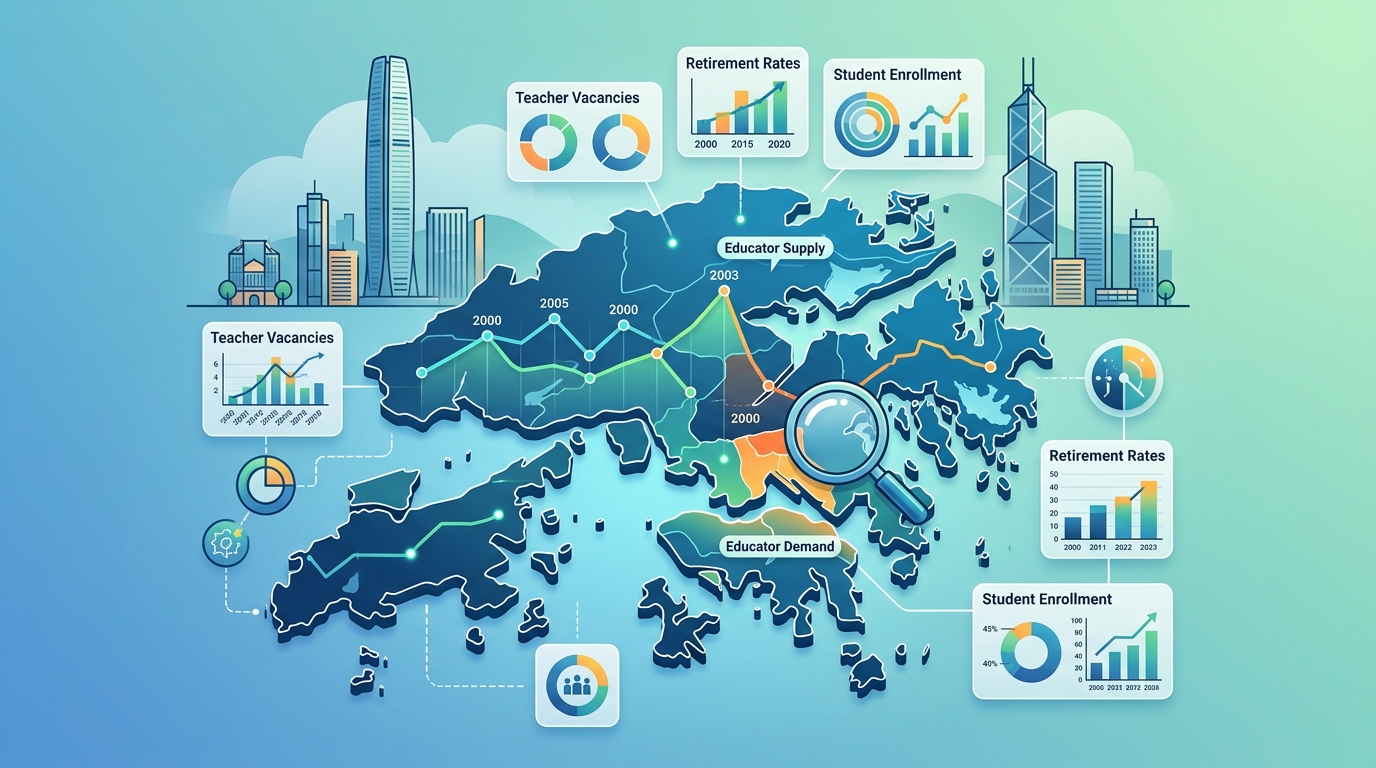
Teacher Shortage Trends: Mapping Hong Kong’s Educator Supply and Demand Since 2000
The past two decades have reshaped Hong Kong’s education landscape in ways few anticipated. Classrooms that once buzzed with competition for teaching positions now struggle to fill vacancies. Student enrollment patterns shifted. Policy reforms came and went. And through it all, the teaching profession faced mounting pressures that would fundamentally alter workforce dynamics.
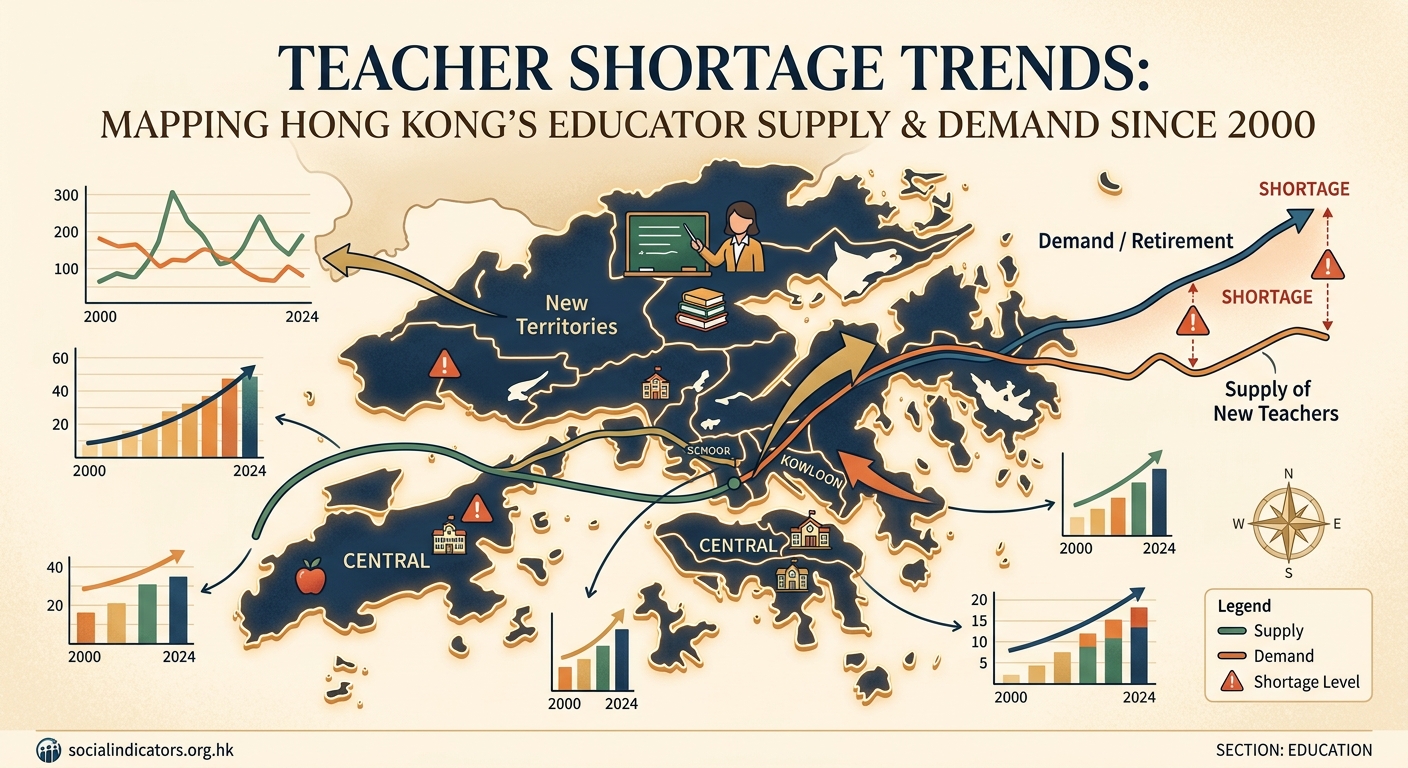
Hong Kong’s teaching workforce has experienced significant fluctuations since 2000, with acute shortages emerging after 2015 driven by demographic shifts, policy changes, emigration waves, and declining professional appeal. Understanding these trends requires examining enrollment data, teacher attrition rates, training program outputs, and the complex interplay between supply-side constraints and demand-side pressures across primary, secondary, and special education sectors.
The Early 2000s: Surplus and Structural Adjustment
The millennium began with an unexpected challenge. Hong Kong had too many teachers.
Birth rates had declined throughout the 1990s. Fewer children meant fewer classrooms needed. The Education and Manpower Bureau responded with a voluntary separation scheme in 2000 and 2001, encouraging experienced teachers to leave the profession early.
This period saw approximately 3,000 teachers exit the system through buyout programs. Schools consolidated. Class sizes shrank from policy mandates, but overall teaching positions decreased.
Teacher training institutions adjusted their intake numbers downward. The Hong Kong Institute of Education (now the Education University of Hong Kong) reduced enrollment in teacher education programs by nearly 30% between 2000 and 2005.
Yet this adjustment created its own problems. The pipeline that produces qualified teachers cannot turn on and off like a faucet. Reducing training capacity today means fewer available teachers five to ten years later.
Mid-2000s to 2014: Relative Stability with Warning Signs
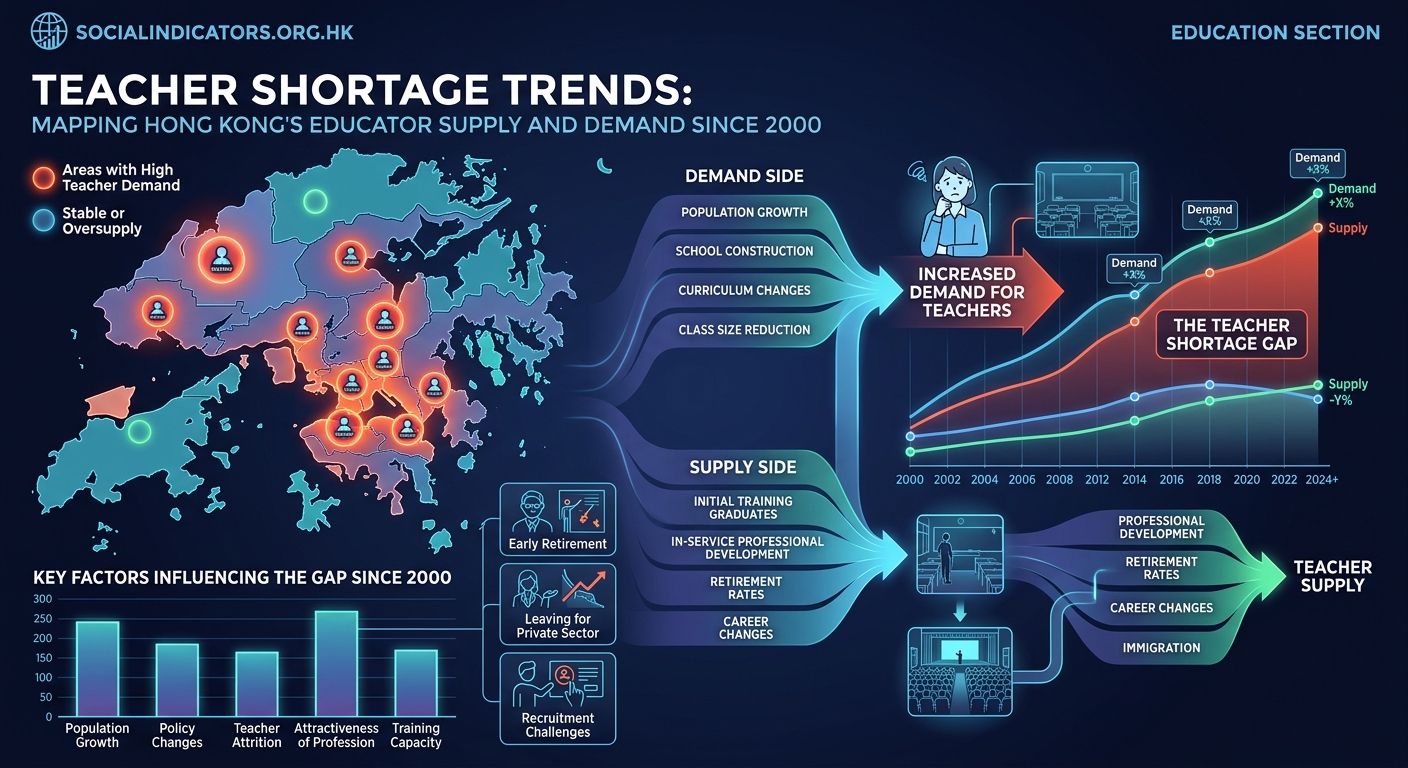
From 2006 through 2014, supply and demand achieved a precarious balance.
Student enrollment stabilized around 540,000 for primary schools and 450,000 for secondary schools. Teacher wastage rates (the percentage leaving the profession annually) hovered between 4% and 6%, considered manageable by international standards.
However, several warning signs emerged during this period:
- Aging workforce demographics, with median teacher age rising from 38 to 42
- Declining interest in teacher education programs among top university applicants
- Increasing workload complaints related to assessment reforms and accountability measures
- Growing salary gaps between teaching and other graduate professions
The government introduced the Fine-tuned Medium of Instruction policy in 2010, requiring additional English-language teaching capacity. Some schools struggled to recruit qualified English teachers, particularly those willing to work in less prestigious districts.
Special education needs (SEN) provisions expanded during this period, but specialist teacher supply lagged behind policy intentions. Schools implemented integrated education without proportional increases in trained SEN teachers.
The 2015 Turning Point: When Shortages Became Acute
Multiple factors converged around 2015 to create genuine shortage conditions.
First, the demographic echo effect arrived. Children born during the mini baby boom of 2011-2013 began entering primary schools. Enrollment numbers reversed their long decline.
Second, retirement waves accelerated. Teachers hired during the expansion years of the 1980s reached retirement age. Between 2015 and 2020, approximately 15% of the teaching workforce became eligible for retirement.
Third, working conditions deteriorated in ways that surveys consistently documented. The 2016 Hong Kong Professional Teachers’ Union survey found 87% of teachers reported increased workload compared to five years earlier. Stress-related sick leave increased by 40% between 2014 and 2017.
Fourth, alternative career options for graduates improved. The finance, technology, and professional services sectors offered competitive salaries without the intense public scrutiny and accountability pressures teachers faced.
Subject-Specific Shortages
Certain subjects experienced more severe shortages than others.
| Subject Area | Shortage Severity (2015-2020) | Primary Contributing Factors |
|---|---|---|
| Mathematics | High | Private sector competition, limited training graduates |
| Science (Physics, Chemistry) | Very High | Industry alternatives, declining program enrollment |
| English Language | High | Native speaker recruitment challenges, emigration |
| Special Education | Severe | Insufficient training capacity, demanding work conditions |
| Information Technology | Very High | Tech sector salary competition, rapid skill obsolescence |
| Putonghua | Moderate | Political tensions, cross-border recruitment complications |
Schools responded by hiring teachers with subject minors rather than majors. Some deployed teachers outside their trained specializations. Quality concerns inevitably followed.
2019-2022: Political Upheaval and Pandemic Pressures
The social unrest of 2019 and the subsequent political changes created unprecedented workforce disruption.
Teachers faced new scrutiny over classroom discussions and curriculum content. The Education Bureau received over 200 complaints about teacher conduct related to political views in 2019 alone, compared to fewer than 20 in previous years.
Professional autonomy concerns prompted some experienced teachers to leave. Exact numbers remain difficult to verify, but anecdotal reports from school principals suggested accelerated mid-career exits.
The COVID-19 pandemic added another layer of complexity. Online teaching requirements exposed digital skill gaps. Teachers managed hybrid learning models while dealing with their own health anxieties and family care responsibilities.
Recruitment became more difficult as border closures prevented mainland-trained teachers from taking up positions. International schools, which typically recruited globally, faced similar constraints.
The period from 2019 to 2022 represented the most challenging recruitment environment I’ve experienced in 30 years of school administration. We were losing experienced teachers faster than we could recruit and train replacements, while simultaneously managing unprecedented operational challenges.
This quote from a secondary school principal captures the compounding pressures of the era.
The Emigration Factor: 2020-Present
Emigration patterns shifted dramatically starting in 2020.
Government statistics show net population outflow of approximately 180,000 between mid-2020 and mid-2022. While not all emigrants were teachers, the profession experienced disproportionate losses.
Teachers possess portable qualifications valued in other education systems. English-speaking destinations like the United Kingdom, Canada, and Australia actively recruited qualified teachers during this period.
The Hong Kong Professional Teachers’ Union (before its dissolution) estimated that 4% to 6% of the teaching workforce emigrated between 2020 and 2022. For a system employing roughly 60,000 teachers, this represents 2,400 to 3,600 departures beyond normal attrition.
Replacement proved challenging because:
- Training programs could not rapidly scale up to compensate
- Career switchers needed time to complete certification requirements
- International recruitment faced competition from other systems with similar shortages
- Public perception of teaching as a stable, respected profession had diminished
Current Supply and Demand Dynamics
As of 2024, the shortage manifests differently across education sectors.
Primary schools face moderate shortages, particularly in New Territories districts with newer residential developments. Student enrollment continues growing as the 2011-2013 birth cohort progresses through the system.
Secondary schools experience more severe pressures. The combination of curriculum reforms, university entrance requirement changes, and STEM emphasis has created demand for specialist teachers that supply cannot match.
Special schools and integrated education programs report the most critical shortages. Government policy expanded SEN provisions without proportionally increasing specialist teacher training capacity. Schools often rely on teaching assistants or general education teachers with minimal additional training.
International schools operate in a separate but connected market. They compete for the same pool of qualified teachers, often offering better compensation and working conditions. This competition drains potential candidates from the local system.
Policy Responses and Their Effectiveness
The Education Bureau has implemented several measures to address shortage trends:
- Increasing teacher training places at the Education University and other institutions
- Launching accelerated certification pathways for career switchers
- Providing retention bonuses and allowances for shortage subjects
- Relaxing certain qualification requirements for temporary appointments
- Promoting teaching as a career through publicity campaigns
Results have been mixed.
Training capacity increases take years to affect workforce supply. A student entering a teacher education program today will not be classroom-ready until 2028 or later.
Career switcher programs attract mid-career professionals but face retention challenges. Many participants underestimate the demands of classroom teaching and exit within three years.
Financial incentives help at the margins but cannot overcome fundamental concerns about workload, autonomy, and professional respect.
Comparative Context: Regional Patterns
Hong Kong’s situation reflects broader regional trends but with unique intensities.
Singapore experienced similar demographic-driven shortages in the mid-2010s. Their response included aggressive international recruitment, substantial salary increases, and reduced administrative burdens. Teacher supply stabilized by 2020.
Taiwan faces ongoing shortages driven by low birth rates and an oversupply in certain regions creating maldistribution rather than absolute scarcity. Contractual teachers now comprise over 30% of the workforce.
Mainland China’s teacher shortage centers on rural areas and less developed provinces. Urban centers like Shanghai and Beijing maintain adequate supply through prestige and compensation advantages.
Japan’s teaching profession confronts severe shortages as the large cohort hired during the 1980s retires. Prefectures compete intensely for limited graduates from teacher training programs.
South Korea recently shifted from surplus to shortage as birth rates plummeted. The government is now reducing training capacity after years of expansion.
Data Limitations and Research Gaps
Understanding hong kong teacher shortage trends requires acknowledging what we don’t know.
Official statistics focus on filled versus vacant positions but provide limited insight into quality dimensions. A position filled by an underqualified teacher or someone teaching outside their specialization counts as “filled” in workforce statistics.
Teacher satisfaction and intention-to-leave data comes primarily from union surveys, which may not represent the full workforce. Government-conducted surveys occur irregularly and use varying methodologies that complicate trend analysis.
Emigration’s impact on the teaching workforce remains partially obscured. Population statistics don’t disaggregate by profession. School-level data on teacher departures doesn’t systematically capture destination information.
Subject-specific shortage data has improved but still lacks the granularity needed for targeted interventions. We know science teachers are scarce, but which science subjects in which districts at which school levels?
Looking Forward: Projection Scenarios
Three scenarios emerge from current trends:
Scenario 1: Continued Deterioration
If emigration continues at 2020-2022 levels and teacher training enrollment remains flat, shortages will intensify through 2028. Schools will increasingly rely on underqualified teachers, larger class sizes, and reduced curriculum offerings. Quality concerns will prompt families who can afford alternatives to exit the government school system, creating a two-tier education landscape.
Scenario 2: Gradual Stabilization
If emigration returns to pre-2020 levels and policy interventions moderately increase supply, the system achieves a new equilibrium by 2026-2027. Shortages persist in specific subjects and districts but become manageable through targeted recruitment and retention efforts. Quality pressures ease but don’t disappear.
Scenario 3: Policy-Driven Recovery
If government implements comprehensive reforms addressing workload, autonomy, and professional respect while substantially increasing compensation and training capacity, the profession regains appeal by 2025. Supply-demand balance restores by 2028-2030. This scenario requires political will and significant resource allocation.
Current trajectories suggest Scenario 2 as most likely, though elements of all three will probably manifest across different education sectors and geographic areas.
Making Sense of Two Decades of Change
The teaching workforce that exists today barely resembles the one that entered the millennium.
We’ve moved from managing surplus to scrambling for supply. From concerns about teacher quality during abundant applicant pools to accepting underqualified candidates because alternatives don’t exist. From teaching as a stable, respected profession to one facing existential questions about its future.
These changes didn’t happen in isolation. They reflect demographic realities, political transformations, economic shifts, and evolving social values. Understanding the trends means seeing how these forces interact and compound.
For policymakers, the data offers both warnings and opportunities. Shortages create urgency that can drive needed reforms. But they also risk normalizing lower standards if addressed only through supply-side quick fixes.
For researchers, gaps in our knowledge highlight where better data collection and analysis could inform more effective interventions.
For educators and administrators navigating these challenges daily, the trends validate their lived experiences while providing context for understanding why recruitment and retention have become so difficult.
The next five years will prove critical. Decisions made now about training capacity, working conditions, and professional support will shape Hong Kong’s education system for decades. The trends since 2000 show us what happens when supply and demand fall out of balance. The question is whether we’ll apply those lessons before the gaps become unbridgeable.


Post Comment