
From Cage Homes to Nano Flats: Quantifying Hong Kong’s Shrinking Living Spaces
Hong Kong residents squeeze into some of the tiniest homes on the planet. The average person lives with just 161 square feet of space, less than half what you’d find in most developed cities. That’s roughly the size of a parking space. For many families, even that figure feels generous. Tens of thousands endure subdivided flats, cage homes, and coffin cubicles where privacy is a luxury and dignity becomes negotiable.
Hong Kong’s average living space per person stands at 161 square feet, far below international standards. Housing costs have pushed thousands into cage homes and nano flats. Government policies, land supply constraints, and rapid population growth drive this crisis. Understanding these statistics helps advocates, researchers, and policymakers address one of the world’s most severe housing challenges and compare conditions across global cities.
The numbers behind Hong Kong’s housing shortage
Hong Kong’s housing crisis isn’t just about high prices. It’s about vanishing space. The median floor area per person has shrunk steadily over the past two decades. In 2001, residents had roughly 170 square feet each. By 2021, that figure dropped to 161 square feet. The trend shows no signs of reversing.
Public housing tenants face even tighter conditions. The average public rental unit provides just 150 square feet per person. Private housing fares slightly better at 170 square feet, but both figures remain shockingly low compared to global standards.
Consider Singapore, where the average person enjoys 270 square feet. In Tokyo, residents have around 215 square feet. New York City offers approximately 500 square feet per capita. Even densely populated cities like London provide 340 square feet per person. Hong Kong’s numbers stand out as an outlier.
These statistics matter because they affect health, education, and mental wellbeing. Children studying in cramped quarters struggle to concentrate. Families sharing 200 square feet experience constant stress. Elderly residents trapped in subdivided flats face isolation and safety risks.
How cage homes and subdivided flats shape the data
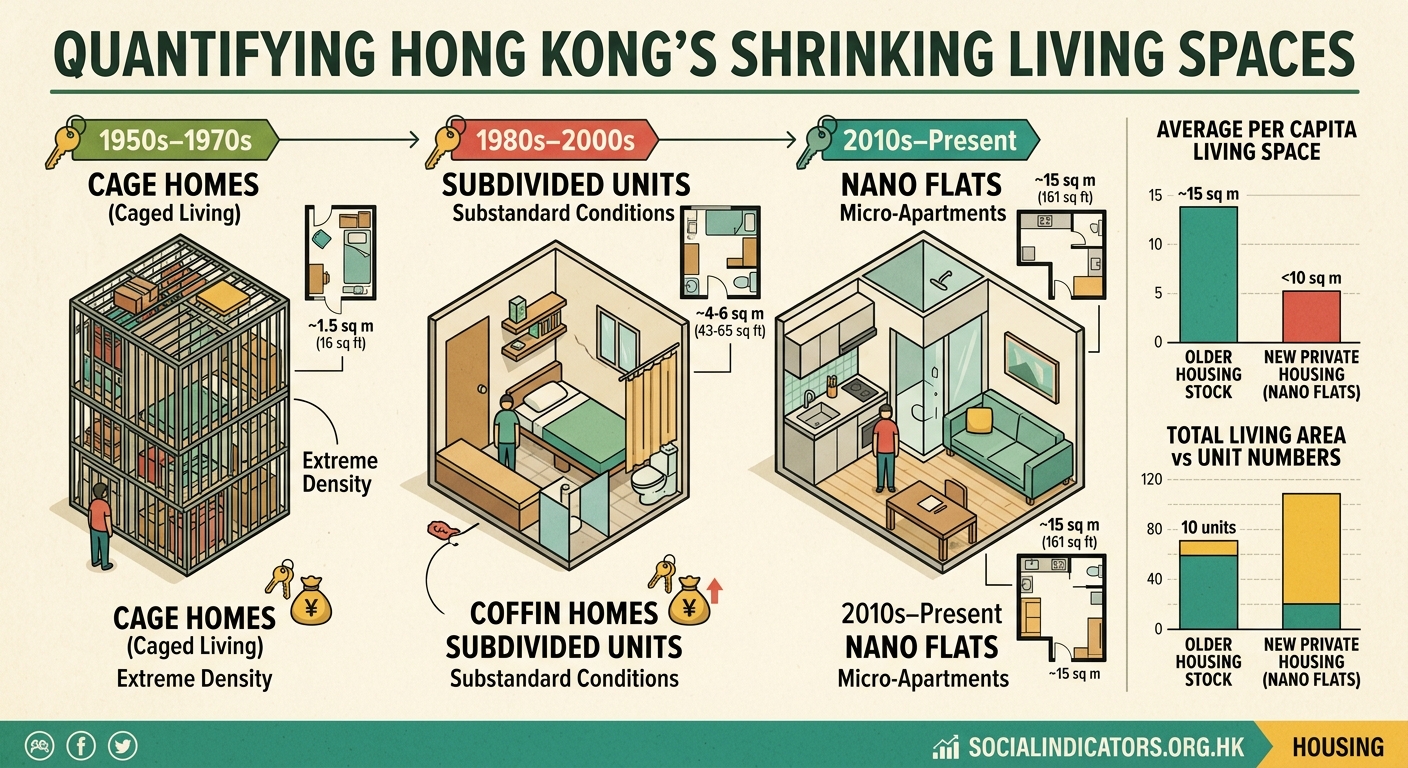
The official statistics tell only part of the story. Beneath the averages lies a hidden population living in conditions that defy modern housing standards. Around 220,000 people occupy subdivided units, according to recent government surveys. These spaces average just 48 square feet per person.
Cage homes represent the most extreme form of this crisis. Metal cages stacked in tenement buildings house single men, mostly elderly or working poor. Each cage measures roughly 15 to 30 square feet. Residents cannot stand upright. They share communal toilets and cooking facilities with dozens of neighbors.
Coffin cubicles offer slightly more space but little additional dignity. These wooden compartments measure about 6 feet by 2.5 feet, just large enough to lie down. Bedspace apartments divide single rooms into 10 or 12 sleeping areas, separated by thin partitions or wire mesh.
Here’s how different housing types compare:
| Housing Type | Average Size Per Person | Typical Monthly Rent | Estimated Population |
|---|---|---|---|
| Cage Home | 15-30 sq ft | HKD 1,500-2,500 | 10,000+ |
| Coffin Cubicle | 15-25 sq ft | HKD 1,800-3,000 | 5,000+ |
| Subdivided Flat | 48 sq ft | HKD 4,000-6,000 | 220,000+ |
| Public Rental | 150 sq ft | HKD 2,000-4,000 | 2.1 million |
| Private Housing | 170 sq ft | HKD 10,000+ | 3.5 million |
These figures reveal the stark inequality within Hong Kong’s housing market. Wealthy residents occupy luxury apartments with thousands of square feet, while the poor survive in spaces smaller than prison cells.
Why Hong Kong’s living spaces keep shrinking
Several forces combine to squeeze Hong Kong residents into ever smaller homes. Understanding these factors helps explain why the crisis persists despite decades of public awareness.
Land supply constraints
Only 7% of Hong Kong’s total land area is zoned for residential use. Mountains, country parks, and restrictive zoning regulations limit development. The government controls land sales, releasing parcels gradually to maintain revenue and property values.
Population density
Hong Kong packs 7.5 million people into 1,104 square kilometers. The urbanized areas reach density levels of 27,000 people per square kilometer in districts like Kwun Tong and Sham Shui Po. This concentration creates intense competition for housing.
Property speculation
Real estate investment drives prices beyond what ordinary families can afford. Mainland Chinese buyers, international investors, and local speculators treat housing as financial assets rather than homes. Empty luxury apartments sit idle while families wait years for public housing.
Income inequality
Median household income hasn’t kept pace with property prices. A typical family now needs 21 years of total income to purchase a median-priced apartment. This ratio was 12 years in 2003. The gap forces more people into subdivided flats and public housing queues.
Construction costs
Building in Hong Kong costs more than almost anywhere else. Strict regulations, expensive labor, and limited flat land drive up development expenses. Developers pass these costs to buyers, making affordable housing financially unviable without government subsidies.
Comparing Hong Kong to other global cities
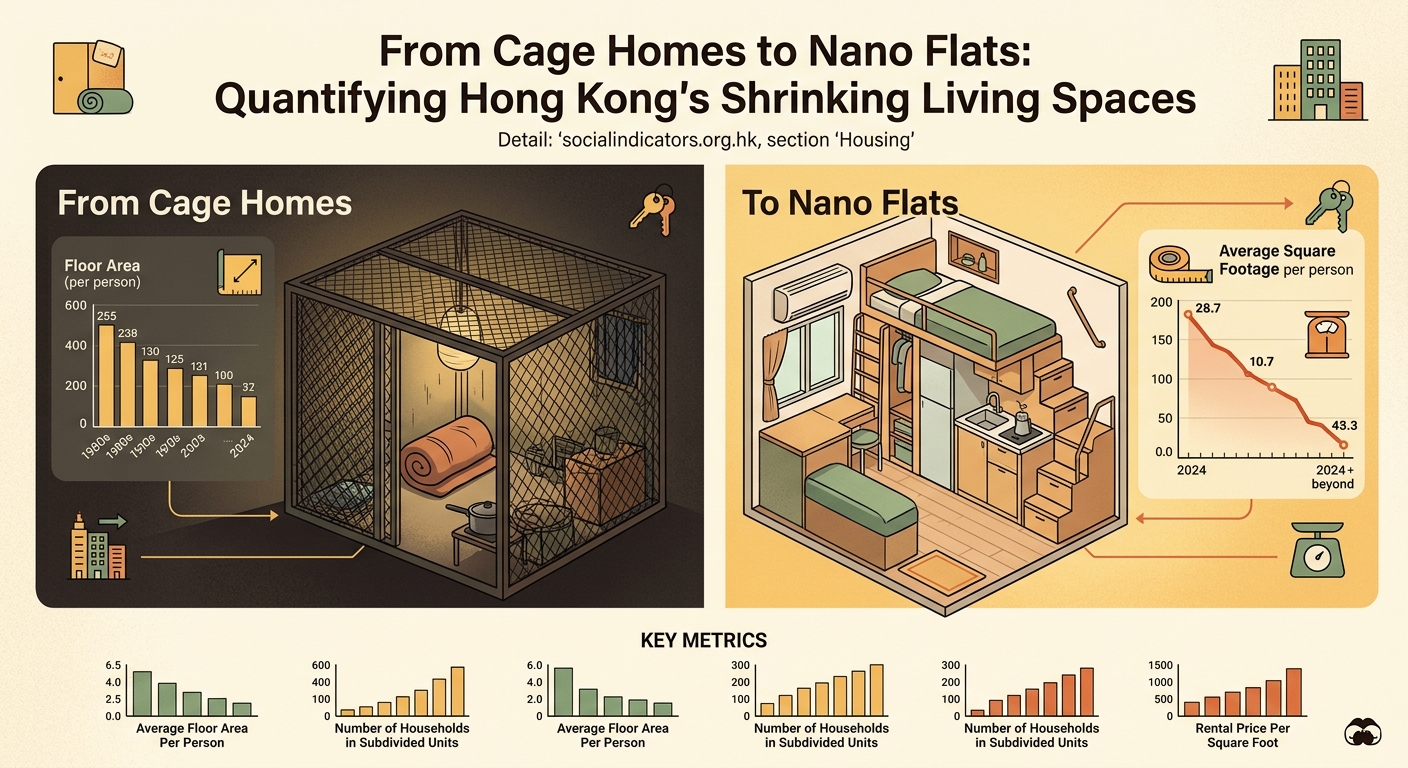
International comparisons highlight just how extreme Hong Kong’s situation has become. The following list shows average living space per person across major cities:
- New York City: 500 sq ft
- London: 340 sq ft
- Paris: 320 sq ft
- Tokyo: 215 sq ft
- Singapore: 270 sq ft
- Seoul: 230 sq ft
- Hong Kong: 161 sq ft
Hong Kong trails every comparable city by significant margins. Even Tokyo, known for compact living, provides 33% more space per resident. Singapore, with similar land constraints and population density, manages 68% more space.
The comparison becomes more striking when examining minimum housing standards. Many developed countries enforce minimum room sizes and occupancy limits. The United Kingdom requires bedrooms to measure at least 70 square feet for one person, 110 square feet for two. Hong Kong has no such minimums for subdivided flats.
“Hong Kong’s housing crisis represents a failure of policy, not geography. Cities with similar density constraints have achieved better outcomes through comprehensive planning, aggressive public housing programs, and strict regulations on subdivided units. The question isn’t whether Hong Kong can improve, but whether policymakers will prioritize human dignity over property values.”
This perspective from housing researchers underscores the policy choices driving current conditions. Technical solutions exist. Political will remains the missing ingredient.
What the government measures and why it matters
Official statistics shape public policy and resource allocation. The Hong Kong government tracks several key metrics to monitor housing conditions:
-
Median floor area per person: Calculated from census data and housing surveys, this figure provides the headline number most commonly cited in policy discussions.
-
Waiting time for public housing: Currently averaging 5.5 years for general applicants, this metric indicates the severity of the shortage and the effectiveness of new construction programs.
-
Housing affordability ratio: Compares median property prices to median household income, showing how many years of income a family needs to purchase a home.
-
Subdivided unit population: Regular surveys count residents living in subdivided flats, though many housing advocates believe official figures underestimate the true total.
-
Cage home residents: Less frequently measured due to the difficulty of accessing and surveying these informal housing arrangements.
These measurements inform the government’s housing production targets, public housing allocation policies, and subsidy programs. However, critics argue the metrics don’t capture the full human cost of inadequate housing.
Practical steps for understanding and using housing data
Researchers, journalists, and advocates need reliable methods to analyze Hong Kong’s housing situation. These approaches help ensure accuracy and context:
-
Cross reference multiple data sources: Government statistics, academic studies, and NGO surveys often use different methodologies. Comparing figures from the Census and Statistics Department, university housing research centers, and organizations like the Society for Community Organization provides a fuller picture.
-
Account for hidden populations: Official counts miss many residents in informal housing. Fieldwork, interviews with social workers, and community surveys reveal conditions that don’t appear in government data.
-
Adjust for inflation and income changes: Raw price data misleads without context. Calculate affordability ratios, compare housing costs to median wages, and track changes over time to understand true accessibility.
-
Consider geographic variations: District level data shows how housing conditions vary across Hong Kong. Sham Shui Po, with high concentrations of subdivided flats, differs dramatically from mid-levels luxury housing. Aggregate citywide figures can obscure these disparities.
-
Include qualitative data: Numbers alone don’t convey the daily reality of living in 48 square feet. Interviews, photo documentation, and case studies add essential human context to statistical analysis.
These methods help produce accurate, nuanced reporting that informs policy debates and public understanding.
Common mistakes when interpreting living space statistics
Housing data requires careful interpretation. These frequent errors lead to misunderstanding:
-
Confusing household size with per person measurements: A 400 square foot apartment sounds reasonable until you realize four people share it. Always convert to per capita figures for meaningful comparisons.
-
Ignoring the distribution behind averages: Mean and median figures hide the range of conditions. Some residents enjoy spacious homes while others suffer in cages. The average doesn’t represent typical experience.
-
Overlooking construction standards: Square footage means different things with varying ceiling heights, usable space, and layout efficiency. Hong Kong developers sometimes count balconies and utility areas that don’t provide actual living space.
-
Neglecting maintenance and building age: Older tenement buildings house most cage homes and subdivided flats. These structures often lack proper ventilation, fire safety, and sanitation. Size isn’t the only housing quality metric that matters.
-
Failing to account for housing type differences: Public and private housing serve different populations with different needs. Comparing raw square footage without considering affordability, location, and tenant characteristics produces misleading conclusions.
Avoiding these pitfalls requires attention to methodology and context. Good analysis acknowledges limitations and uncertainties in the data.
How nano flats represent the latest evolution
Developers have responded to the housing crisis by creating ever smaller units marketed as “nano flats.” These apartments typically measure 200 to 300 square feet total, housing one or two people. They represent the private market’s answer to affordability pressures.
Nano flats sell for HKD 3 to 5 million, making them accessible to young professionals and first time buyers priced out of standard apartments. Developers market them as efficient, modern living spaces with clever storage solutions and convertible furniture.
Critics argue nano flats normalize inadequate housing. They lock buyers into tiny spaces with no room for families or life changes. The per square foot price often exceeds larger apartments, making them poor value despite lower absolute costs.
Government regulations now set minimum sizes for new private developments at 280 square feet for studio units. This floor prevents the smallest nano flats but does little to address overall space constraints.
The nano flat phenomenon reflects Hong Kong’s acceptance of shrinking living standards as inevitable. What would have seemed unacceptably small a generation ago now represents aspirational housing for many young residents.
Understanding the human impact beyond statistics
Numbers quantify the crisis but don’t capture the daily struggle of living in inadequate space. Consider these realities:
Children in subdivided flats have no space for homework, play, or privacy. They study on beds, eat on beds, and sleep surrounded by family belongings. Educational outcomes suffer. Mental health deteriorates.
Elderly cage home residents face isolation and health risks. Many lack family support. The cramped, poorly ventilated conditions accelerate physical decline. Social services struggle to reach them in aging tenement buildings.
Families wait years for public housing while paying exorbitant rents for subdivided flats. The waiting list exceeds 250,000 applications. Each year of delay means another year of savings depleted, another year of children growing up in inadequate conditions.
Young professionals delay marriage and children because they can’t afford family sized housing. Hong Kong’s fertility rate has dropped to 0.9 children per woman, among the lowest globally. Housing costs directly impact demographic trends.
These human costs compound over time. A generation raised in subdivided flats carries the physical and psychological effects into adulthood. The housing crisis becomes a public health crisis, an education crisis, and a demographic crisis.
Moving forward with better housing data
Understanding Hong Kong’s living space crisis requires both rigorous data analysis and human empathy. The statistics provide essential evidence for policy advocacy. The stories behind the numbers drive the urgency for change.
Researchers and journalists should continue documenting conditions, tracking trends, and holding officials accountable. International comparisons shame Hong Kong’s performance and demonstrate that better outcomes are possible. Community organizations need this data to advocate for residents trapped in inadequate housing.
The path forward demands political courage to prioritize housing over property values, to release more land for development, and to enforce minimum standards for all housing types. The data shows the problem clearly. The solutions require will, not innovation. Hong Kong’s residents deserve living spaces that support dignity, health, and opportunity. The current situation fails that basic standard.


Post Comment