
Migration Patterns and Brain Drain: Understanding Hong Kong’s Population Exodus
Thousands of professionals, academics, and families have left Hong Kong since 2019. The exodus represents one of the most significant demographic shifts in the city’s modern history. Census data, visa applications, and school enrollment figures all point to the same reality: skilled workers are departing at unprecedented rates.
Hong Kong has experienced substantial population decline since 2019, with over 200,000 residents leaving by 2023. The outflow primarily affects educated professionals, medical workers, and families with school-age children. Government statistics show negative net migration for four consecutive years, driven by political uncertainty, pandemic restrictions, and changing career prospects. This brain drain threatens critical sectors including healthcare, education, and technology.
Understanding the scale of departure
The numbers tell a stark story. Between mid-2020 and mid-2023, Hong Kong’s population dropped by approximately 190,000 people. This represents a 2.5% decline in just three years.
Net migration figures reveal even sharper trends. In 2020, the city recorded a net outflow of 45,900 residents. The following year saw 23,600 more departures. By 2022, another 68,900 had left.
These aren’t temporary workers or short-term visitors. Census data indicates that permanent residents, particularly those in their 30s and 40s, make up a significant portion of emigrants.
School enrollment provides another window into the trend. Primary and secondary schools reported declining student numbers starting in 2020. Some international schools saw enrollment drop by 15 to 20 percent within two years.
Professional sectors face acute shortages. The Hospital Authority reported over 3,000 nursing vacancies in 2023. Teaching positions remain unfilled across multiple districts. Technology firms struggle to retain senior developers and project managers.
Who is leaving and why
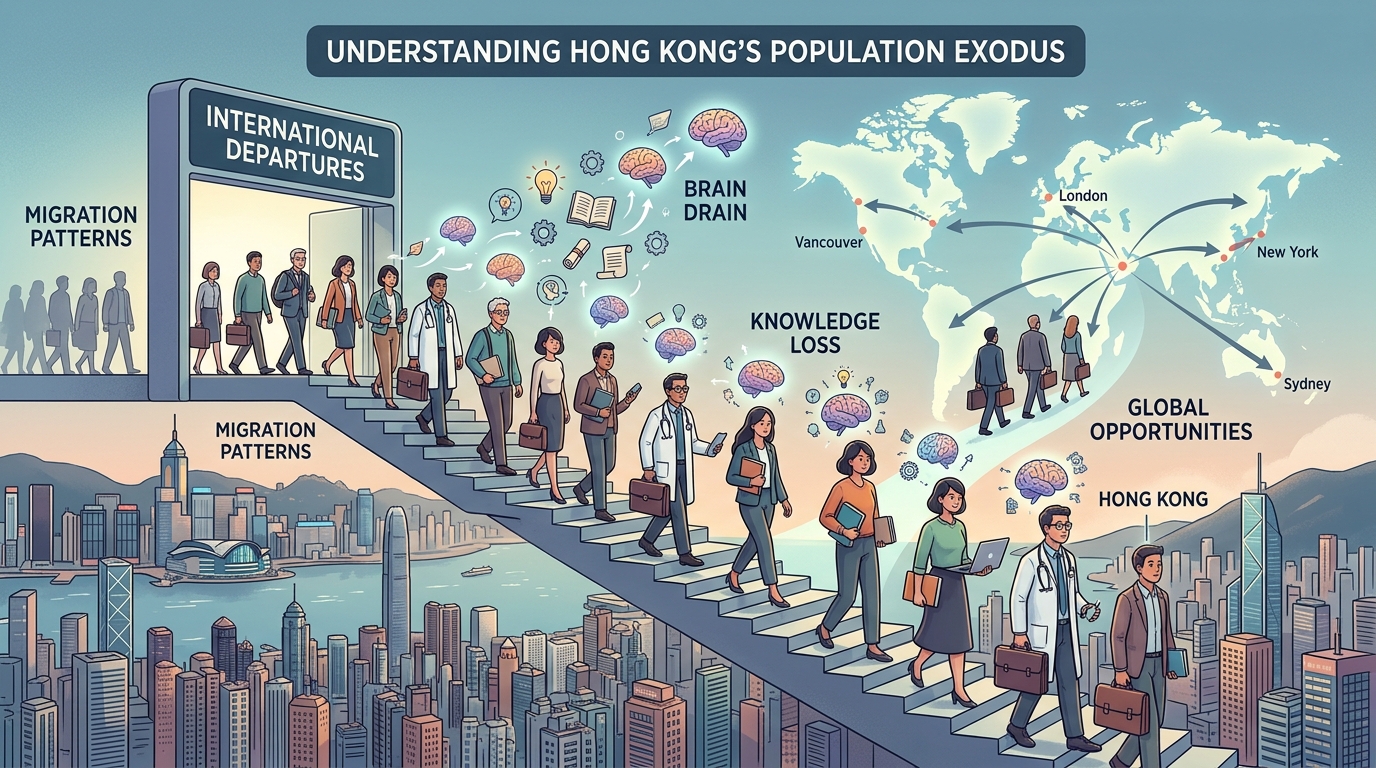
Three groups dominate the emigration wave:
Mid-career professionals aged 30 to 50
This cohort possesses valuable skills, established careers, and financial resources to relocate. Many work in finance, law, technology, or healthcare. They cite concerns about career progression, education quality for children, and long-term stability.
Families with school-age children
Parents prioritize educational opportunities and social environment. The shift in curriculum, language policies, and university admissions has prompted many to seek alternatives abroad.
Recent university graduates
Young adults with international education or language skills face a challenging job market. Some perceive limited growth prospects or cultural fit within evolving workplace norms.
Survey data from various sources point to common motivations:
- Political and social environment changes
- Pandemic-related restrictions and uncertainty
- Concerns about rule of law and civil liberties
- Career and business prospects
- Education system changes
- Quality of life considerations
Financial factors play a smaller role than commonly assumed. Most emigrants possess sufficient savings or transferable skills. The decision reflects lifestyle priorities rather than economic necessity alone.
Destination patterns and migration pathways
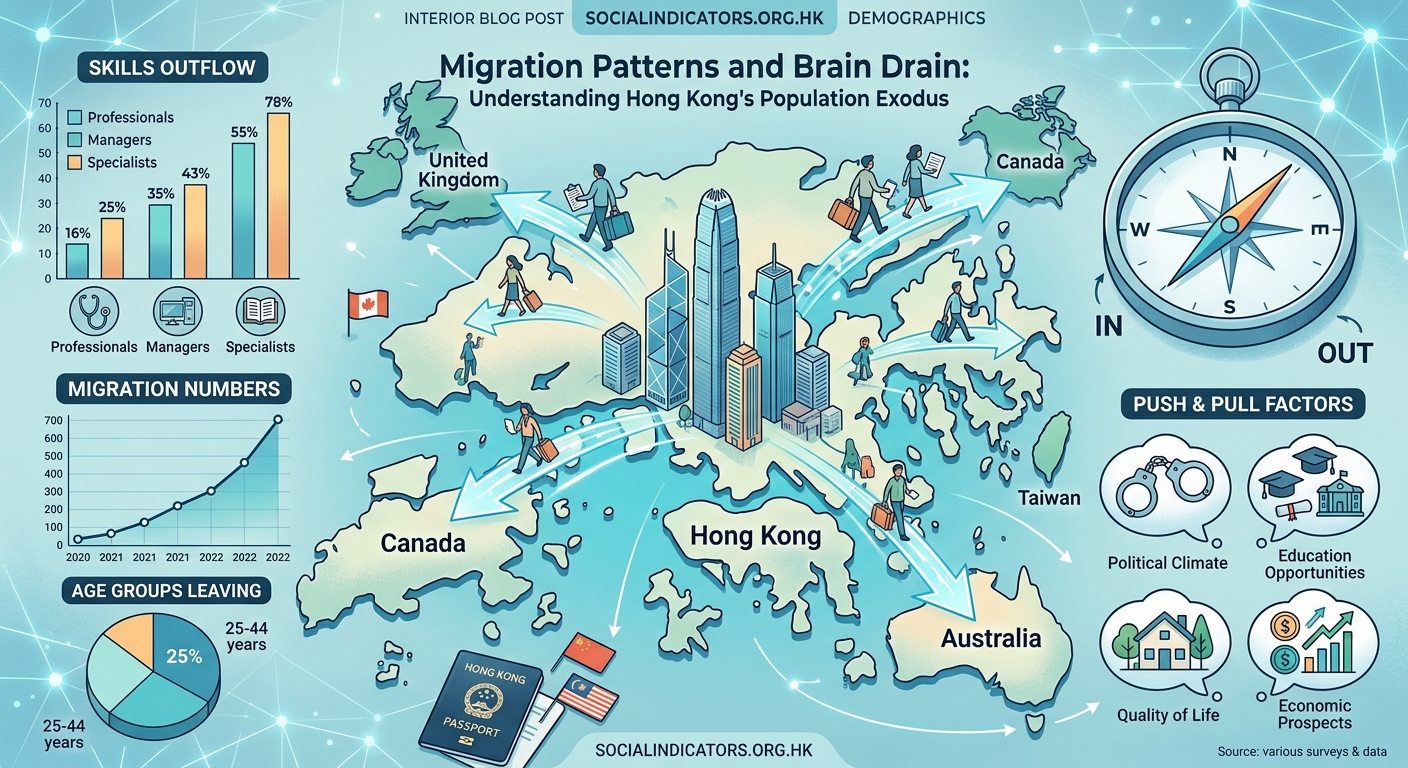
Five countries absorb the majority of Hong Kong emigrants:
- United Kingdom (via BN(O) visa scheme)
- Canada (through various immigration streams)
- Australia (skilled migration and family reunification)
- United States (employment and student visas)
- Taiwan (investment and residency programs)
The UK’s BN(O) visa pathway, introduced in January 2021, has proven particularly popular. By mid-2023, over 140,000 Hong Kong residents had applied. The scheme allows BN(O) passport holders and their families to live, work, and study in Britain, with a path to permanent residency after five years.
Canadian immigration programs attract professionals through Express Entry, Provincial Nominee Programs, and the Hong Kong pathway introduced in 2021. The latter offers work permits and expedited permanent residence for recent graduates and professionals.
Australia’s skilled migration streams and business innovation visas appeal to entrepreneurs and established professionals. Processing times and points-based assessment favor applicants with higher education and work experience.
Taiwan has emerged as a regional alternative. Geographic proximity, cultural familiarity, and lower cost of living make it attractive for families and retirees. Investment and employment pathways provide residency options.
Economic and social consequences
The departure of skilled workers creates ripple effects across multiple sectors.
Healthcare faces critical staffing gaps. Public hospitals operate with vacancy rates exceeding 10% for nurses and allied health professionals. Wait times for specialist appointments have lengthened. Some clinics reduce operating hours due to insufficient staff.
Education institutions struggle with teacher shortages. Schools report difficulty filling positions in English, STEM subjects, and special education. Class sizes increase in some districts while others face potential closures.
The technology sector loses talent to overseas opportunities. Startups find it harder to recruit experienced developers and product managers. Some companies relocate operations to Singapore or other regional hubs.
Professional services experience knowledge drain. Law firms, accounting practices, and consulting groups lose mid-level associates who transfer to overseas offices or competitors.
The loss of experienced professionals creates institutional memory gaps. Organizations must invest more in training and knowledge transfer, which affects productivity and service quality in the short term.
Small businesses and family enterprises face succession challenges. Second-generation owners who have emigrated leave aging parents to manage operations or consider closure.
Demographic shifts and population structure
Age distribution changes significantly impact future planning. The departure of young families accelerates population aging. Birth rates, already low, decline further as potential parents leave.
Dependency ratios worsen as the working-age population shrinks relative to retirees. This affects tax revenue, social services, and pension sustainability.
School consolidation becomes necessary in some districts. The Education Bureau has facilitated mergers and closures as student numbers fall. This affects neighborhood character and property values.
Housing market dynamics shift. Certain districts popular with expatriate families see price adjustments. Luxury segments experience slower transaction volumes. The overall market remains complex, influenced by multiple factors beyond migration alone.
Labor force composition evolves. Some sectors recruit from mainland China or Southeast Asia to fill gaps. This changes workplace culture and service delivery in customer-facing industries.
Government responses and retention efforts
Authorities have implemented various measures to address population decline and talent retention.
The Top Talent Pass Scheme, launched in late 2022, aims to attract high earners and graduates from leading universities. It offers two-year visas without requiring a job offer. Initial uptake exceeded expectations, though long-term settlement rates remain uncertain.
Enhanced tax deductions for research and development encourage companies to invest in local talent development. Financial incentives target specific industries like biotechnology and fintech.
Public housing allocation policies adjust to changing demographics. Some units previously designated for families become available for singles or elderly residents.
Healthcare recruitment drives target overseas-trained professionals. Licensing pathways for foreign medical graduates have been streamlined, though language and cultural adaptation remain challenges.
Education reforms attempt to address parental concerns. International curriculum options expand in government-subsidized schools. Language policies receive periodic review.
These initiatives show mixed results. Some attract new arrivals, but retention of existing residents proves more difficult. Trust and confidence take years to rebuild once eroded.
Comparing Hong Kong to historical brain drain episodes
Other cities and regions have experienced similar outflows during periods of political or economic transition.
East Germany saw massive emigration before the Berlin Wall fell. An estimated 3.5 million left between 1949 and 1989, primarily young and educated individuals. The economic and demographic consequences persisted for decades.
Ireland experienced significant emigration during the 1980s economic crisis. Approximately 200,000 people, many with university degrees, left for opportunities in the UK, US, and Australia. The trend reversed during the Celtic Tiger boom of the 1990s.
Venezuela has lost millions of residents since 2015 due to economic collapse and political instability. Professionals, including doctors, engineers, and teachers, departed for neighboring countries and beyond.
These cases offer lessons about reversal conditions. Economic opportunity alone rarely suffices. Political stability, institutional trust, and social cohesion matter equally. Recovery takes years and requires sustained effort.
Hong Kong’s situation shares elements with these episodes but also differs in important ways. The city maintains economic vitality in many sectors. Infrastructure and public services function effectively. The challenge centers more on confidence and alignment between personal values and institutional direction.
Data sources and measurement challenges
Tracking emigration accurately presents methodological difficulties.
Official statistics rely on census data, immigration records, and administrative databases. These capture departures but not always destinations or permanence. Some residents maintain Hong Kong identity cards while living abroad, complicating classification.
Visa application data from receiving countries provides partial insight. UK BN(O) figures are public. Canadian and Australian numbers appear in immigration reports. These sources confirm trends but miss emigrants using other pathways.
School enrollment data serves as a proxy indicator. Declining student numbers reflect family departures. However, birth rate changes and school choice patterns also influence figures.
Professional body membership and licensing data reveal sector-specific trends. Medical, legal, and accounting registrations show net declines when departures exceed new registrants.
Survey research adds qualitative depth. Academic studies and polling organizations periodically assess emigration intentions and motivations. Response rates and sample representativeness affect reliability.
| Data Source | Strengths | Limitations |
|---|---|---|
| Census records | Comprehensive population counts | Only every 5-10 years; lag time |
| Immigration department | Real-time departure tracking | Doesn’t capture permanent vs temporary |
| Visa applications abroad | Confirms destination intentions | Misses non-visa pathways |
| School enrollment | Indicates family movement | Affected by birth rates |
| Professional registrations | Sector-specific precision | Limited to licensed professions |
Researchers triangulate multiple sources to build accurate pictures. No single metric tells the complete story.
Future projections and scenarios
Demographic modeling suggests continued population decline through 2030 under current trends. The pace may moderate as the most motivated emigrants have already left.
Three scenarios emerge from policy analysis:
Stabilization scenario
Net migration balances as departures slow and new talent schemes attract replacements. Population stabilizes around 7.2 million. Age structure continues shifting older. Sectors adapt through automation and productivity improvements.
Continued decline scenario
Departures persist at 30,000 to 50,000 annually. Population falls to 6.8 million by 2030. Labor shortages intensify in healthcare, education, and services. Economic growth slows. Government increases recruitment from mainland and overseas.
Reversal scenario
Confidence rebuilds through policy adjustments and regional stability. Return migration begins as some emigrants find overseas life challenging. Population recovers toward 7.5 million. This scenario requires significant shifts in governance approach and regional dynamics.
Most analysts consider stabilization most likely in the medium term. Complete reversal appears improbable without substantial changes. Continued decline remains possible if confidence erodes further.
Implications for individuals and families
Those considering departure face complex decisions with long-term consequences.
Career factors to evaluate:
- Professional licensing and credential recognition abroad
- Industry demand and salary expectations in destination countries
- Language requirements and cultural workplace norms
- Retirement savings portability and pension access
Family considerations include:
- Children’s age and educational stage
- Extended family relationships and caregiving responsibilities
- Housing and cost of living comparisons
- Social network rebuilding challenges
Financial planning requires attention to:
- Tax implications in both jurisdictions
- Currency exchange and asset conversion
- Property market timing
- Healthcare and insurance coverage gaps
Those choosing to remain also face adjustments. Professional opportunities may shift as industries restructure. Social circles change as friends depart. Property values and neighborhood character evolve.
Neither choice guarantees better outcomes. Both involve trade-offs and uncertainty. Individual circumstances, priorities, and risk tolerance determine optimal paths.
Regional context and competitive dynamics
Hong Kong’s brain drain occurs within broader regional competition for talent.
Singapore actively recruits professionals from Hong Kong and elsewhere. Streamlined visa processes, favorable tax treatment, and political stability attract finance, technology, and biomedical talent. The city-state has gained market share in several industries traditionally dominated by Hong Kong.
Mainland Chinese cities offer opportunities in technology, manufacturing, and domestic market-focused industries. Shenzhen, Shanghai, and Beijing attract some Hong Kong professionals, though cultural and regulatory differences create friction.
Tokyo and Seoul compete for regional headquarters and specialized talent. Language barriers limit their appeal for most Hong Kong emigrants but niche sectors see movement.
Dubai and other Middle Eastern hubs attract finance and professional services workers. Tax advantages and cosmopolitan environments appeal to some, though cultural adjustment proves significant.
The competition reshapes regional economic geography. Hong Kong’s traditional advantages in rule of law, English language, and international connectivity face challenges. The city must articulate renewed value propositions to retain relevance.
Research gaps and ongoing monitoring
Several questions require further investigation.
Return migration patterns remain poorly documented. How many emigrants eventually return? Under what conditions? What skills and perspectives do they bring back?
Second-order effects need assessment. How does brain drain affect innovation, entrepreneurship, and cultural vitality? What happens to civic institutions when active members depart?
Comparative analysis with other global cities would illuminate common patterns. How do London, New York, or Singapore retain talent during challenging periods? What policies prove effective?
Intergenerational impacts warrant study. How do children of emigrants maintain connections to Hong Kong? Do they return as adults? How does diaspora identity evolve?
Ongoing monitoring through consistent data collection enables evidence-based policy. Annual reports tracking key indicators would improve transparency and accountability.
Academic institutions, think tanks, and government agencies all play roles in this research agenda. International collaboration enhances methodological rigor and comparative insight.
Making sense of lasting change
Hong Kong’s population exodus represents more than statistics. Behind each departure stands a family’s difficult decision, a career redirected, a community connection severed.
The brain drain reflects deep uncertainty about the city’s trajectory. Skilled workers vote with their feet when they perceive misalignment between personal values and institutional direction.
Recovery requires rebuilding confidence through consistent policy, institutional integrity, and inclusive governance. Talent schemes and financial incentives help at the margins but cannot substitute for fundamental trust.
The city retains substantial strengths: robust infrastructure, efficient markets, strategic location, and accumulated expertise. These assets provide foundation for renewal if authorities address underlying concerns.
For now, the data tells a story of transition. Population decline continues. Professional sectors adapt with mixed success. Families weigh difficult choices. The outcome remains uncertain, shaped by decisions made today that will echo for decades.
Whether you’re analyzing these trends professionally, considering your own future, or simply trying to understand your changing city, the numbers provide clarity about scale and direction. What they cannot predict is how individuals, institutions, and society will ultimately respond to this moment of transformation.



Post Comment