
Ethnic Minorities in Hong Kong: Population Growth and Integration Challenges
Hong Kong’s ethnic minority population has grown steadily over the past two decades, yet many communities continue to face systemic barriers that limit their full participation in society. From language education gaps to workplace discrimination, these challenges affect nearly every aspect of daily life for South Asian, Southeast Asian, and other non-Chinese residents. Understanding these obstacles is essential for developing effective policies that promote genuine integration and equal opportunity.
Ethnic minorities in Hong Kong encounter persistent barriers in education, employment, and social integration despite population growth. Language policy gaps, workplace discrimination, and limited policy support create structural disadvantages. [Census data](https://www.censtatd.gov.hk/en/) reveals widening disparities in income, educational attainment, and housing quality. Addressing these challenges requires comprehensive policy reform, improved Chinese language education, anti-discrimination enforcement, and community-based integration programs that recognize diverse needs.
Population growth tells only part of the story
The ethnic minority population in Hong Kong reached approximately 8% of the total population by recent census counts. This represents significant growth from earlier decades.
Yet numbers alone mask the lived reality of these communities.
Pakistani, Nepali, Indian, Filipino, Indonesian, and other ethnic minority groups each face distinct challenges. Some have lived in Hong Kong for generations. Others arrived more recently.
Census data shows ethnic minorities are younger on average than the general population. They have higher fertility rates. Many work in sectors that other residents avoid.
Despite contributing to Hong Kong’s economy and diversity, these communities remain largely invisible in mainstream policy discussions. Their concerns rarely make headlines. Their voices are underrepresented in civic institutions.
This invisibility itself constitutes a challenge.
Language barriers create cascading disadvantages
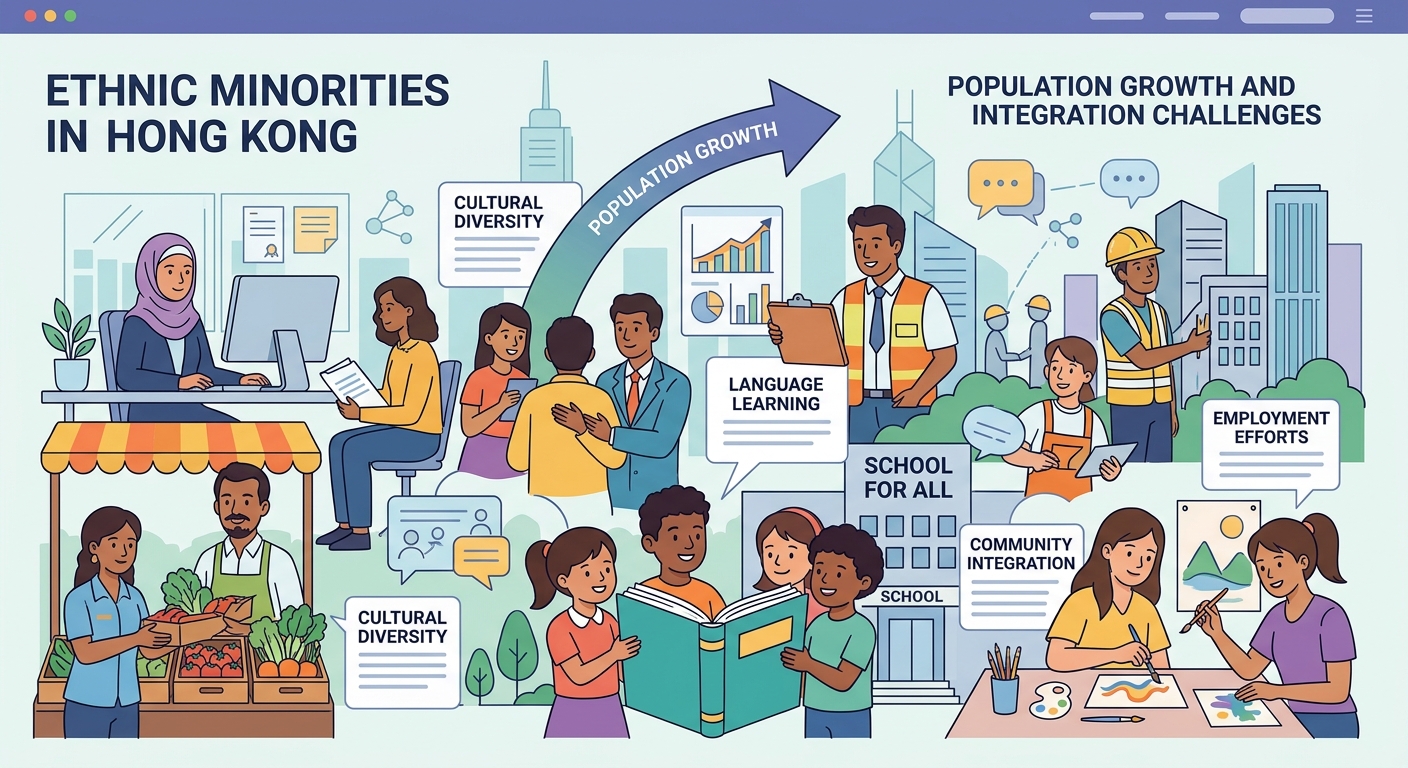
Chinese language proficiency remains the single biggest obstacle for ethnic minority integration.
Most ethnic minority children attend schools where Chinese is taught as a second language. This approach sounds reasonable in theory. In practice, it creates a two-tier education system.
Students who cannot master written Chinese face limited options for secondary education. They struggle to access university programs. Their career prospects narrow significantly.
The government introduced the Chinese Language Curriculum Second Language Learning Framework in 2014. Implementation has been inconsistent across schools. Many teachers lack training in teaching Chinese as a second language.
Parents often cannot help with homework. They cannot communicate effectively with teachers. School notices arrive in Chinese. Parent-teacher meetings happen in Cantonese.
This language gap extends beyond schools:
- Medical appointments become stressful when doctors speak limited English
- Government services require Chinese literacy for most transactions
- Legal documents arrive without translation
- Banking and housing contracts use technical Chinese terminology
- Emergency services may struggle with non-Cantonese speakers
Adult language classes exist but face capacity constraints. Working parents have little time for evening classes. Childcare during class hours remains unaffordable for many families.
Employment discrimination limits economic mobility
Ethnic minorities face significant workplace barriers despite legal protections.
The Race Discrimination Ordinance passed in 2008. Enforcement remains weak. Many employers openly prefer Chinese candidates. Job advertisements sometimes specify ethnicity requirements.
Data shows ethnic minorities concentrate in lower-wage sectors:
- Security guards
- Construction workers
- Domestic helpers
- Restaurant staff
- Retail assistants
Professional roles remain largely inaccessible. Even university-educated ethnic minorities struggle to find white-collar employment.
Language requirements often serve as proxies for discrimination. Employers demand native-level Cantonese for positions where English would suffice. They reject qualified candidates based on accent or appearance.
“I have a degree from a Hong Kong university, but every interview ends the same way. They say my Chinese isn’t good enough, even for positions where I would work in English. It’s discouraging.” – Survey respondent, 2022 employment study
Promotion opportunities are scarce. Ethnic minority workers report hitting glass ceilings in organizations. Management positions go to Chinese colleagues with similar or lesser qualifications.
Wage gaps persist even within the same job categories. Studies document lower average earnings for ethnic minorities compared to Chinese workers in identical roles.
Educational outcomes reveal systemic gaps
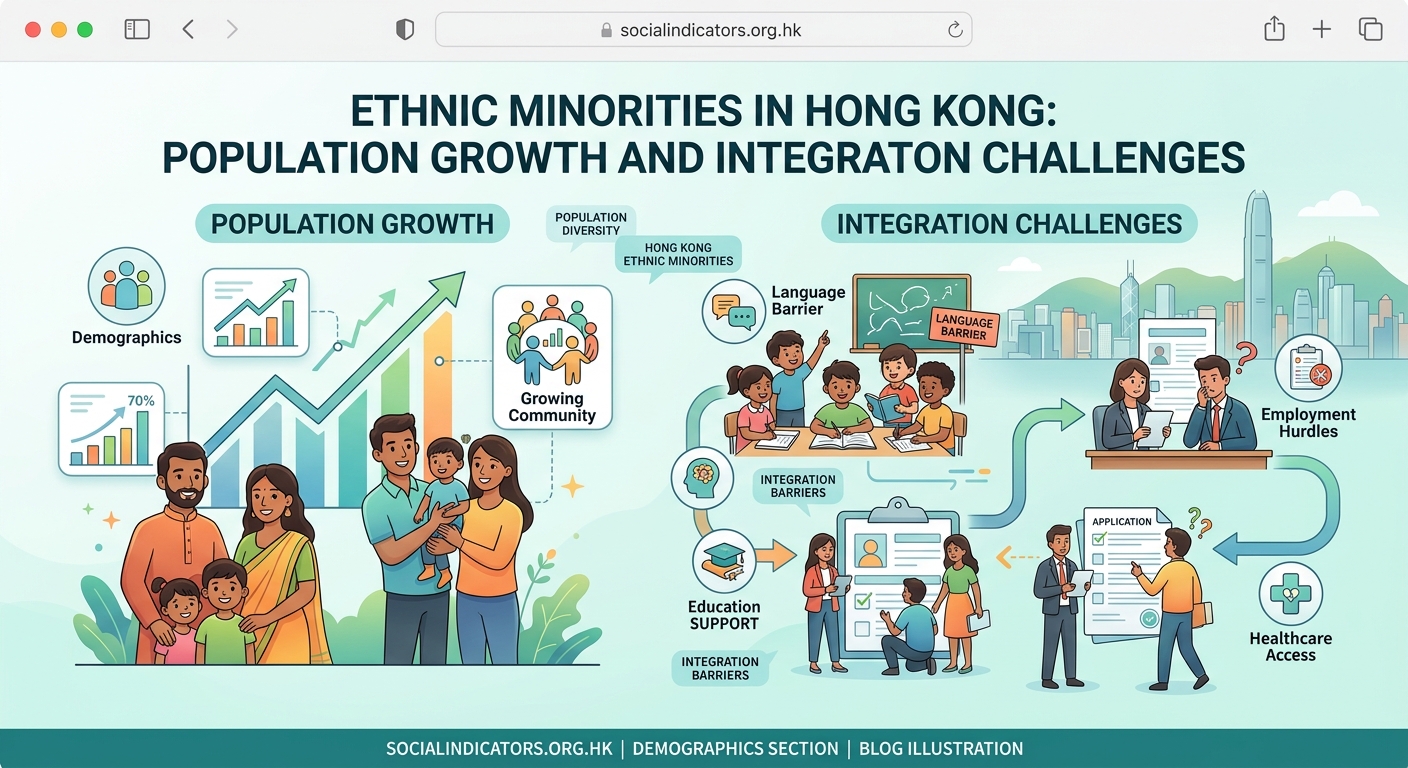
School performance data shows troubling patterns.
Ethnic minority students score lower on the Diploma of Secondary Education Examination. Pass rates for Chinese Language lag far behind the general student population.
This affects university admission. Local universities require Chinese Language passes. Students who fail this subject cannot access higher education, regardless of their performance in other subjects.
Many ethnic minority families send children to designated schools serving predominantly non-Chinese students. These schools often lack resources. They struggle to attract experienced teachers. Facilities may be outdated.
Streaming begins early. Ethnic minority children get tracked into vocational programs. Academic pathways close before students develop their full potential.
| Educational Challenge | Impact on Students | Current Policy Gap |
|---|---|---|
| Chinese as second language | Lower exam pass rates | Inconsistent curriculum implementation |
| School segregation | Limited peer integration | No mandatory diversity quotas |
| University admission | Restricted access to higher education | Inflexible language requirements |
| Career guidance | Narrow vocational tracking | Insufficient multilingual counselors |
| Parental engagement | Communication barriers | Limited translation services |
Extracurricular activities remain less accessible. Cost barriers exclude low-income ethnic minority families. Language requirements limit participation in mainstream programs.
Bullying affects ethnic minority students at higher rates. They report feeling isolated. Some face racist comments from peers or even teachers.
Housing conditions reflect economic marginalization
Ethnic minorities live in some of Hong Kong’s most crowded and substandard housing.
Subdivided units and rooftop structures house many families. Multiple generations share tiny spaces. Privacy is nonexistent.
Discrimination in the private rental market is common. Landlords refuse ethnic minority tenants. They cite concerns about cooking smells, noise, or subletting.
Real estate agents steer ethnic minority clients toward specific buildings or neighborhoods. This creates de facto segregation.
Public housing allocation processes disadvantage ethnic minorities. Long residency requirements exclude recent arrivals. Point systems favor larger families but ignore overcrowding among ethnic minorities.
Waiting times for public housing stretch beyond a decade for many applicants. During this period, families endure inadequate private rentals.
Location matters too. Affordable housing concentrates in remote districts. This increases commute times. Children travel long distances to school. Parents spend hours reaching work.
Healthcare access faces multiple obstacles
Language barriers complicate medical care.
Hospitals provide interpretation services inconsistently. Patients struggle to describe symptoms. Doctors cannot explain diagnoses clearly. Medication instructions get misunderstood.
Mental health services are particularly inadequate. Cultural stigma combines with language gaps. Ethnic minorities underutilize counseling and psychiatric care.
Traditional medicine practices from home countries lack recognition. Patients face dismissal of their health beliefs and practices.
Health literacy varies widely. Preventive care information rarely reaches ethnic minority communities. Vaccination rates lag. Chronic disease management suffers.
Cost remains a barrier despite public healthcare. Ethnic minorities work in sectors without medical benefits. They delay treatment until conditions become severe.
Social integration remains superficial
Ethnic minorities participate in Hong Kong society yet remain apart from it.
Friendship networks rarely cross ethnic lines. Chinese and ethnic minority communities occupy the same neighborhoods but interact minimally.
Cultural festivals receive government support but attract mainly ethnic minority attendees. Mainstream participation is limited.
Civic engagement is low. Ethnic minorities hold few positions in district councils. Advisory committees lack ethnic minority representation.
Media portrayal reinforces stereotypes. News coverage focuses on crime when ethnic minorities are involved. Positive stories are rare.
Sports and arts offer some integration opportunities. Yet even successful ethnic minority athletes or artists face questions about their “real” identity.
Intermarriage rates remain low. Social boundaries persist across generations.
Policy responses fall short of needs
Government initiatives have increased in recent years. Impact remains limited.
Support service centers serve ethnic minority communities. They provide language classes, employment assistance, and social activities. Funding constraints limit their reach.
The Education Bureau issues guidelines for schools. Compliance is voluntary. Monitoring is weak.
Anti-discrimination enforcement lacks teeth. The Equal Opportunities Commission receives complaints but achieves few substantive outcomes. Penalties are minimal.
Mainstream social services struggle to serve ethnic minorities effectively. Language capacity is insufficient. Cultural competence training is basic.
Data collection has improved. The census now disaggregates ethnic minority populations. Yet policy development does not always follow data insights.
Consultation with ethnic minority communities happens irregularly. Token representation on committees does not translate to genuine influence.
Community organizations fill critical gaps
Non-governmental organizations provide essential services that government programs miss.
Ethnic minority-led groups offer culturally appropriate support. They understand community needs from lived experience.
These organizations run homework clubs for children. They provide translation services. They advocate for policy changes.
Funding remains precarious. Most rely on short-term grants. Staff turnover is high. Sustainability is constantly at risk.
Collaboration among organizations has strengthened. Networks share resources and coordinate advocacy. Collective action amplifies voices.
Faith-based organizations play significant roles. Mosques, temples, and churches serve as community hubs. They provide social support beyond religious functions.
What genuine integration requires
Addressing ethnic minorities in Hong Kong challenges demands comprehensive reform.
Language policy must change fundamentally. Chinese language education for ethnic minorities needs dedicated resources, trained teachers, and realistic expectations. Alternative pathways to university should exist for students who demonstrate competence in English and other subjects.
Employment discrimination requires serious enforcement. The Race Discrimination Ordinance needs strengthening. Penalties should be meaningful. Proactive compliance monitoring should replace complaint-based systems.
Education segregation must end. Incentives should encourage ethnic minority enrollment in mainstream schools. Support services should follow students rather than concentrating in designated schools.
Housing discrimination needs active combating. Fair housing enforcement should include testing and prosecution. Public housing allocation should account for ethnic minority circumstances.
Healthcare interpretation services must become standard. Cultural competence training should be mandatory for medical professionals. Health information should reach communities in appropriate languages and formats.
Political representation matters. Electoral systems should ensure ethnic minority voices are heard. Advisory bodies should include meaningful ethnic minority participation.
Data collection should continue improving. Research should inform policy. Outcomes should be monitored and programs adjusted based on evidence.
Most importantly, ethnic minorities should be recognized as full members of Hong Kong society. Their contributions should be celebrated. Their concerns should matter. Their futures should be integral to Hong Kong’s future.
Building a truly inclusive Hong Kong
The challenges facing ethnic minorities in Hong Kong are serious but not insurmountable.
Other diverse societies have made progress through sustained commitment. Hong Kong has resources and capacity to do the same.
Change requires political will. It requires resource allocation. It requires listening to ethnic minority voices and acting on what they share.
The alternative is accepting a permanent underclass. That outcome serves no one’s interests. It wastes human potential. It contradicts Hong Kong’s values.
Every student deserves educational opportunity. Every worker deserves fair treatment. Every family deserves decent housing. Every resident deserves to feel they belong.
These are not radical demands. They are basic requirements for a just society.
Hong Kong can meet them. The question is whether it will choose to do so.



Post Comment