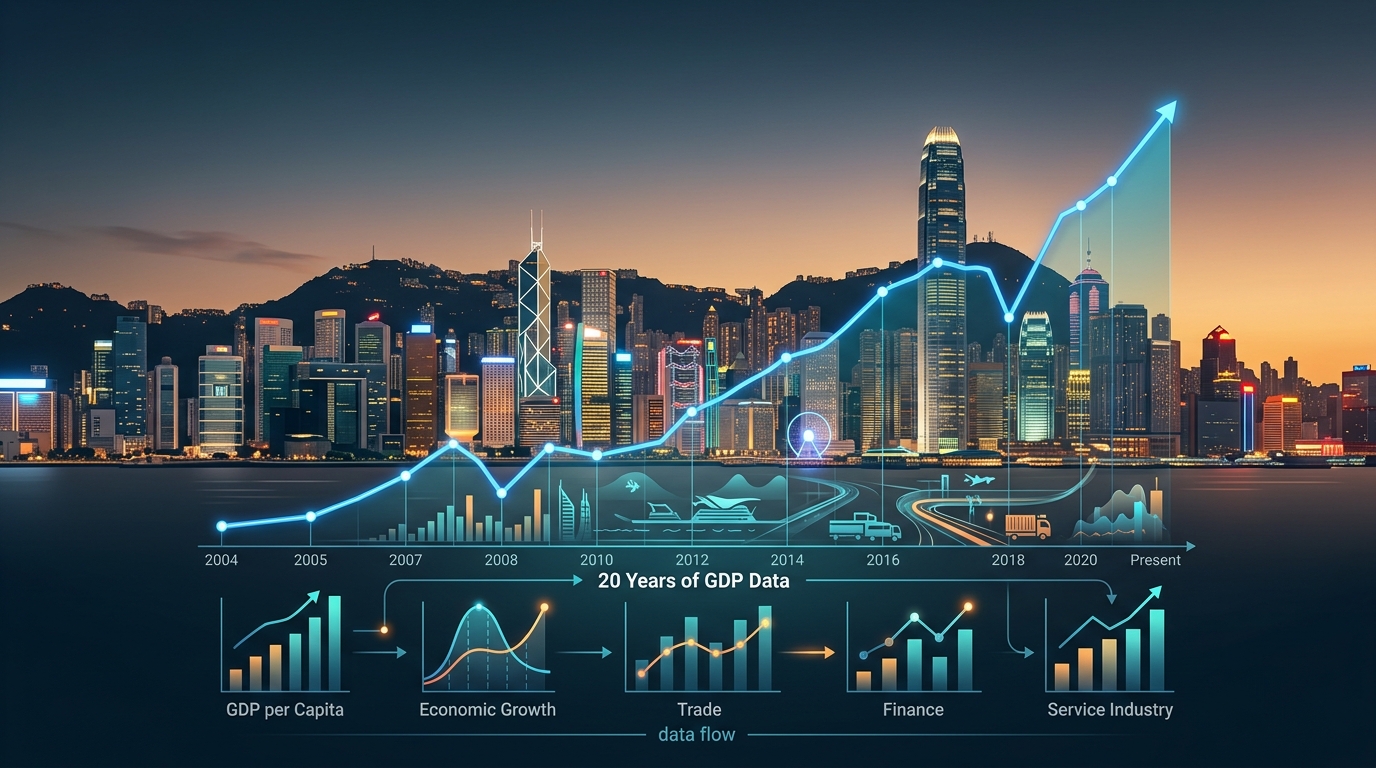
What Do 20 Years of GDP Data Reveal About Hong Kong’s Economic Resilience?
Two decades of economic data tell a story that numbers alone cannot capture. Hong Kong has faced financial crises, political upheaval, a global pandemic, and shifting trade relationships. Yet the city continues to function as one of Asia’s most important financial centers. Understanding this resilience requires looking beyond headline GDP figures to see how the economy adapts, absorbs shocks, and rebuilds.
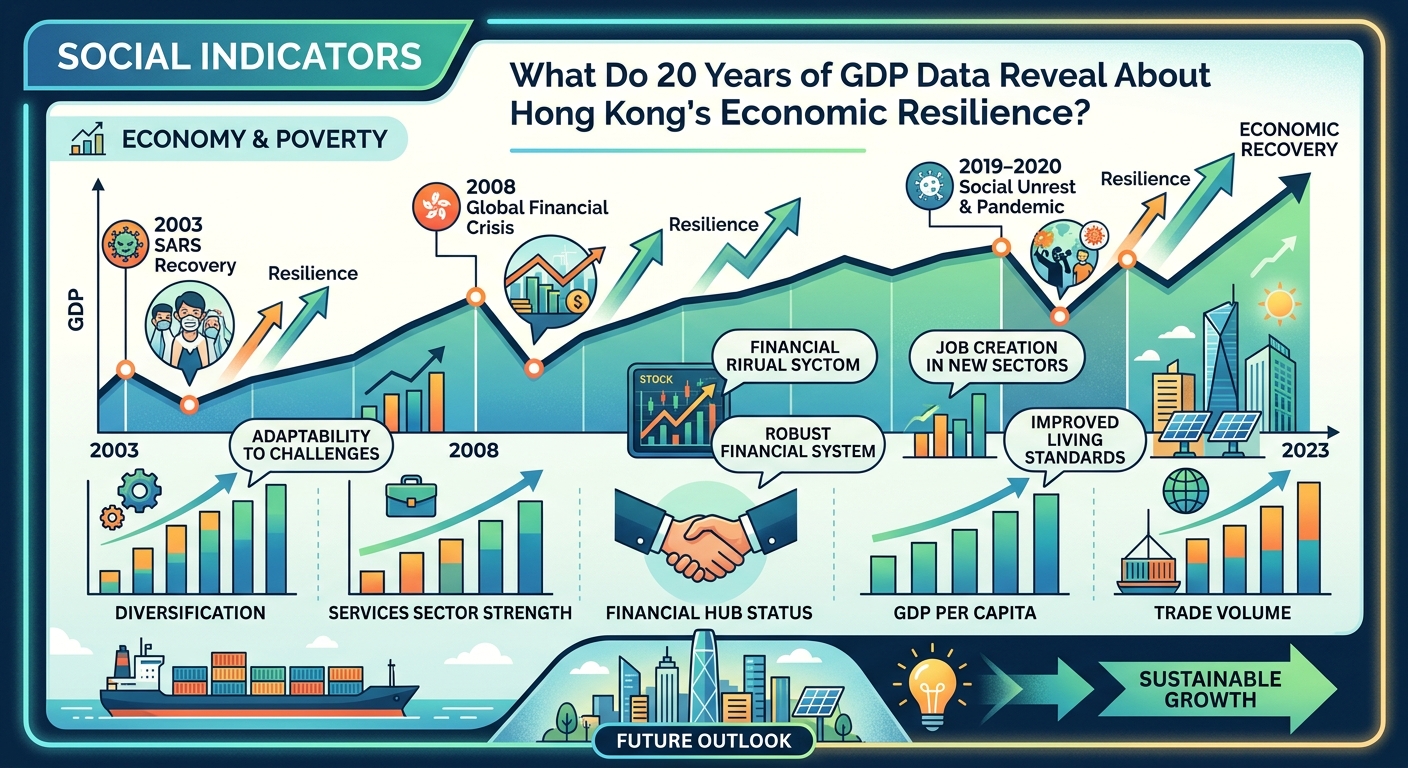
Hong Kong’s economic resilience stems from its flexible labor market, deep capital reserves, strong legal framework, and strategic position in global trade. Twenty years of GDP data show repeated recoveries from major shocks, including the [2003 SARS outbreak](https://www.who.int/health-topics/severe-acute-respiratory-syndrome), 2008 financial crisis, 2019 social unrest, and 2020 pandemic. The city’s ability to bounce back relies on institutional strength, diversified revenue streams, and rapid policy responses that stabilize markets during turbulent periods.
What the numbers reveal about stability
GDP growth rates fluctuate wildly during crisis years, but the pattern of recovery matters more than the depth of any single downturn. Between 2003 and 2023, Hong Kong experienced at least five major economic shocks. Each time, growth contracted sharply before rebounding within 12 to 18 months.
The 2003 SARS epidemic caused GDP to contract by 4% in a single quarter. By 2004, growth had returned to 8.7%. The 2008 global financial crisis triggered a 2.5% annual contraction, yet 2010 saw 6.8% growth. More recently, the combined impact of social unrest in 2019 and the pandemic in 2020 pushed the economy into its deepest recession since records began. Still, partial recovery began in 2021.
These patterns suggest that Hong Kong’s economic resilience depends less on avoiding shocks and more on institutional mechanisms that enable rapid stabilization. The currency peg to the US dollar provides monetary stability. Foreign exchange reserves exceeding $400 billion offer a buffer against capital flight. A low tax regime and minimal public debt give policymakers fiscal room to respond.
How different sectors absorb economic shocks

Not all parts of the economy respond the same way to external pressures. Financial services, trade and logistics, tourism, and professional services each show distinct patterns of vulnerability and recovery.
Financial services account for roughly 20% of GDP. This sector proved remarkably stable during political tensions because global banks value Hong Kong’s legal system, time zone position, and access to mainland China. Even during the 2019 protests, major financial institutions maintained operations and capital flows remained robust.
Trade and logistics suffered more during the US-China trade war. Re-export volumes declined as companies restructured supply chains. Yet the sector adapted by focusing on higher value services like supply chain management, quality control, and product customization rather than pure volume.
Tourism represents the most volatile sector. Visitor arrivals can drop 50% or more during crises, as happened in 2003 and 2020. Recovery depends heavily on mainland China policy, since mainland visitors account for roughly 80% of total arrivals. When border restrictions ease, tourism rebounds within months.
Professional services including legal, accounting, and consulting work show steady growth regardless of broader economic conditions. These services support cross-border transactions, regulatory compliance, and corporate restructuring. Demand actually increases during uncertain periods when companies need expert guidance.
Three factors that determine recovery speed
Economic resilience depends on specific structural features that allow rapid adjustment. Hong Kong possesses three critical advantages that accelerate recovery from downturns.
-
Labor market flexibility enables companies to adjust costs without lengthy procedures. Hiring and firing regulations remain minimal compared to most developed economies. This allows businesses to scale operations up or down based on demand. During the 2020 pandemic, unemployment rose to 6.4% but fell back to 4.1% within 18 months as restrictions eased.
-
Capital mobility ensures that investment flows respond immediately to changing conditions. No capital controls exist. Companies can repatriate profits, investors can move funds, and banks can adjust positions without government approval. This openness means capital returns as soon as conditions stabilize.
-
Institutional credibility maintains confidence even during political uncertainty. The legal system operates independently. Property rights receive strong protection. Contracts get enforced reliably. These features matter more to long-term investors than short-term political headlines.
“Economic resilience isn’t about preventing all shocks. It’s about having systems in place that allow rapid adjustment when shocks occur. Hong Kong’s open economy and strong institutions enable that adjustment faster than more controlled systems.” — Former Financial Secretary
Measuring resilience beyond GDP growth
Standard GDP figures miss important dimensions of economic health. A more complete picture requires examining multiple indicators that reveal underlying strength or weakness.
| Indicator | What it reveals | Hong Kong’s pattern |
|---|---|---|
| Unemployment duration | How fast people find new work | Average 10-12 weeks even during downturns |
| Corporate bankruptcy rate | Business survival under stress | Remains below 1% annually |
| Foreign direct investment | Long-term confidence | Maintains top-5 global ranking |
| Property price volatility | Asset market stability | High volatility but no systemic crashes |
| Government debt to GDP | Fiscal sustainability | Consistently below 5% |
| Banking system liquidity | Financial system health | Tier 1 capital ratios above 18% |
These metrics show that Hong Kong maintains strong fundamentals even when GDP growth turns negative. Businesses fail at low rates. People find work relatively fast. The financial system stays well capitalized. Government finances remain sound.
Property prices deserve special attention because real estate represents such a large share of household wealth. Prices fluctuate significantly, sometimes dropping 20% or more during crises. Yet the market has never experienced a systemic crash requiring government bailouts. Strict lending standards and high down payment requirements prevent the kind of overleveraging that causes financial system failures.
The role of policy responses in stabilization
Government intervention during crises follows a consistent pattern. Policymakers avoid direct market interference but provide targeted support to maintain confidence and bridge temporary disruptions.
During the 2003 SARS outbreak, the government launched stimulus measures worth 1.4% of GDP. These included tax rebates, fee waivers, and loan guarantees for small businesses. The measures aimed to maintain cash flow rather than prevent business failures.
The 2008 financial crisis response focused on ensuring banking system liquidity. The government provided no direct bailouts but made clear that deposit insurance would be expanded if needed. This prevented bank runs while allowing market mechanisms to function.
In 2020, the pandemic response included direct cash payments to residents, wage subsidies for employers, and rent relief for businesses. Total support exceeded 10% of GDP, the largest intervention in Hong Kong’s history. These measures prevented mass unemployment and business failures during lockdowns.
Each intervention shared common features:
- Temporary support rather than permanent subsidies
- Broad eligibility to avoid picking winners
- Automatic sunset provisions
- Funding from fiscal reserves rather than borrowing
- Clear communication about program limits
This approach maintains market discipline while preventing cascading failures during acute crises. Companies that cannot survive even with temporary support exit the market. Those with viable business models receive breathing room to adjust.
Structural changes that strengthen long-term resilience
The economy has evolved significantly over 20 years in ways that enhance stability. Some changes resulted from deliberate policy choices. Others emerged from market forces and technological shifts.
Financial services have become more sophisticated. Hong Kong now hosts the world’s largest offshore renminbi market. Stock market capitalization has grown from $400 billion in 2003 to over $4 trillion today. The city serves as the primary listing venue for Chinese companies accessing international capital.
Professional services have expanded to support increasingly complex cross-border transactions. Legal services now include international arbitration, intellectual property disputes, and regulatory compliance across multiple jurisdictions. Accounting firms provide not just auditing but risk management and corporate restructuring services.
Technology adoption has accelerated, particularly in financial services. Digital payment systems, algorithmic trading, and blockchain applications have all gained traction. While Hong Kong lags Singapore in some fintech areas, the technology infrastructure supports efficient markets and reduces transaction costs.
Infrastructure investment has improved connectivity with mainland China. The Hong Kong-Zhuhai-Macau Bridge, high-speed rail links, and expanded border crossings integrate the city more deeply into the Greater Bay Area. This integration provides access to a market of 86 million people within a one-hour travel radius.
Challenges that test future resilience
Past performance does not guarantee future results. Several structural challenges could undermine Hong Kong’s ability to maintain its economic position and absorb future shocks.
Geopolitical tensions between the United States and China create uncertainty for businesses operating across both markets. Companies face pressure to choose sides. Sanctions and counter-sanctions disrupt established relationships. Hong Kong’s role as a bridge between systems becomes more difficult when those systems actively conflict.
Competition from other Asian financial centers has intensified. Singapore offers similar advantages with less political risk. Shanghai gains capabilities as China’s financial markets open. Tokyo positions itself as a stable alternative. Hong Kong must continuously improve its value proposition to retain business.
Housing affordability has reached crisis levels. Property prices relative to income rank among the world’s highest. Young professionals struggle to build wealth. This creates social tensions and makes it harder to attract talent. Without addressing housing costs, the city risks losing its competitive edge in human capital.
An aging population will strain public finances. The proportion of residents over 65 will double by 2040. Healthcare and social service costs will rise sharply. The working-age population will shrink. These demographic shifts require policy adjustments to maintain fiscal sustainability.
Climate change poses physical risks to infrastructure and economic activity. Rising sea levels threaten reclaimed land. More intense typhoons disrupt business operations. Heat stress affects outdoor workers. Adaptation requires significant investment in resilient infrastructure.
How businesses can build resilience strategies
Companies operating in or through Hong Kong can learn from the city’s broader patterns of adaptation. Several practical approaches help businesses weather uncertainty while maintaining growth potential.
Maintain financial buffers larger than normal business planning would suggest. Hong Kong companies that survived multiple crises typically held cash reserves covering at least six months of operating expenses. This cushion allows time to adjust without forced asset sales or emergency borrowing at unfavorable terms.
Diversify customer and supplier relationships across multiple markets. Overreliance on any single geography creates vulnerability when that market faces disruption. Companies with balanced exposure across Asia, Europe, and North America proved more stable during trade conflicts and pandemic lockdowns.
Invest in employee skills that remain valuable across different economic conditions. Technical expertise, language abilities, and cross-cultural competence enable staff to adapt when business models shift. Companies that maintained training budgets during downturns recovered faster because their workforce could handle new responsibilities.
Build relationships with multiple financial institutions rather than relying on a single banking partner. Access to credit tightens during crises. Companies with established relationships across several banks found it easier to secure financing when individual institutions became cautious.
Develop scenario plans for different types of disruptions. Companies that had already considered pandemic, political, and financial crisis scenarios adapted faster in 2020 because they had frameworks for decision making. These plans need not be detailed, but thinking through basic responses saves time when speed matters.
What two decades of data tell us about the future
Looking backward helps frame forward-looking questions. The past 20 years show that Hong Kong can absorb significant shocks and recover relatively quickly. But recovery speed has slowed with each successive crisis. The 2003 rebound took 12 months. The 2008 recovery needed 18 months. The post-2020 recovery remains incomplete after three years.
This pattern suggests that each shock leaves residual damage that makes the system slightly more fragile. Capital that leaves during crises does not always return. Businesses that close do not always reopen. Talent that emigrates does not always come back. Resilience depends on maintaining the institutional features that enable adaptation while addressing the structural challenges that accumulate over time.
The city’s economic future depends less on any single policy choice and more on whether it can maintain the characteristics that have enabled past recoveries: rule of law, fiscal prudence, market openness, and institutional credibility. These features took decades to build. They can erode more quickly than they were established.
Making sense of resilience in uncertain times
Economic data provides a foundation for understanding how systems respond to stress, but numbers alone cannot capture the human dimensions of resilience. Behind every GDP figure are businesses that closed and others that adapted. Families that struggled and others that found opportunity. Workers who lost jobs and others who gained new skills.
Hong Kong’s economic resilience over 20 years reflects both structural advantages and conscious choices by policymakers, businesses, and individuals. The advantages include geography, infrastructure, and institutions built over generations. The choices involve how to respond when circumstances change, whether to maintain openness or retreat, whether to invest in adaptation or preserve existing arrangements.
The next 20 years will test whether these patterns continue. New challenges will emerge. Some will resemble past shocks. Others will be unprecedented. The capacity to respond effectively depends on learning from previous experiences while remaining flexible enough to handle novel situations.
For those analyzing Hong Kong’s economy, the lesson is clear: resilience is not a fixed characteristic but an ongoing process of adaptation. It requires maintaining core strengths while continuously adjusting to changing conditions. The data from two decades of economic performance shows this process in action, with all its successes and continuing challenges.

Post Comment