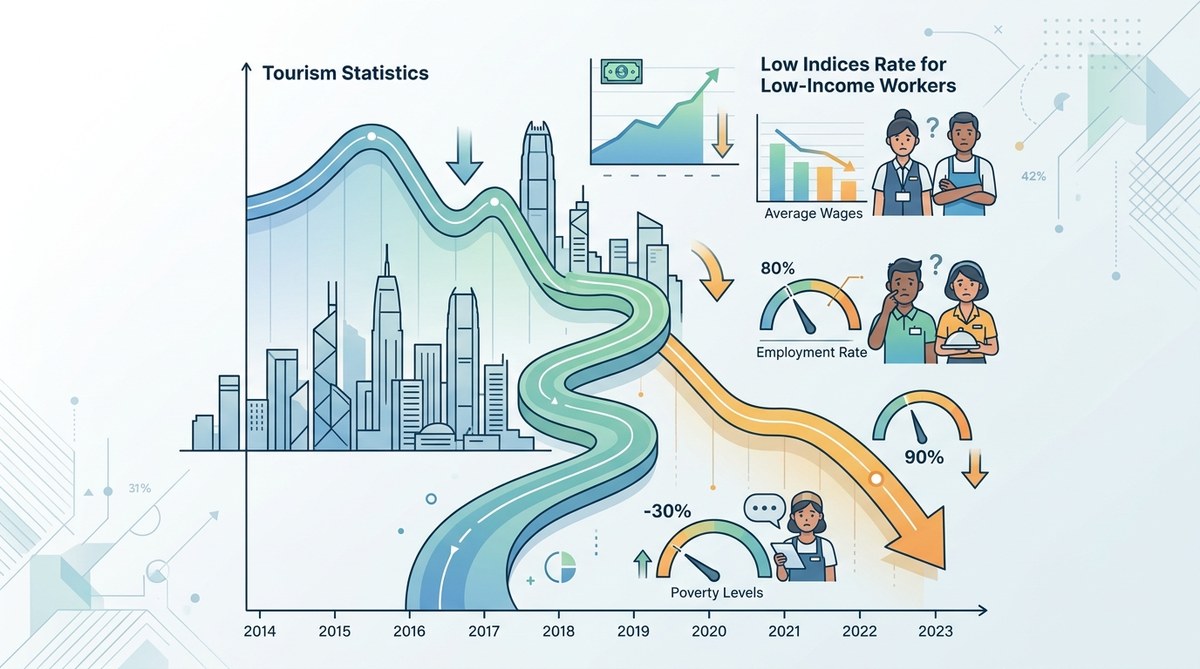
How Hong Kong’s Tourism Downturn Has Affected Low-Income Workers: A Decade of Data
Between 2019 and 2021, Hong Kong lost more than 90% of its international visitor arrivals. That collapse did not affect everyone equally. The city’s low-income workers, especially those in retail, hospitality, and transportation, saw their livelihoods vanish almost overnight. And the recovery? It has been slow, uneven, and incomplete. For researchers and policy analysts tracking social welfare, this pattern raises urgent questions about economic resilience, income protection, and the hidden cost of depending on tourism as a pillar of employment. Let us look at what a decade of data actually reveals about the people who were hit hardest and what that means for the future of social policy in Hong Kong.
Hong Kong’s tourism sector saw visitor numbers drop by over 90% during the pandemic, and recovery has been uneven through 2026. Low-income workers in retail, hospitality, and transportation bore the brunt of job losses and wage cuts. Our decade-long data analysis reveals that these workers experienced slower income recovery compared to higher earners, widening inequality across the city. The Social Development Index tracks these trends to inform better policy interventions and support the most vulnerable communities.
The Tourism Collapse in Numbers
Hong Kong welcomed 56 million visitors in 2018. That number fell to just over 3.5 million in 2021. Even by 2026, annual arrivals have not returned to pre-pandemic levels. The drop was not just a temporary shock. It reshaped the labor market for an entire segment of the workforce.
The tourism sector once accounted for roughly 4.5% of Hong Kong’s GDP and directly employed over 250,000 people. Many of those jobs were held by low-income workers with limited formal education, migrants, and older employees who lacked the safety net of white-collar protections. When the visitors stopped coming, these workers had nowhere to turn.
Retail sales fell by more than 40% in 2020 alone. Hotels reported occupancy rates below 30% for extended periods. Restaurants that depended on tourist traffic closed by the hundreds. Each closure meant lost wages for dishwashers, housekeepers, sales assistants, and drivers. These were not temporary furloughs for many workers. They were permanent job losses.
Who Lost the Most?
The data from our https://socialindicators.org.hk/how-hong-kong-s-social-development-index-reveals-hidden-inequality-patterns/ shows that the tourism downturn widened existing income gaps. Low-income workers in tourism-adjacent sectors experienced income drops of 35% to 50% during the worst months. Middle and high-income workers in finance, tech, and professional services saw much smaller declines, often bouncing back within a year.
Here is a breakdown of the most affected groups:
- Retail sales workers: Over 60,000 lost jobs between 2019 and 2022. Many were women over 40 who struggled to re-enter the workforce.
- Hotel and hospitality staff: Employment in accommodation services fell by nearly 45%. Housekeeping and front-desk roles were hit hardest.
- Transportation and logistics: Taxi drivers, tour bus operators, and airport ground staff saw income cuts of 50% or more.
- Food and beverage workers: Waitstaff and kitchen helpers in tourist-heavy districts like Tsim Sha Tsui and Causeway Bay lost shifts or were let go entirely.
These workers shared a common profile. They had low educational attainment, limited savings, and weak social safety nets. Many lived in subdivided flats and relied on daily wages to cover rent and food. A few weeks without work pushed them into poverty.
Why Recovery Has Been So Uneven
One of the most troubling findings from our research is the gap in recovery speed. Higher-income workers in tourism-adjacent roles, such as marketing managers or travel agency owners, were often able to pivot to online businesses or consulting. Low-income workers could not.
A hotel housekeeper cannot work from home. A tour bus driver cannot retrain overnight. A restaurant server cannot easily switch industries without language skills or credentials. The structural barriers to mobility are steep, and the downturn made them steeper.
Our https://socialindicators.org.hk/understanding-the-working-poor-employment-statistics-that-challenge-common-assumptions/ reveals that many low-income workers who lost tourism jobs ended up in gig work or informal employment with lower pay, no benefits, and no job security. This shift from stable to precarious work is one of the most significant long-term consequences of the tourism collapse.
What the Data Misses If You Only Look at Averages
Aggregate unemployment figures for Hong Kong during the pandemic peaked at around 7.2%. That number looks bad but manageable. But averages hide the real story. The unemployment rate for low-skilled workers in tourism-heavy districts exceeded 15% in 2021. For certain demographic groups, it was even higher.
| Common Mistake in Analysis | What It Misses | Better Approach |
|---|---|---|
| Looking only at citywide unemployment averages | Hides severe localized spikes in poor districts | Disaggregate data by district and occupation |
| Comparing year-over-year GDP alone | Ignores how income is distributed across brackets | Track median wage changes by income decile |
| Measuring job recovery by total headcount | Misses a shift from full-time to part-time or gig work | Include underemployment and hours worked metrics |
| Focusing on the tourism sector only | Misses spillover effects into housing and food | Map interconnected industries and household spending |
| Using pre-pandemic trends as a baseline | Understates the depth of the shock | Use 2019 peaks as the reference point |
Three Steps Policymakers Can Take Right Now
Data alone does not solve problems. But it can guide better decisions. Based on our analysis of the past decade, here are three practical steps that could help low-income workers weather future tourism shocks.
-
Create a portable benefits system. Low-income workers in tourism often move between employers or industries. Tying health insurance, retirement contributions, and paid leave to the individual rather than the employer would provide a continuous safety net. Several cities in Asia are already testing this model.
-
Invest in reskilling programs with living stipends. Training programs only work if people can afford to attend them. Many low-income workers cannot take unpaid time off to learn new skills. Offering a modest living stipend during retraining would remove the biggest barrier to mobility.
-
Strengthen real-time labor market monitoring. The current data systems in Hong Kong lag by months or even years. A real-time dashboard that tracks hours worked, wages, and employment by district and sector would allow policymakers to target assistance before a crisis deepens. Our https://socialindicators.org.hk/what-do-20-years-of-gdp-data-reveal-about-hong-kong-s-economic-resilience/ shows how traditional economic indicators fail to capture these granular shifts.
The Role of the Social Development Index
The Social Development Index (SDI) is one of the most valuable tools for understanding how macroeconomic shocks translate into human suffering. It does not just track GDP or unemployment. It measures education access, health outcomes, housing quality, social participation, and mental well-being. When tourism collapsed, the SDI captured the cascading effects that GDP growth figures missed.
For example, the SDI showed that food insecurity rose sharply in districts with high concentrations of tourism workers. It also tracked a rise in domestic violence and mental health distress during the same period. These are the hidden costs of an economic downturn that do not show up in standard employment reports.
Researchers and policy analysts who rely solely on traditional economic indicators will miss the full picture. The SDI provides a more complete view of how social conditions change when a major industry falters. Our https://socialindicators.org.hk/7-critical-indicators-that-define-poverty-in-hong-kong-beyond-income-levels/ offers a closer look at the metrics that matter most.
What This Means for Long-Term Policy Planning
Hong Kong cannot assume that tourism will bounce back to 2018 levels. Global travel patterns have shifted. Competition from other Asian destinations has increased. And the structural weaknesses exposed by this downturn will not fix themselves.
Low-income workers who were already vulnerable before 2019 are now in a much worse position. Their savings are gone. Their skills have atrophied. Their social networks have eroded. A return to normal will not help them if the new normal does not include them.
Policy interventions need to be targeted, timely, and informed by real data. Universal programs like across-the-board tax cuts or broad stimulus payments help, but they do not reach the people who need it most. The data from the past decade is clear: the workers who suffered the most during the tourism downturn are also the ones who benefit least from blanket policies.
Using Data to Drive Better Decisions
For academic researchers, policy analysts, and journalists, the challenge is not a lack of data. It is connecting the data to the right decisions. The numbers tell a story of resilience for some and collapse for others. The question is whether we are willing to listen.
Our https://socialindicators.org.hk/how-income-inequality-in-hong-kong-has-evolved-over-three-decades/ shows that the gap between high and low earners has been widening for years. The tourism downturn did not create that gap. It just made it impossible to ignore.
A Decade of Lessons, Still Unlearned
If there is one lesson from the past ten years, it is this: economic shocks do not distribute their damage evenly. The people with the fewest resources before a crisis are the ones who carry the heaviest burden during it and struggle the longest after it.
Hong Kong’s tourism downturn was not a natural disaster. It was a predictable consequence of over-reliance on a single sector and a lack of protections for the workers at the bottom of that sector. The data exists. The tools exist. The question is whether the political will exists to act.
For anyone studying the socioeconomic impact of tourism decline on vulnerable populations, the Hong Kong case offers a decade of evidence. We know what happened. We know who was hurt. We know what might have helped. The next step is to make sure those lessons are not forgotten when the next wave of visitors arrives.
If you are researching this topic further, our https://socialindicators.org.hk/does-social-welfare-spending-reduce-poverty-analyzing-two-decades-of-evidence/ provides additional context on how welfare programs performed during this period. And for a district-level breakdown of poverty rates, https://socialindicators.org.hk/how-many-hong-kong-residents-live-in-poverty-breaking-down-the-latest-statistics-by-district-and-demographics/ offers the latest figures through 2026.
The data is here. The story is clear. The rest is up to us.

Post Comment