
How Hong Kong’s Dual Economy Is Creating a New Underclass in 2026
Hong Kong has always been a city of extremes. You can stand on a bustling Central street and see a billionaire step out of a luxury sedan while a cleaner walks past carrying a bag of rice for the week. That contrast has grown sharper in recent years. The numbers tell a story that is hard to ignore. While the financial sector and high-end services continue to boom, a growing share of the population is being left behind. This is not just about rich versus poor. It is about a structural split in the economy itself. Hong Kong’s dual economy is creating a new underclass in 2026, and the data shows it is happening faster than most people realize.
Hong Kong’s dual economy is no longer a theory. It is a measurable reality. The city’s high-skill, high-pay sector pulls away while low-skill service jobs stagnate. A new underclass is forming, defined by housing insecurity, stagnant wages, and limited access to social mobility. Our analysis of the Social Development Index shows that traditional economic indicators miss this growing divide. Understanding the data is the first step toward informed policy.
What Is a Dual Economy and Why Does It Matter Now?
A dual economy happens when one part of a city or country operates at a high level of productivity and income while another part lags behind. Think of it like two different cities sharing the same postal code. In Hong Kong, the high end includes finance, law, tech, and international trade. These industries pay well and attract global talent. The low end includes retail, hospitality, cleaning, security, and delivery services. These jobs have not seen the same wage growth.
In 2026, the gap between these two worlds is wider than it has been in decades. The top 10 percent of earners now make more than 40 times what the bottom 10 percent earn. That ratio has grown steadily since 2010. The middle class is shrinking. More people are falling into low-wage work, and they are staying there.
How the Dual Economy Creates a New Underclass
The term “underclass” can sound harsh, but it describes a real condition. It refers to people who are not just poor but are structurally disconnected from the mainstream economy. They work, often full time, but cannot earn enough to cover basic needs. They have little access to savings, healthcare security, or upward mobility.
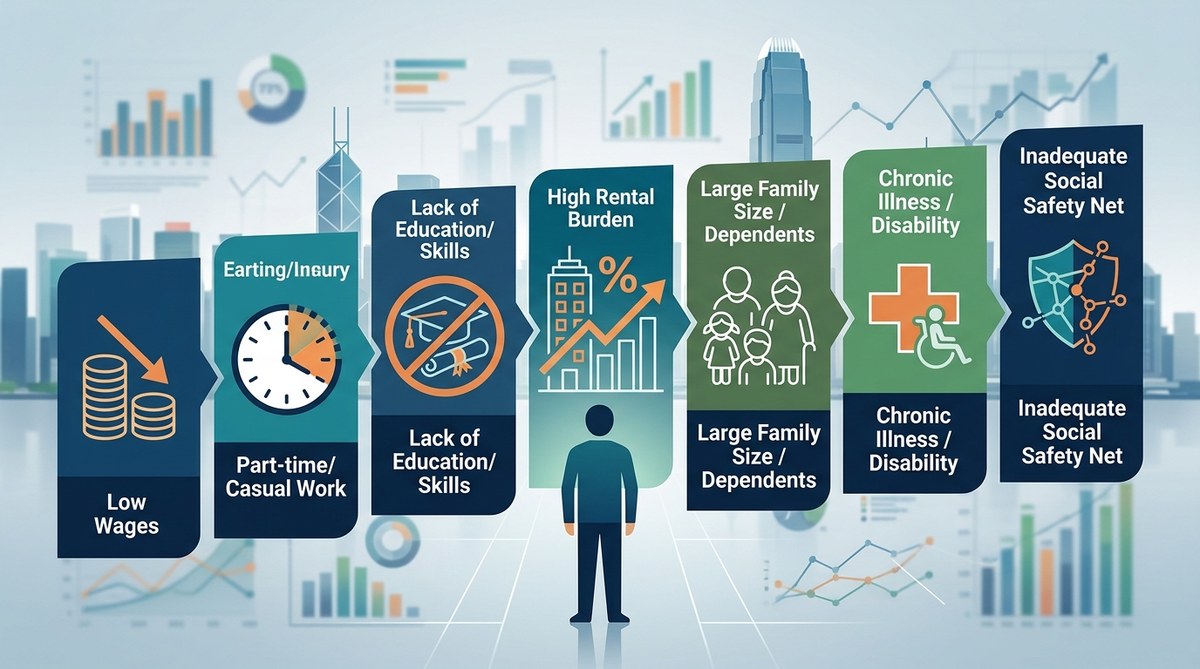
Hong Kong’s dual economy feeds this underclass in three specific ways.
1. Wage Stagnation in Low-Skill Sectors
Wages for service workers have barely budged in real terms over the past decade. Meanwhile, the cost of rent, food, and transportation has climbed. A security guard or a retail assistant in 2026 earns about the same as they did in 2016 when you adjust for inflation. That means they are effectively getting poorer each year.
2. Housing Costs That Lock People Out
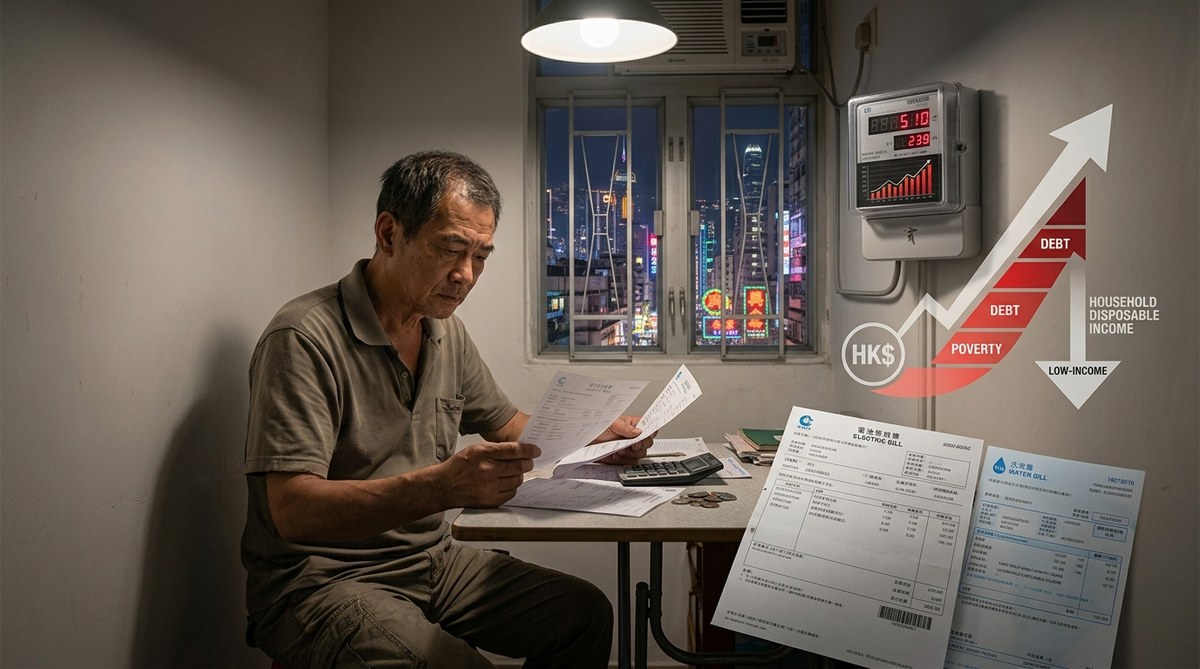
Housing is the biggest driver of the underclass crisis. Private rental costs have risen faster than wages for 15 years straight. Public housing wait times stretch past five years. Many low-income workers end up in subdivided flats, also known as nano flats or cage homes. These spaces are small, poorly ventilated, and expensive per square foot. The stress of housing insecurity affects health, family stability, and job performance.
3. Limited Access to Social Safety Nets
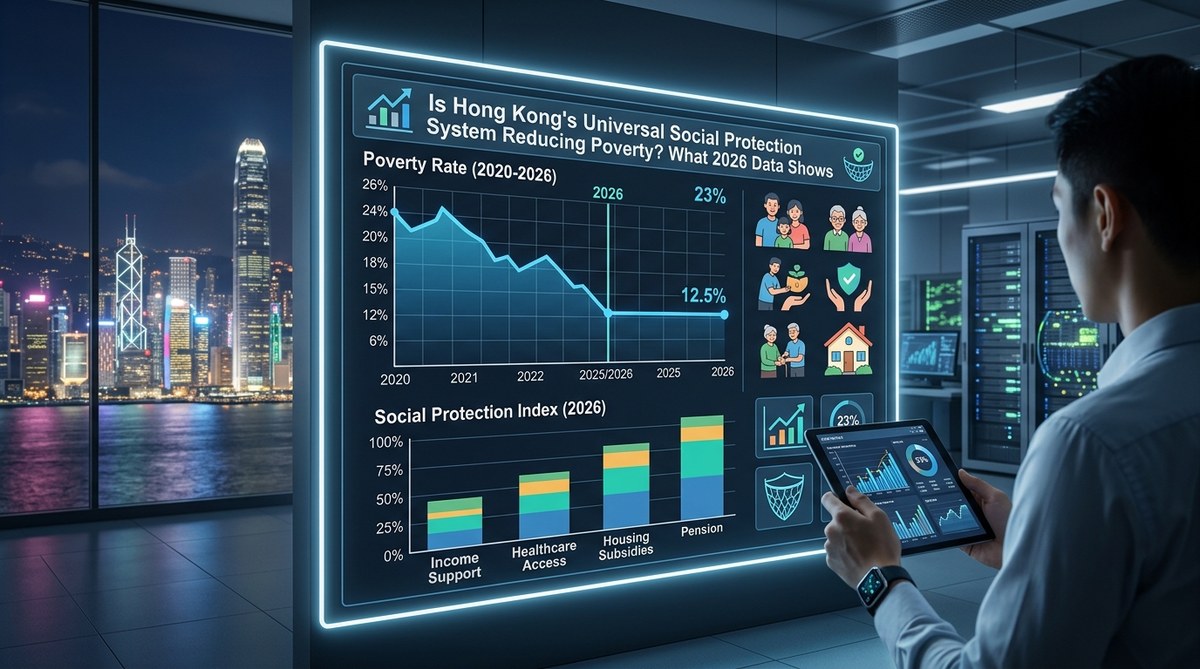
Hong Kong’s welfare system is lean compared to other developed economies. There is no universal retirement pension. Healthcare is subsidized but public hospitals are overcrowded. Childcare support is minimal. When a low-income worker gets sick or loses a job, there is very little buffer. That lack of a safety net keeps people trapped in the underclass.
Key Indicators That Reveal the Growing Divide
To understand the dual economy, you need to look beyond average income. The average hides the split. Here are the indicators that matter most.
| Indicator | What It Shows | Trend Since 2015 |
|---|---|---|
| Gini coefficient | Income inequality | Rising steadily |
| Real wage growth (bottom decile) | Purchasing power for lowest earners | Near zero |
| Median rent to income ratio | Housing burden | Above 50 percent |
| Public housing wait time | Access to affordable shelter | Lengthening |
| Working poor rate | Employed but below poverty line | Increasing |
| Gig economy share | Precarious work | Growing |
These numbers paint a clear picture. The economy is growing, but the benefits are not trickling down. They are concentrating at the top.
Three Forces That Are Accelerating the Crisis in 2026
The dual economy is not a static problem. It is getting worse. Here are three forces that are speeding up the creation of a permanent underclass.
-
Automation and job polarization. Middle-skill jobs are disappearing. Bank tellers, data entry clerks, and administrative assistants are being replaced by software. The new jobs that replace them are either high-skill (requiring degrees and certifications) or low-skill (requiring little training but offering low pay). The middle rung of the ladder is being removed.
-
The shift to a service and gig economy. More workers are in part-time, temporary, or gig roles. These jobs offer no benefits, no paid leave, and no job security. A delivery rider in 2026 may work 60 hours a week and still earn below the poverty line. The gig economy looks flexible, but for many it is just precarious.
-
Population aging and caregiving burdens. Hong Kong has one of the fastest aging populations in Asia. Older workers are often pushed out of higher-paying jobs and into low-wage roles. Younger workers are increasingly responsible for caring for elderly parents, which limits their ability to move, train, or take risks. This creates a cycle of poverty that spans generations.
What the Social Development Index Tells Us
The Social Development Index (SDI) tracks more than just GDP. It measures health, education, housing, social participation, and personal safety. In recent years, the SDI has shown a troubling pattern. While the city’s economic indicators look strong, the social indicators are flat or declining.
For example, the SDI sub-index for housing affordability has dropped every year since 2018. The education sub-index shows growing gaps between wealthy and low-income districts. The health sub-index reveals that low-income residents face longer wait times and worse outcomes.
These are not random fluctuations. They are the fingerprints of the dual economy. The high-end sector pulls the economic numbers up, but the social fabric is fraying.
“When you only measure GDP, you miss the story. The Social Development Index shows us that Hong Kong is not becoming a better place for everyone. It is becoming a better place for a smaller group of people. That is the definition of a dual economy.” — Dr. Emily Ng, Social Policy Researcher at the University of Hong Kong
How to Spot the Underclass in the Data
If you are a researcher, journalist, or policy advocate, you need to know where to look. The underclass is not always visible in headline statistics. Here is a practical checklist for identifying the dual economy effect in any dataset.
- Look at the bottom quartile, not just the average.
- Track real wages after housing costs.
- Measure the share of households spending more than 50 percent of income on rent.
- Monitor the growth of part-time and gig employment as a share of total jobs.
- Compare health outcomes by district, not just city-wide averages.
- Check the poverty rate among employed people, not just the unemployed.
When you apply these filters, the dual economy becomes obvious. The underclass is not a small group. It is a growing segment of the population that is working hard but falling behind.
A Practical Process for Analyzing the Dual Economy
If you want to apply this framework to your own research or reporting, here is a step-by-step approach.
- Start with the Gini coefficient. This measures income inequality across the whole population. A rising Gini confirms the split is getting worse.
- Pull wage data by decile. Compare the top 10 percent to the bottom 10 percent. Look at real wages, not nominal.
- Calculate the housing cost burden. For each income decile, find out what share of income goes to rent. Anything above 40 percent is a red flag.
- Examine employment composition. What share of jobs are full-time, part-time, or gig? Is the middle shrinking?
- Cross-reference with the Social Development Index. Look at the sub-indices for housing, health, and education. Are they moving in the same direction as GDP?
- Check district-level data. Inequality often hides behind city averages. Break the numbers down by district to see the real picture.
This process will give you a clear, data-driven view of the dual economy and the underclass it creates.
Common Misconceptions About Hong Kong’s Economic Divide
There are several myths that make it harder to understand the problem. Let’s clear them up.
- Myth: The working poor are just lazy. The data shows the opposite. Most of the underclass works full time. They are stuck in low-productivity jobs with no room for advancement.
- Myth: Economic growth will fix everything. Growth alone does not help if it is concentrated in one sector. Hong Kong’s GDP has grown, but the underclass has grown too.
- Myth: Welfare is generous enough. Hong Kong spends less on social welfare than most comparable cities. The safety net has too many holes.
- Myth: The underclass is temporary. The data shows that people are staying in low-income brackets for longer. Mobility is declining, not improving.
Why This Matters for Policy and Advocacy
The dual economy is not just an academic concept. It has real consequences. Children growing up in the underclass face worse educational outcomes. Older workers face poverty in retirement. The health system is strained by people who delay care because they cannot afford it.
If you are a policymaker or advocate, the data gives you a clear target. You need to address housing affordability, wage growth at the bottom, and social safety net expansion. You also need to track the right indicators. If you only watch GDP and unemployment, you will miss the crisis.
For a deeper look at how these trends have evolved, check out our analysis of how income inequality in Hong Kong has evolved over three decades. It puts the current moment in historical context.
What Comes Next for Hong Kong’s Underclass
The trends are clear, but they are not inevitable. Policy choices can change the direction. The first step is recognizing that the dual economy exists and that it is creating a permanent underclass. The second step is using the data to design targeted interventions.
We also recommend reading our piece on 7 critical indicators that define poverty in Hong Kong beyond income levels. It gives you the tools to measure what really matters.
Turning Data Into Action
The numbers are not just for researchers. They are for anyone who cares about the future of Hong Kong. If you are a journalist, use the data to tell better stories. If you are a policy analyst, use it to build better arguments. If you are a concerned resident, use it to ask harder questions of your representatives.
The dual economy will not fix itself. But with clear data and honest conversation, we can start to close the gap. The underclass does not need pity. It needs policy that works. And policy that works starts with understanding the numbers.

Post Comment