How Income Inequality Shapes Educational Outcomes in Hong Kong Schools
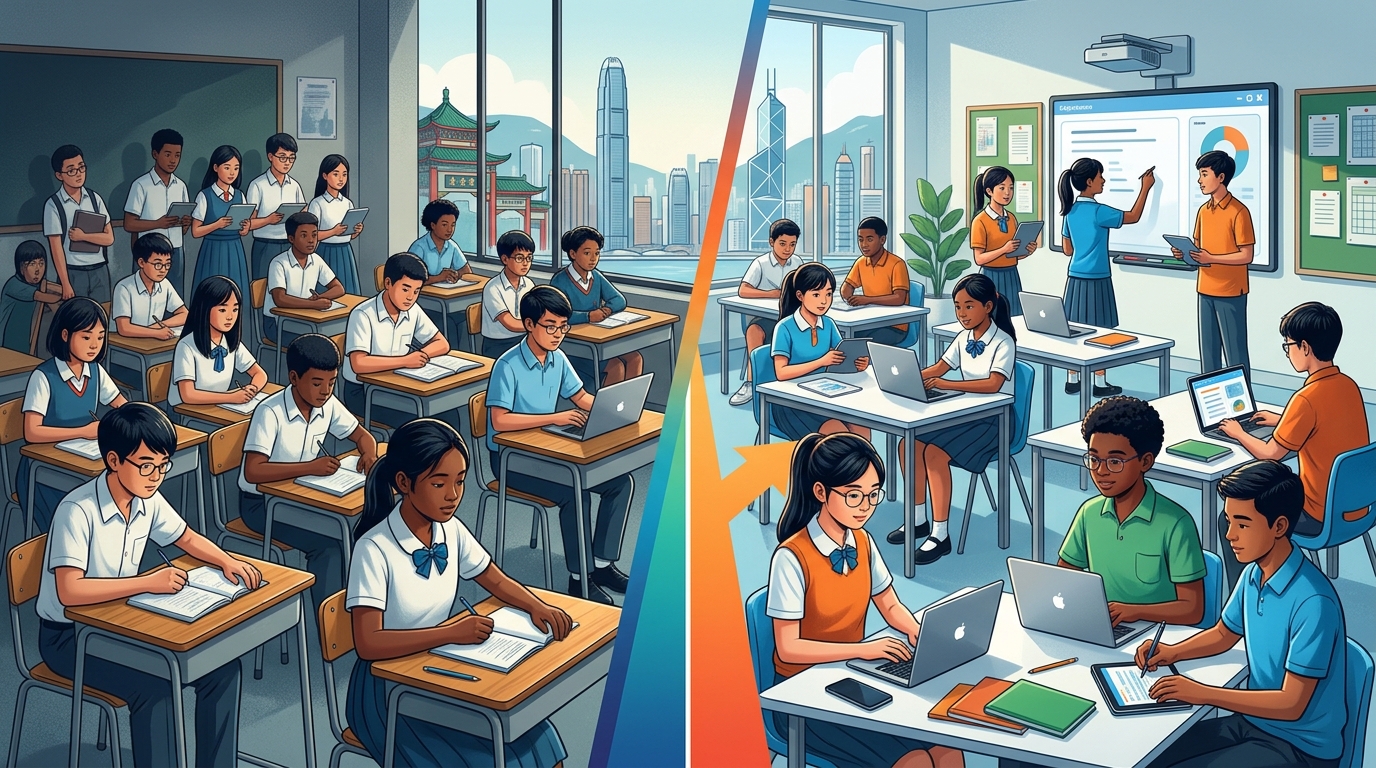
Family income determines more than just housing quality or vacation destinations in Hong Kong. It shapes which schools children attend, what tutoring they receive, and ultimately their academic performance. The city’s education system reflects broader wealth divides, creating parallel tracks where students from different economic backgrounds experience vastly different schooling conditions.
Hong Kong’s education outcomes correlate strongly with household income, creating persistent achievement gaps between wealthy and low-income students. Children from families earning below median income face limited access to tutoring, extracurricular programs, and quality learning environments. These disparities compound across grade levels, affecting university admission rates and career trajectories. Understanding these patterns helps researchers and policymakers design interventions that address systemic barriers rather than individual deficits.
The wealth gap starts before kindergarten
Educational disparities emerge long before children enter primary school. Families with higher incomes invest substantially in early childhood education, enrolling toddlers in language programs, music classes, and pre-kindergarten preparation courses. These early investments create cognitive advantages that persist throughout schooling.
Data from the Census and Statistics Department shows that families in the top income quartile spend three times more on educational services compared to bottom quartile households. This spending gap translates directly into school readiness. Children from affluent families typically enter Primary 1 with larger vocabularies, stronger numeracy skills, and better social adjustment.
The situation intensifies as children progress through school. Wealthier families can afford private tutoring, which has become nearly universal among middle and upper-class students. Shadow education spending now exceeds what many families pay for housing, creating a parallel education system accessible only to those who can afford it.
Measuring the achievement divide across income levels
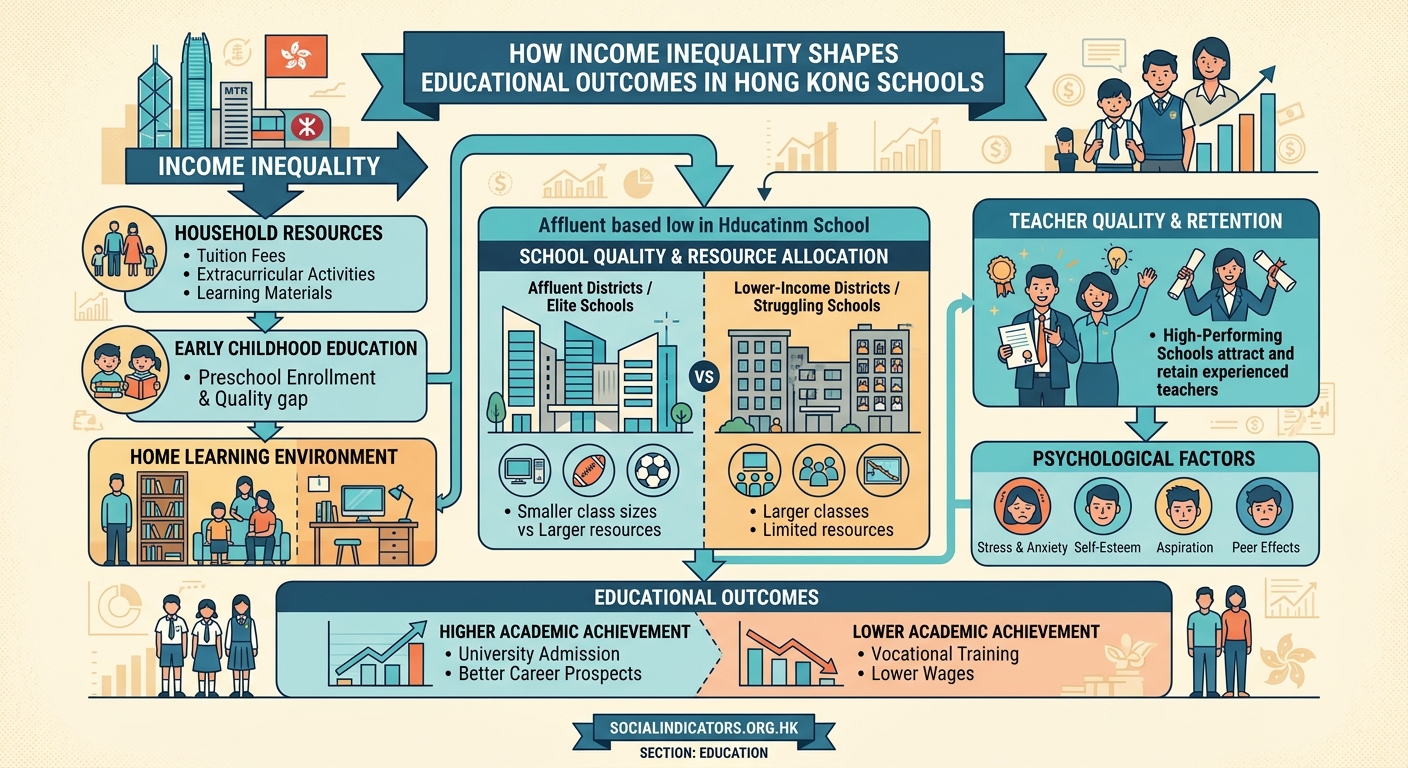
Standardized assessment data reveals consistent patterns. Students from households earning above HK$50,000 monthly score significantly higher on Territory-wide System Assessments compared to peers from families earning below HK$20,000. The gap appears across all subjects but proves especially pronounced in English language proficiency.
| Income Bracket | Average TSA Score | Private Tutoring Rate | University Admission Rate |
|---|---|---|---|
| Below HK$20,000 | 52% | 38% | 24% |
| HK$20,000 to HK$40,000 | 68% | 71% | 42% |
| Above HK$50,000 | 84% | 93% | 71% |
These numbers tell a stark story. Higher family income correlates with better test performance, greater access to supplementary education, and substantially improved chances of university admission. The relationship holds even after controlling for parental education levels, suggesting that current financial resources matter as much as family background.
School banding reinforces these patterns. Elite Band 1 secondary schools enroll disproportionately high numbers of students from affluent neighborhoods. Geographic clustering of wealth means that catchment areas effectively sort students by family income, despite official policies promoting equal access.
How housing costs reshape educational access
Hong Kong’s housing crisis directly impacts educational outcomes. Families living in subdivided flats or public housing estates face environmental barriers that affluent families never encounter. Limited space means no dedicated study areas. Noise from neighbors disrupts homework completion. Lack of air conditioning during summer months makes concentration difficult.
These physical constraints matter more than many policymakers recognize. Students need quiet spaces for reading and homework. They benefit from having desks, adequate lighting, and comfortable temperatures. When basic environmental conditions are missing, academic performance suffers regardless of student motivation or ability.
Transportation costs add another burden. Families in remote public housing estates often cannot afford extracurricular activities that require travel to other districts. A music lesson in Central becomes inaccessible when transport costs exceed the lesson fee. Sports teams, debate clubs, and volunteer opportunities remain out of reach for students whose families cannot cover transportation expenses.
Students from lower-income families face compounding disadvantages. Limited home study space, restricted access to tutoring, fewer extracurricular opportunities, and higher stress levels all contribute to achievement gaps. Addressing these disparities requires systemic interventions that recognize how poverty constrains educational engagement at multiple levels.
Three structural factors that maintain educational stratification
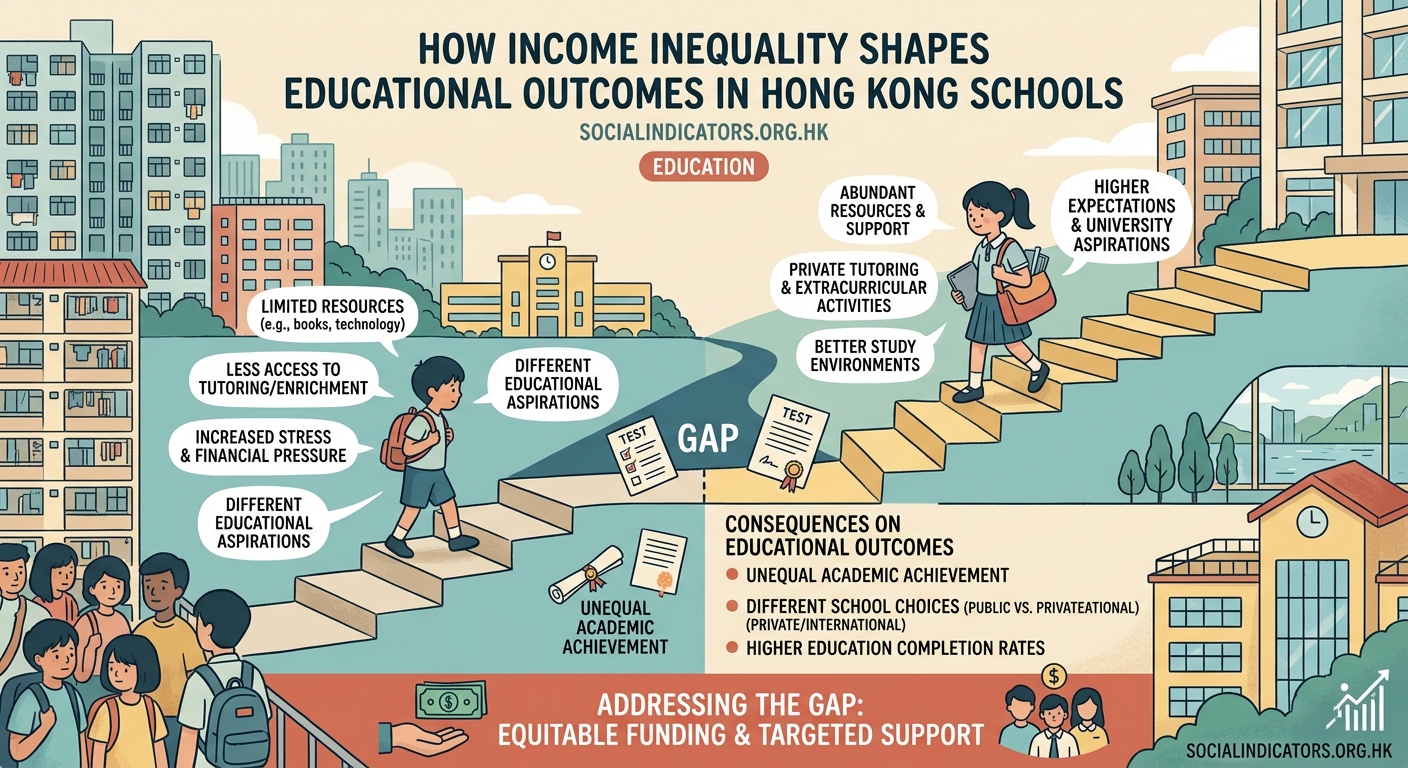
Understanding how income inequality perpetuates educational gaps requires examining specific mechanisms:
-
Differential resource allocation within schools: Even within the same school, students from wealthier families access more opportunities. They join overseas exchange programs, participate in expensive competitions, and receive teacher recommendations for special programs. Schools often assume parental financial support for activities, inadvertently excluding lower-income students.
-
Information asymmetry about pathways and opportunities: Affluent families possess detailed knowledge about school admissions, scholarship applications, and career pathways. They hire educational consultants, attend information sessions, and network with other parents. Lower-income families often lack this cultural capital, missing deadlines and opportunities simply because they did not know they existed.
-
Health and nutrition impacts on learning capacity: Food insecurity affects cognitive function. Students who skip breakfast or eat inadequate meals struggle to concentrate during lessons. Untreated dental problems, vision issues, and chronic health conditions all interfere with learning. Wealthier families address these problems immediately. Lower-income families may delay treatment due to cost concerns, allowing minor issues to become major barriers.
The private tutoring arms race
Private tutoring has transformed from supplementary support into a prerequisite for academic success. Approximately 85% of secondary students receive some form of paid tutoring. The industry generates over HK$5 billion annually, employing thousands of tutors and operating through both individual arrangements and large tutorial centers.
This system advantages wealthy students in multiple ways. They access premium tutors who charge HK$1,000 or more per hour. These elite tutors often teach at top schools, providing insider knowledge about exam formats and marking schemes. They offer personalized attention that addresses individual learning gaps.
Lower-income students who receive tutoring typically attend large group sessions at budget centers. Class sizes of 30 or more students limit individual attention. Teaching quality varies widely. The most effective tutors command premium prices, creating a tiered market where family income determines tutoring quality.
Some students receive no tutoring at all. Families earning below the poverty line cannot afford even basic tutorial services. These students rely entirely on school instruction, placing them at a significant disadvantage when competing against peers who receive extensive outside support.
Policy responses and their limitations
Government initiatives have attempted to address educational inequality with mixed results. The School Textbook Assistance Scheme provides financial support for books and supplies. Student travel subsidies reduce transportation costs. After-school care programs offer supervised study space for working parents.
These programs help but do not eliminate structural disadvantages. Textbook subsidies cover basic materials but not supplementary workbooks that tutors recommend. Travel subsidies assist with school commutes but not extracurricular activities. After-school programs provide space but often lack the individualized academic support that wealthy students receive through private tutoring.
The government has also promoted all-day schooling and expanded extracurricular offerings at public schools. These changes benefit students whose families cannot afford private programs. However, implementation varies widely across schools. Elite schools with strong parent associations offer extensive activities. Schools in low-income areas struggle to fund programs beyond basic requirements.
Some schools have adopted income-blind admissions for special programs, ensuring that financial constraints do not exclude talented students. Others provide scholarships for overseas trips or competition fees. These targeted interventions help individual students but do not address systemic inequality affecting thousands of children.
What the data reveals about long-term trajectories
Longitudinal studies tracking students from primary school through university show how early advantages compound over time. Students who attend kindergartens with strong English programs are more likely to gain admission to elite primary schools. Primary school performance determines secondary school banding. Secondary school banding largely predicts university admission.
Family income influences each transition point. Wealthy families can afford kindergartens charging HK$100,000 annually. They hire consultants to prepare children for primary school interviews. They purchase properties in catchment areas for desirable schools. Each advantage builds on previous ones, creating diverging trajectories that become increasingly difficult to alter.
The university admission gap proves especially consequential. Students from low-income families who do reach university often attend less prestigious institutions or enroll in programs with limited career prospects. They graduate with fewer professional networks, less prestigious credentials, and more limited employment opportunities. Income inequality in education thus perpetuates broader economic stratification across generations.
Comparing Hong Kong’s patterns with regional contexts
Hong Kong’s educational stratification is not unique but exhibits particular characteristics. Singapore similarly shows strong income-achievement correlations, though government intervention is more aggressive. South Korea’s private tutoring industry exceeds Hong Kong’s in both scale and intensity. Taiwan has implemented policies that reduced but did not eliminate income-based gaps.
What distinguishes Hong Kong is the combination of extreme housing costs, limited public space, and a highly competitive examination system. These factors interact to amplify how family income shapes educational outcomes. A student in public housing faces not just less tutoring but also inadequate study space, longer commutes, and fewer community resources compared to peers in private housing.
The city’s low tax rates limit government capacity to fund redistributive programs. Education spending as a percentage of GDP remains below many developed economies. This constraint means that private spending fills gaps, advantaging families with financial resources while leaving others behind.
Research methods for studying income effects on schooling
Academic researchers studying these patterns employ several approaches. Regression analysis isolates income effects from other variables like parental education or family structure. Longitudinal tracking follows cohorts over time, revealing how early disparities evolve. Qualitative interviews with students, parents, and teachers provide insights into mechanisms that quantitative data cannot capture.
Key challenges include data access and measurement validity. The Education Bureau does not publicly release detailed achievement data linked to family income. Researchers must rely on surveys, which introduce selection bias, or negotiate access to administrative records. Income measurement itself poses difficulties, as families may underreport earnings or have irregular income streams.
Despite these limitations, consistent findings emerge across studies. The income-achievement correlation appears robust across different datasets, time periods, and analytical approaches. Effect sizes vary but the direction remains clear. Family economic resources substantially influence educational outcomes in Hong Kong’s school system.
Implications for education professionals and policymakers
Teachers and school administrators can take specific actions to mitigate income-based disparities:
- Identify students who lack access to tutoring and provide targeted in-school support
- Ensure that extracurricular participation does not require substantial family spending
- Communicate opportunities clearly to all families, not just those already well-informed
- Create homework policies that recognize varying home environments
- Partner with community organizations to expand resources available to low-income students
Policymakers face more complex decisions. Expanding direct financial assistance helps but does not address underlying structural issues. Regulating the tutoring industry could reduce spending pressure but might drive services underground. Reforming examination systems could reduce the advantage that intensive test preparation provides.
Some researchers advocate for more fundamental changes. Increasing education spending would allow schools to provide services currently available only through private markets. Implementing income-blind admissions at elite schools could disrupt the concentration of advantage. Addressing housing affordability would improve home learning environments for thousands of students.
Moving from analysis to action
Understanding how income inequality shapes educational outcomes represents only the first step. The real challenge lies in designing and implementing interventions that disrupt established patterns. This requires coordination across government agencies, schools, community organizations, and families themselves.
Effective responses must address multiple levels simultaneously. Individual students need tutoring, mentoring, and material support. Schools require funding to expand programs and reduce class sizes. Communities benefit from libraries, study spaces, and after-school programs. Systemic reforms should reduce the stakes of high-pressure examinations and increase pathways to success.
The data makes clear that current patterns are neither natural nor inevitable. They result from specific policy choices, market dynamics, and institutional structures. Different choices could produce different outcomes. Hong Kong possesses the economic resources to ensure that family income does not determine educational opportunity. What remains uncertain is whether the political will exists to make that commitment real.
Research continues to document disparities and evaluate interventions. Education professionals work daily to support students facing economic barriers. Policymakers debate reforms and allocate budgets. Parents advocate for their children and their communities. Progress requires all these efforts working together, informed by evidence about what actually works to reduce inequality.
The students sitting in classrooms today will shape Hong Kong’s future. Their potential should not be constrained by circumstances beyond their control. Creating a more equitable education system benefits not just individual children but the entire society. It represents both a moral imperative and a practical investment in collective prosperity.


Post Comment