
Income Inequality Across Generations: A Statistical Portrait of Hong Kong’s Age Divide
Young professionals in Hong Kong face a vastly different economic reality than their parents did at the same age. The gap between what a 25-year-old earns today compared to a 55-year-old reveals stark patterns about wealth accumulation, housing access, and financial security across generations. Understanding these patterns matters for everyone, from policymakers crafting social programs to families planning their financial futures.
Income inequality in Hong Kong varies dramatically by age group, with older workers holding significantly more wealth than younger cohorts. Those aged 45-64 control the highest median incomes, while workers under 35 face stagnant wages and rising costs. This generational divide affects housing affordability, retirement security, and social mobility, creating distinct economic experiences across different life stages that require targeted policy responses.
How age shapes income distribution in Hong Kong
Age determines more than just your career stage in Hong Kong. It fundamentally shapes your earning potential, wealth accumulation, and economic security.
The relationship between age and income follows a predictable curve in most economies. Workers typically earn less at the start of their careers, peak in middle age, then see incomes decline approaching retirement. Hong Kong follows this pattern, but with extreme variations that set it apart from other developed economies.
Data from the Census and Statistics Department shows median monthly employment earnings increase steadily from age 25 to 54, then plateau or decline. But the story gets more complex when you examine income inequality within each age bracket.
Younger workers face a compressed earnings range. Most entry-level positions cluster around similar salary bands, creating relatively low inequality among those under 30. The Gini coefficient, a standard measure of inequality where 0 represents perfect equality and 1 represents maximum inequality, sits lower for this age group than for any other.
Middle-aged workers show the highest income inequality. By ages 45-64, career trajectories have diverged dramatically. Some individuals have climbed to executive positions or built successful businesses. Others remain in positions with modest wage growth. This creates a wide income distribution within the same age cohort.
Retirees present a different pattern entirely. Those over 65 often rely on savings, pensions, and family support rather than employment income. This group shows high inequality because some retirees have substantial investment income while others depend entirely on government assistance.
Breaking down earnings by generation
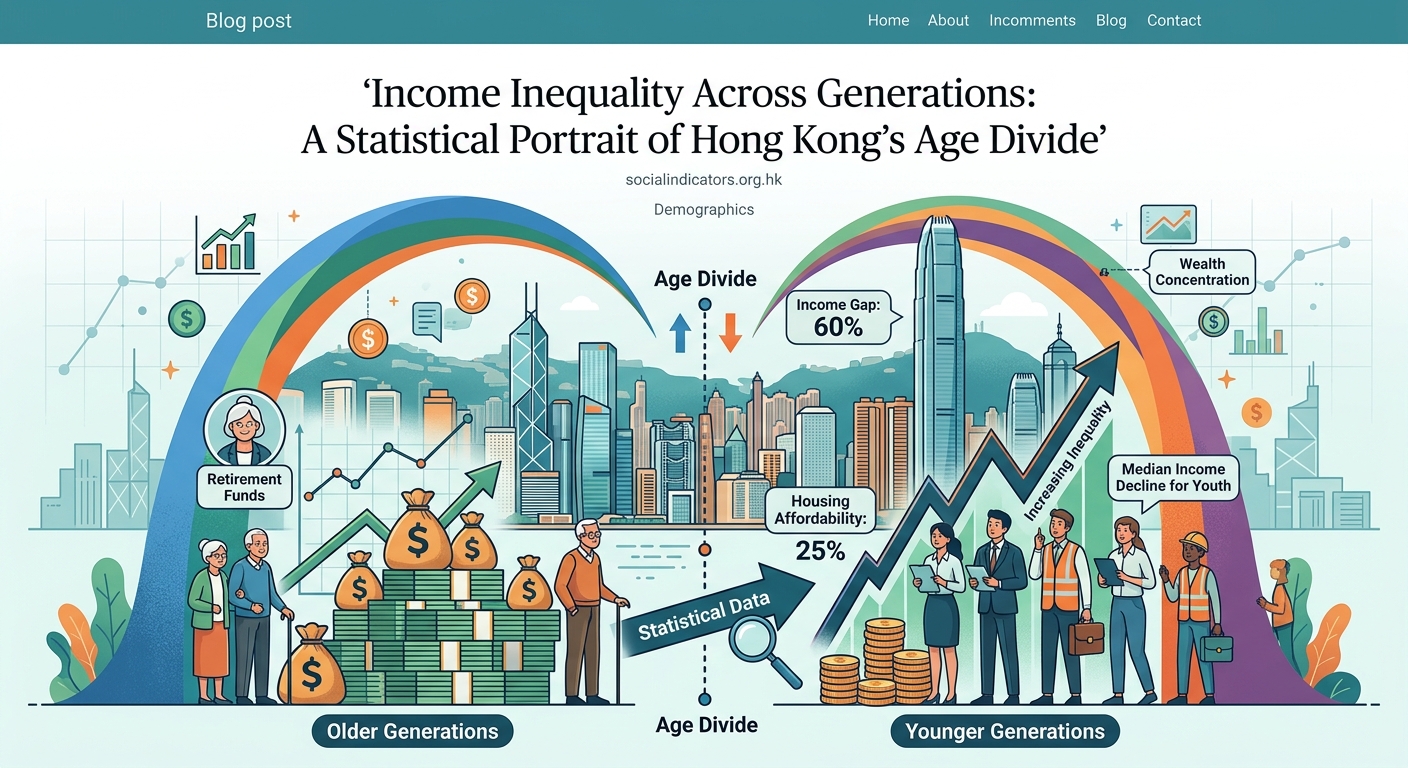
Generational cohorts in Hong Kong experienced fundamentally different economic conditions during their formative working years. These experiences shape current income patterns.
Baby Boomers, now in their 60s and 70s, entered the workforce during Hong Kong’s manufacturing boom and subsequent transformation into a financial hub. Many purchased property when prices remained accessible relative to incomes. This generation accumulated wealth through both rising salaries and asset appreciation.
Generation X workers, currently in their 40s and 50s, caught the tail end of rapid economic growth. They faced higher property prices than their predecessors but still found homeownership achievable for many. This cohort now occupies senior positions across industries, contributing to their higher median incomes.
Millennials and Generation Z workers confront a transformed landscape. Property prices have soared beyond the reach of most individual earners. Wage growth has slowed even as living costs continue rising. These younger cohorts earn less in real terms than previous generations did at the same age, after adjusting for inflation and cost of living.
Consider these income realities across age groups:
- Workers aged 25-34 earn a median monthly income approximately 40% lower than those aged 45-54
- The top 10% of earners aged 50-59 make over 8 times what the bottom 10% in their age group earn
- Young workers under 30 spend a higher percentage of income on housing than any previous generation did at that age
- Retirement savings rates have declined among workers under 40 compared to previous cohorts
The housing factor in generational wealth gaps
Property ownership represents the single largest driver of wealth inequality between age groups in Hong Kong. Real estate prices have increased far faster than wages over the past three decades.
Older Hong Kong residents who purchased property in the 1980s or 1990s now own assets worth many multiples of their original purchase price. A flat bought for HK$500,000 in 1990 might now sell for HK$5 million or more. This appreciation created substantial wealth for those who bought early.
Younger workers face a completely different scenario. The same property that cost 5 times the annual median income in 1990 might now cost 20 times the annual median income. This makes homeownership unattainable for many without family assistance.
This creates a self-reinforcing cycle. Older property owners can leverage their equity for investments, business ventures, or helping their children. Those without property wealth struggle to accumulate assets while paying high rents that prevent saving.
The impact extends beyond individual balance sheets. Generational wealth gaps affect social mobility, family formation decisions, and retirement security across different age cohorts.
Measuring inequality within and between age groups
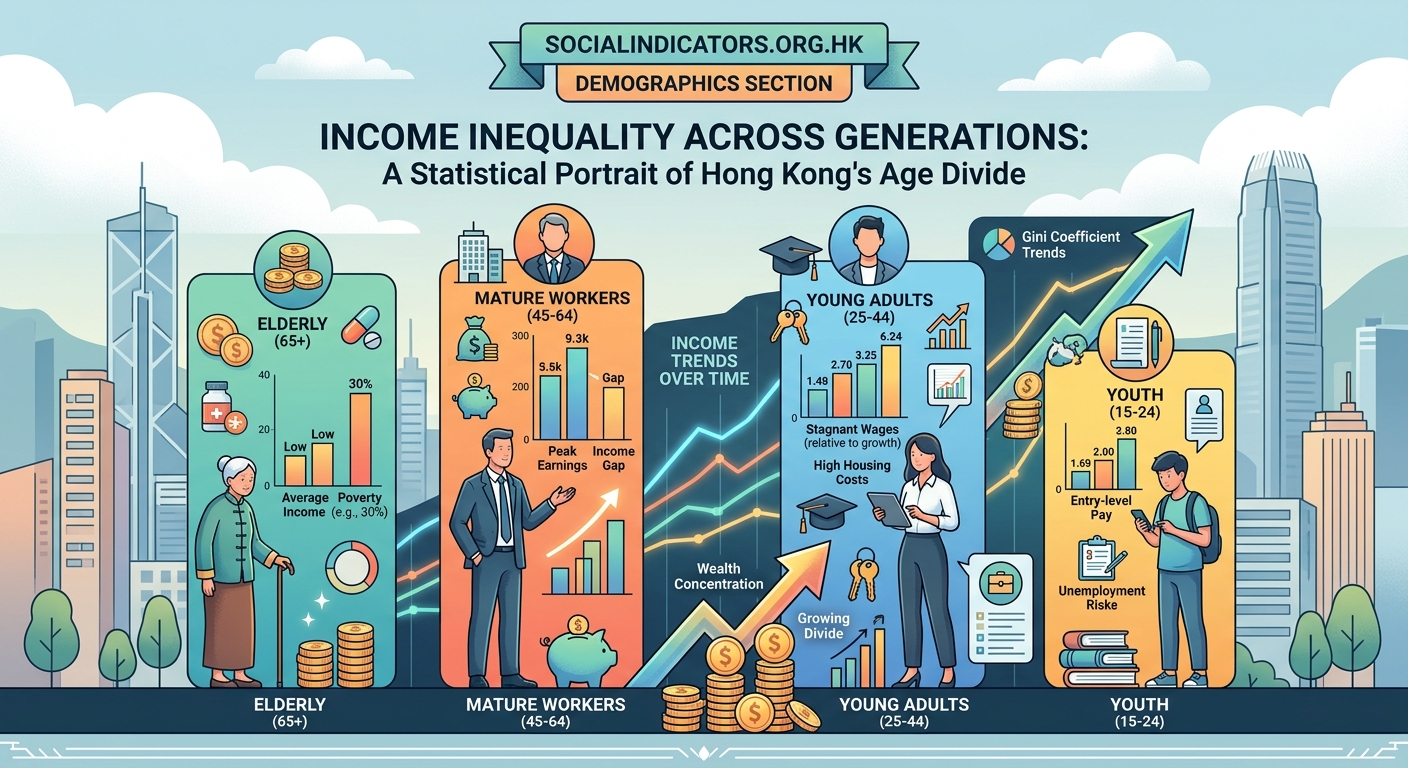
Standard inequality metrics reveal different patterns when applied to age-specific populations versus the overall population.
| Metric | Overall Population | Ages 25-34 | Ages 45-54 | Ages 65+ |
|---|---|---|---|---|
| Gini Coefficient | 0.539 | 0.412 | 0.487 | 0.623 |
| Income Ratio (Top 10% to Bottom 10%) | 43.9 | 12.3 | 31.7 | 89.4 |
| Median Monthly Income (HKD) | 18,400 | 16,500 | 27,000 | 8,200 |
These numbers tell several stories simultaneously. The overall Gini coefficient of 0.539 places Hong Kong among the most unequal developed economies. But breaking this down by age reveals that inequality concentrates heavily in older age groups.
Young workers show relatively compressed income distributions because most work in entry or junior positions. Career differentiation has not yet occurred. A 28-year-old accountant and a 28-year-old marketing coordinator might earn similar amounts despite working in different fields.
Middle-aged workers display moderate inequality. Career paths have diverged, but most remain in the workforce with regular employment income. The spread widens but remains bounded by labor market conditions.
Elderly populations show extreme inequality. Some retirees live comfortably on pensions, rental income, and investment returns. Others survive on minimal government support. This creates the widest income distribution of any age group.
Policy responses to age-based income gaps
Government programs in Hong Kong increasingly recognize that different age groups face distinct economic challenges requiring tailored interventions.
For younger workers, policies focus on education subsidies, startup support, and affordable housing initiatives. The Home Ownership Scheme provides below-market-rate flats for first-time buyers, though demand far exceeds supply. Youth employment programs aim to improve job matching and skills development.
Middle-aged workers benefit from continuing education programs and retraining schemes. The Employees Retraining Board offers courses for career transitions, particularly important as industries evolve and automation affects certain sectors.
Elderly residents receive support through the Comprehensive Social Security Assistance scheme, Old Age Living Allowance, and public healthcare subsidies. These programs acknowledge that many retirees have insufficient savings to maintain basic living standards.
Effective social policy must recognize that a 30-year-old facing high rents and a 70-year-old managing healthcare costs need fundamentally different support mechanisms. One-size-fits-all approaches fail to address the specific challenges each generation confronts.
Critics argue current programs remain insufficient given the scale of generational wealth gaps. Proposals for more aggressive interventions include:
- Expanding public housing supply to reduce the percentage of income younger workers spend on shelter
- Implementing progressive taxation that redistributes wealth from asset-rich older residents to income-poor younger workers
- Strengthening mandatory pension contributions to ensure current young workers accumulate adequate retirement savings
- Creating targeted wage subsidies for entry-level positions to boost youth incomes
Each approach involves tradeoffs between economic efficiency, political feasibility, and social equity.
How income patterns affect life decisions across ages
Economic realities shape major life choices differently for each generation of Hong Kong residents. These decisions then reinforce or mitigate existing inequalities.
Younger workers increasingly delay marriage and childbearing due to financial constraints. The median age of first marriage has risen steadily over the past two decades. High housing costs and economic uncertainty make family formation feel unaffordable for many in their 20s and early 30s.
Middle-aged residents face sandwich generation pressures. Many simultaneously support aging parents and adult children who cannot afford independent housing. This reduces their ability to save for retirement while also limiting how much financial assistance they can provide to younger family members.
Older residents make decisions about when to retire based partly on whether they own property. Those with mortgage-free homes can retire earlier on modest incomes. Renters often work longer out of necessity, even when health challenges make continued employment difficult.
These patterns create feedback loops. Delayed family formation among younger workers means fewer children, which affects future demographic structures and dependency ratios. Extended working lives among older residents can limit job opportunities for younger workers entering the labor market.
Data sources and measurement challenges
Understanding income inequality across age groups requires reliable data collection and careful interpretation. Several challenges complicate this analysis.
Official statistics from the Census and Statistics Department provide the most comprehensive income data. The General Household Survey collects information on employment earnings, household income, and demographic characteristics. Population censuses conducted every decade offer detailed snapshots of income distribution.
But these sources have limitations. Self-reported income data may understate earnings from informal work, investment returns, or business income. Household-level data can obscure individual income patterns, particularly in multigenerational households common in Hong Kong.
Wealth data proves even harder to collect. Income represents only one component of economic wellbeing. Asset ownership, particularly property, matters enormously for understanding generational inequality. But comprehensive wealth surveys remain rare.
Comparing income across time periods requires adjusting for inflation and changes in purchasing power. A salary that seemed generous in 1990 might barely cover basic expenses today. Real income comparisons account for these factors but depend on which price indices you use.
International comparisons face additional complications. Different countries define income categories differently, use varying survey methodologies, and have distinct social safety nets that affect disposable income.
Why generational income gaps persist and grow
Several structural factors drive widening income inequality between age groups in Hong Kong. Understanding these mechanisms helps explain why gaps prove difficult to close.
Asset price inflation outpacing wage growth creates the fundamental dynamic. Property values, stock prices, and other assets have increased far faster than employment income over recent decades. Those who owned assets early benefited from this appreciation. Those entering the market later face higher prices without proportional income increases.
Labor market changes affect different age groups unevenly. Automation and offshoring have reduced opportunities in manufacturing and routine office work, sectors that previously offered stable middle-class incomes for workers without advanced degrees. Knowledge economy jobs often require credentials and experience that favor older workers.
Educational credential inflation means younger workers need more education to access the same positions previous generations reached with less schooling. This delays earnings and increases debt for many young adults.
Tax and transfer systems in Hong Kong remain relatively light compared to other developed economies. Limited redistribution means market income inequalities translate more directly into disposable income inequalities. This affects younger workers with lower market incomes more severely.
Demographic shifts matter too. Longer lifespans mean retirement savings must stretch further. Lower birth rates mean fewer working-age adults supporting each retiree. These trends create fiscal pressures that complicate efforts to address generational inequalities.
What the numbers mean for Hong Kong’s future
Current income patterns between age groups will shape Hong Kong’s economic and social landscape for decades to come. Several trends deserve attention.
Retirement security for current young workers looks precarious. Many earn too little to save adequately while paying high housing costs. The Mandatory Provident Fund system, introduced only in 2000, will provide insufficient retirement income for many contributors. Without policy changes, elderly poverty could increase substantially as current young workers age.
Social cohesion faces pressure when different generations experience such divergent economic realities. Younger residents who see homeownership and financial security as unattainable may lose faith in existing economic arrangements. This could drive emigration among the most educated young workers.
Political implications follow economic patterns. Age-based income gaps correlate with different policy preferences. Older, wealthier residents may support policies that protect asset values and limit redistribution. Younger, income-poor residents may favor more aggressive interventions to improve affordability and opportunity.
Business and labor markets will adapt to these patterns. Companies may struggle to attract young talent if compensation packages cannot support reasonable living standards. Entrepreneurship might decline if young workers lack capital and feel unable to take risks.
Family structures continue evolving in response to economic pressures. Multigenerational households may become more common as young adults cannot afford independent housing. This affects everything from residential development patterns to caregiving arrangements.
Comparing Hong Kong to regional peers
Income inequality by age group in Hong Kong differs from patterns in other Asian economies. These comparisons provide context and suggest alternative approaches.
Singapore shows similar overall inequality levels but different age patterns. Government housing programs provide affordable homeownership for a larger share of young workers. Mandatory savings rates exceed those in Hong Kong, improving retirement security. The result is somewhat less extreme generational wealth gaps despite comparable overall inequality.
Japan faces different challenges. Decades of slow economic growth have limited wealth accumulation for all age groups. Younger workers earn less than previous generations, but older workers also saw limited wage growth. Inequality between generations remains lower, though overall prosperity has stagnated.
South Korea shows high inequality but with different drivers. Educational competition and corporate hierarchy create income gaps within age cohorts. Generational patterns exist but matter less than educational credentials and employer prestige.
Mainland Chinese cities present yet another pattern. Rapid economic growth has lifted incomes across all age groups, though inequality remains high. Property ownership creates wealth gaps, but recent price controls aim to limit speculation and improve affordability.
These comparisons suggest that Hong Kong’s specific combination of high property prices, limited social housing, light taxation, and modest redistribution creates its particular pattern of age-based inequality.
Addressing measurement and interpretation issues
Statistical analysis of income inequality by age requires careful attention to methodological choices that affect conclusions.
Should analysis focus on individual income or household income? Individual income shows clearer age patterns since it tracks personal earnings. Household income better reflects actual living standards but obscures individual age effects in multigenerational households.
How should non-employment income be treated? Investment returns, rental income, and government transfers matter enormously for retirees but less for young workers. Including these sources shows higher elderly inequality. Excluding them focuses on labor market outcomes but misses important economic resources.
What income concept matters most? Gross income, disposable income after taxes and transfers, or consumption-based measures each tell different stories. Hong Kong’s low tax rates mean gross and disposable income differ less than in high-tax economies.
How should housing costs be incorporated? Homeowners and renters face different expense structures. Two individuals with identical incomes have vastly different economic wellbeing if one owns a mortgage-free home and the other pays market rent.
These methodological choices are not merely technical details. They fundamentally shape our understanding of who faces economic hardship and what policies might help.
Making sense of the age-income relationship
Income inequality in Hong Kong cannot be understood without examining how it varies across age groups. Young workers, middle-aged professionals, and retirees face completely different economic realities shaped by when they entered the housing market, what industries they work in, and what assets they have accumulated.
The data reveals patterns that demand attention from researchers, policymakers, and citizens. Generational wealth gaps are not inevitable features of economic life. They result from specific policy choices, market structures, and historical circumstances. Different choices could produce different outcomes.
For those studying these patterns, the numbers provide a foundation for understanding how Hong Kong’s economy distributes resources across generations. For those experiencing these inequalities, the statistics validate lived experiences of financial pressure or relative security. For those crafting policy responses, age-specific data highlights where interventions might prove most effective.
The generational dimension of income inequality will only grow more important as Hong Kong’s population ages and young workers continue facing affordability challenges. Tracking these patterns over time, understanding their causes, and evaluating potential solutions remains essential work for anyone concerned with Hong Kong’s economic future.




Post Comment