
Why Hong Kong’s Healthcare Expenditure Doesn’t Match Its Population Aging Rate
Hong Kong faces a striking paradox. The city’s population is aging faster than almost anywhere else in Asia, yet healthcare expenditure remains surprisingly modest compared to other high-income economies. This mismatch raises urgent questions for policymakers, economists, and public health professionals trying to understand how the city can sustain quality care as demographic pressures mount.
Hong Kong’s healthcare spending remains low despite rapid population aging due to efficient public systems, high private sector participation, and constrained government budgets. However, rising chronic disease rates, workforce shortages, and increasing demand threaten this model’s sustainability. Understanding these dynamics is essential for crafting policies that balance fiscal responsibility with equitable access to care for an aging society.
Why Hong Kong’s aging rate outpaces its healthcare budget
Hong Kong’s elderly population, defined as those aged 65 and above, has grown from 11% in 2000 to over 20% in 2023. Projections suggest this figure will exceed 30% by 2040. Yet total healthcare expenditure as a percentage of GDP hovers around 6%, far below the OECD average of nearly 10%.
This gap reflects deliberate policy choices and structural features unique to Hong Kong. The government has historically maintained a lean public healthcare system subsidized by general revenue, not dedicated health insurance contributions. Public hospitals and clinics deliver the bulk of care at minimal cost to patients, while a robust private sector serves those willing to pay out of pocket or through employer-sponsored insurance.
The result is a dual-track system. Public facilities handle about 90% of inpatient care, but private providers dominate outpatient services and elective procedures. This division keeps government spending contained while allowing market forces to absorb demand from wealthier residents.
However, this balance is under strain. Chronic conditions such as diabetes, hypertension, and dementia are rising sharply among older adults. These diseases require long-term management, not just acute intervention, and they impose cumulative costs that current budgets struggle to accommodate.
Three factors that keep spending low
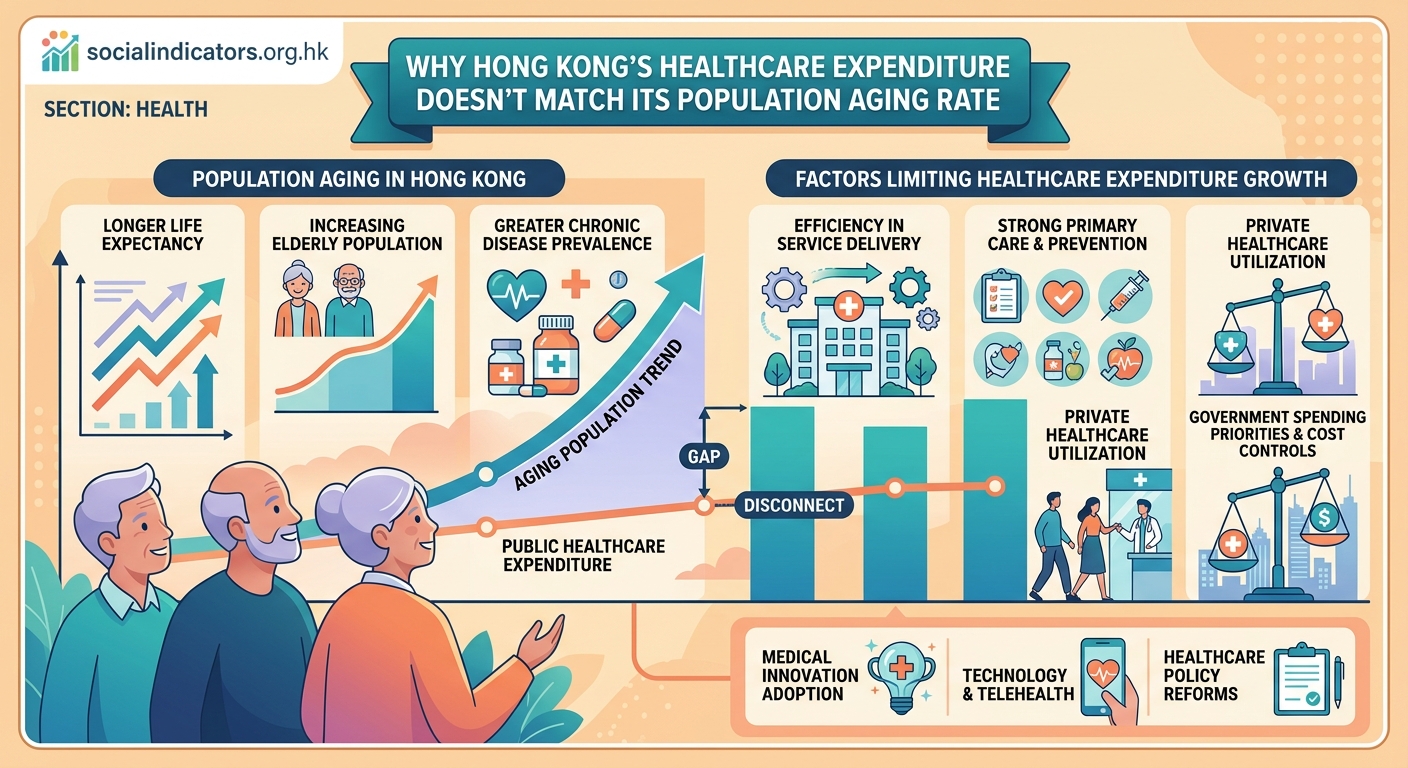
Understanding Hong Kong healthcare spending aging population dynamics requires examining the mechanisms that have historically constrained costs.
-
Subsidized public care with rationed access. Public hospitals charge nominal fees, often less than $100 per day for inpatient stays. But waiting times for non-urgent procedures can stretch to months or even years. This implicit rationing discourages overuse and shifts demand to private providers for those who can afford faster service.
-
High private insurance penetration. Roughly 30% of the population holds private health insurance, often provided by employers. These plans cover private hospital stays and specialist visits, reducing pressure on public facilities. The government recently introduced a voluntary insurance scheme to encourage more residents to buy coverage, further offloading demand.
-
Efficient resource allocation. Hong Kong’s Hospital Authority operates a centralized network of public hospitals, allowing economies of scale in procurement, staffing, and capital investment. Centralized governance also enables data-driven planning and resource reallocation across districts based on need.
These factors have enabled the city to deliver relatively good health outcomes, including high life expectancy and low infant mortality, without matching the healthcare spending levels of peers like Singapore or Japan.
Demographic pressure points
The aging population creates specific challenges that budget constraints alone cannot address.
Older adults consume healthcare at higher rates. A person over 65 typically incurs medical costs three to five times greater than someone under 40. As the elderly share of the population grows, aggregate demand rises even if per capita spending remains flat.
Chronic disease prevalence compounds this effect. Conditions such as cardiovascular disease, cancer, and cognitive decline require ongoing medication, monitoring, and rehabilitation. These services are labor-intensive and difficult to automate, meaning costs scale with patient volume.
Workforce shortages add another layer of difficulty. Hong Kong faces a persistent shortage of doctors and nurses, particularly in geriatrics and primary care. Recruiting and retaining healthcare professionals is expensive, and training pipelines take years to expand. Meanwhile, existing staff face burnout from rising caseloads and extended shifts.
Family caregiving, once a reliable buffer, is weakening. Smaller household sizes, higher female labor force participation, and geographic dispersion of families reduce the availability of informal care. This shifts more responsibility to formal healthcare and social services, which must expand capacity and funding to meet demand.
Comparing Hong Kong to regional peers
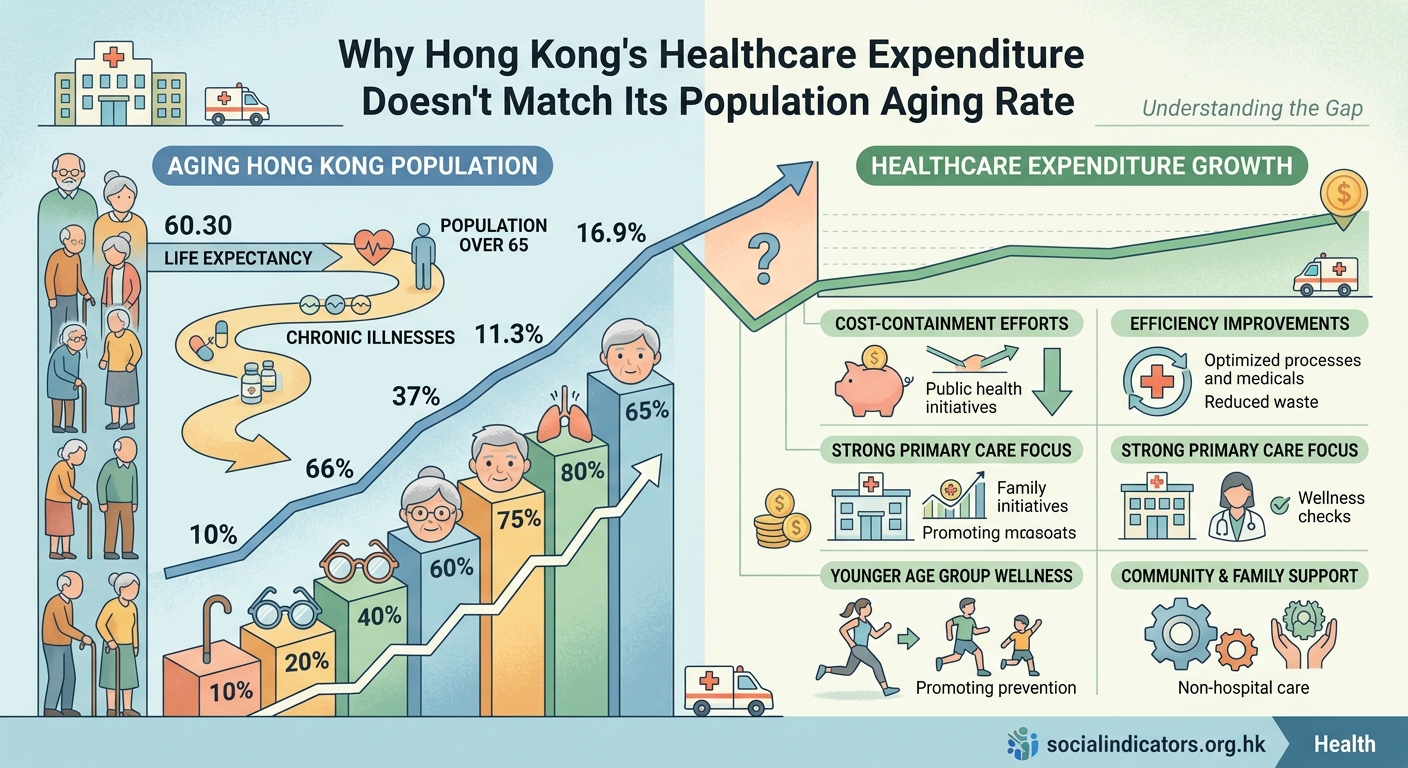
A table comparing healthcare metrics across Asian economies clarifies Hong Kong’s position.
| Economy | Healthcare spending (% GDP) | Population aged 65+ (%) | Life expectancy (years) | Public share of spending (%) |
|---|---|---|---|---|
| Hong Kong | 6.1 | 20.5 | 85.5 | 47 |
| Singapore | 4.5 | 16.8 | 83.6 | 42 |
| Japan | 11.0 | 29.1 | 84.6 | 84 |
| South Korea | 8.4 | 17.5 | 83.5 | 60 |
| Taiwan | 6.6 | 17.6 | 81.0 | 68 |
Hong Kong’s spending is modest relative to its aging rate and life expectancy. Singapore spends even less but has a younger population. Japan, with the oldest population, spends nearly double Hong Kong’s share of GDP, reflecting the fiscal burden of universal coverage for an elderly society.
The public share of spending in Hong Kong is also lower than in Japan or South Korea, indicating greater reliance on private financing. This reduces government outlays but raises equity concerns, as lower-income residents may face barriers to timely care.
Policy gaps and fiscal constraints
Hong Kong’s fiscal conservatism shapes healthcare budgeting. The government traditionally maintains budget surpluses and low taxation, with no sales tax or value-added tax. This limits revenue available for social spending, including healthcare.
Policymakers face competing priorities. Education, housing, and infrastructure also demand resources, and political pressures discourage tax increases. Healthcare spending must compete within these constraints, often losing out to more visible or politically urgent needs.
The Hospital Authority relies heavily on annual government subventions, which are subject to budget negotiations. This creates uncertainty for long-term planning and capital investment. Hospitals cannot easily borrow or raise funds independently, limiting flexibility to respond to surges in demand.
Preventive care and primary care remain underfunded relative to acute hospital services. Chronic disease management, health promotion, and community-based care receive less attention and fewer resources, even though these interventions are cost-effective over the long term.
“A healthcare system that prioritizes acute intervention over prevention and primary care will always struggle to manage an aging population efficiently. Investing upstream reduces downstream costs and improves quality of life for older adults.”
This expert perspective highlights a fundamental tension. Short-term budget pressures favor cutting preventive spending, but this choice increases future costs as untreated conditions worsen and require expensive hospital care.
How private sector dynamics influence spending
Private healthcare in Hong Kong operates largely without price regulation. Providers set fees based on market conditions, and insurance companies negotiate reimbursement rates. This creates wide variation in costs and access.
Wealthier residents bypass public waiting lists by paying for private care. This two-tier system reduces pressure on public facilities but exacerbates inequality. Those without insurance or savings face longer waits and more limited options.
The government’s voluntary health insurance scheme aims to encourage more residents to buy private coverage. The scheme offers tax deductions for premiums and mandates minimum coverage standards. However, uptake has been slower than expected, and premiums remain unaffordable for many middle-income families.
Private hospitals and clinics focus on profitable services such as elective surgery, diagnostics, and maternity care. They avoid complex or chronic cases that require sustained, low-margin care. This leaves the public sector to handle the most resource-intensive patients, including frail elderly with multiple comorbidities.
Emerging trends in healthcare demand
Several trends will shape Hong Kong healthcare spending aging population dynamics in the coming decades.
- Rising prevalence of dementia. Cognitive decline affects roughly 10% of those over 65 and 30% of those over 85. Dementia care is labor-intensive and requires specialized training, yet Hong Kong has limited geriatric psychiatry capacity.
- Increased use of technology. Telemedicine, remote monitoring, and electronic health records can improve efficiency and access. However, adoption requires upfront investment and training, which budget constraints may delay.
- Shift toward community care. Aging in place is preferred by most older adults and is often more cost-effective than institutional care. Expanding community nursing, home care, and day centers requires reallocation of resources from hospitals to primary and social services.
- Workforce internationalization. Recruiting doctors and nurses from overseas can alleviate shortages, but licensing requirements and cultural adaptation pose challenges. Policy reforms to streamline foreign credential recognition could help.
These trends present opportunities and risks. Proactive investment in preventive care, community services, and workforce development can mitigate cost pressures. Inaction risks a crisis of access and quality as demand outstrips supply.
Common mistakes in interpreting the data
Misunderstanding the relationship between healthcare spending and aging can lead to flawed policy conclusions.
| Mistake | Why it matters | Better approach |
|---|---|---|
| Assuming higher spending always improves outcomes | Spending efficiency matters more than volume | Compare outcomes per dollar, not just total spending |
| Ignoring private sector contributions | Private spending is significant but less visible | Include out-of-pocket and insurance costs in total expenditure |
| Treating aging as a distant problem | Demographic shifts unfold gradually but accelerate | Plan for peak demand decades ahead, not just current needs |
| Overlooking preventive care | Acute care dominates budgets but prevention saves money | Shift resources toward primary care and health promotion |
Avoiding these mistakes requires a holistic view of healthcare financing, delivery, and outcomes. Policymakers must balance short-term fiscal discipline with long-term sustainability.
What other economies can learn from Hong Kong
Hong Kong’s experience offers lessons for other aging societies.
The dual-track model demonstrates that public and private sectors can coexist, each serving distinct populations. However, this requires careful regulation to prevent inequality from widening. Subsidies or vouchers can help lower-income residents access private care when public waiting times are excessive.
Centralized governance of public hospitals enables efficient resource allocation and quality control. Countries with fragmented healthcare systems might benefit from greater coordination and data sharing across providers.
Fiscal conservatism has kept Hong Kong’s spending low, but it also creates vulnerability. As aging accelerates, the gap between needs and resources will widen unless revenue sources expand or spending priorities shift. Other economies should weigh the trade-offs between low taxes and adequate social investment.
Finally, Hong Kong’s high life expectancy shows that good outcomes are possible without top-tier spending. But sustaining this performance requires ongoing investment in prevention, primary care, and workforce development. Neglecting these areas risks future declines in health and rising costs.
Bridging the gap between aging and spending
Hong Kong stands at a crossroads. Its population is aging rapidly, yet healthcare spending remains constrained by fiscal policy and structural choices. This mismatch is sustainable in the short term but increasingly precarious as demographic pressures mount.
Addressing this challenge requires a multi-pronged strategy. Expanding primary care and preventive services can reduce reliance on expensive hospital interventions. Investing in workforce training and technology can improve efficiency and access. Reforming financing mechanisms, such as introducing dedicated health taxes or expanding insurance coverage, can generate revenue without undermining fiscal stability.
The data is clear. Hong Kong healthcare spending aging population trends are diverging, and the gap will widen without policy action. For researchers, economists, and public health professionals, understanding these dynamics is the first step toward crafting solutions that ensure equitable, sustainable care for all residents as the city ages.



Post Comment