How Demographic Shifts Are Reshaping Hong Kong’s Social Development Priorities
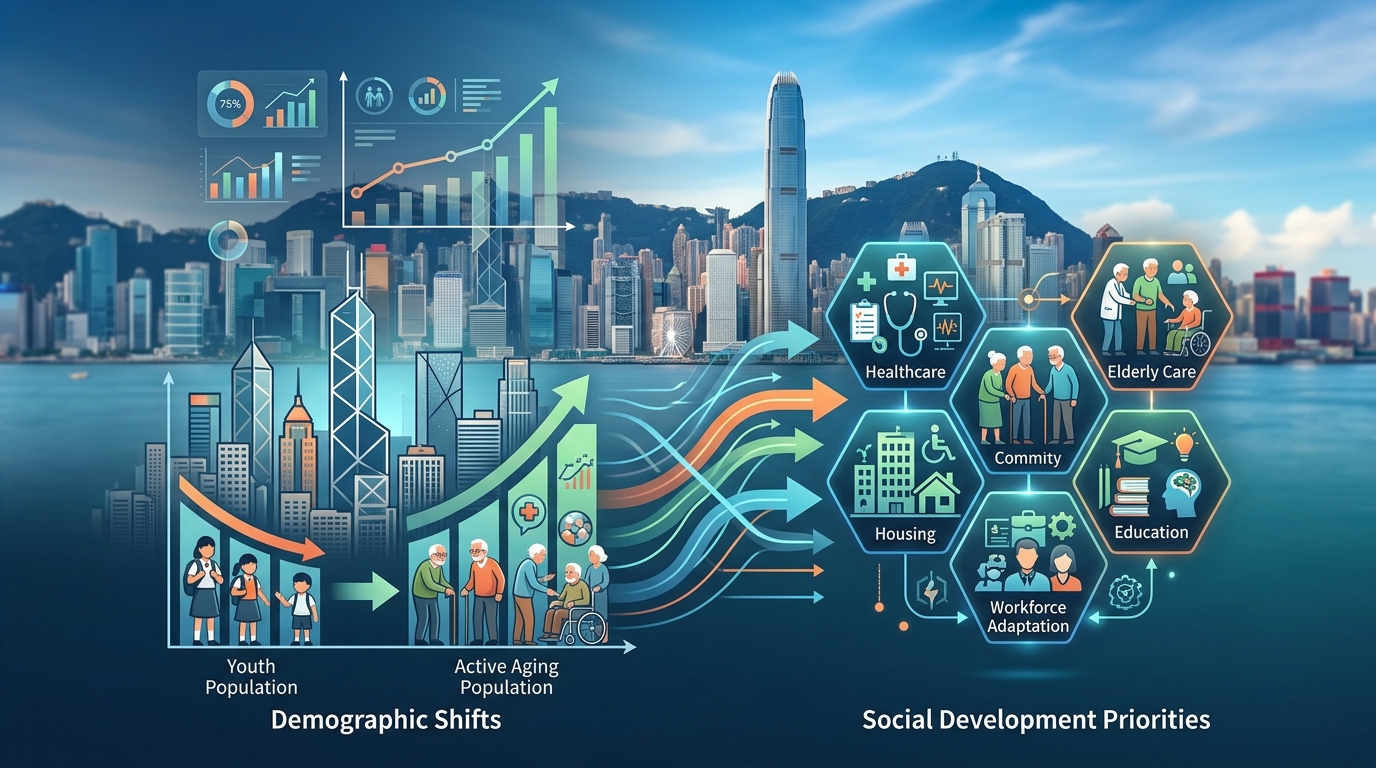
Hong Kong’s population is changing faster than most people realize. The city that once prided itself on a young, dynamic workforce now faces a stark reality: one in four residents will be over 65 by 2034. Meanwhile, emigration waves have pulled away families, professionals, and young adults. These shifts are not just statistics. They are reshaping how the government allocates budgets, designs services, and plans for the next decade.
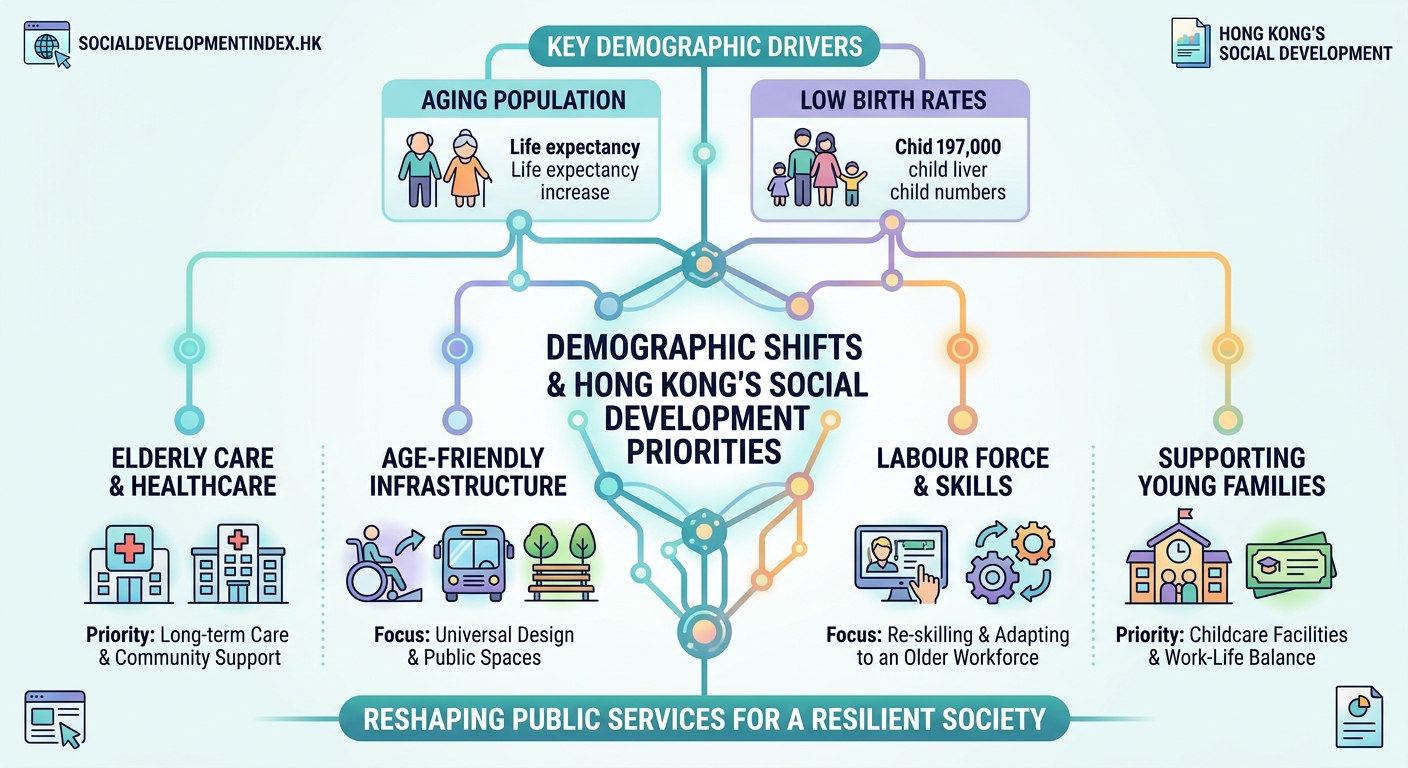
Hong Kong demographic changes social policy by forcing government agencies to redirect resources toward elderly care, adjust housing strategies for smaller households, and redesign healthcare systems. Migration outflows and low birth rates compound the challenge, making long-term planning essential. Policy makers must balance immediate needs with sustainable solutions that address workforce shortages, intergenerational equity, and service delivery gaps across all districts.
Why population structure matters for policy planning
Demographic data is not abstract. It tells you how many hospital beds to build, how many schools to close, and where to invest in transport infrastructure. When the proportion of elderly residents doubles, demand for geriatric care surges. When young families leave, childcare centers sit empty and primary schools consolidate.
Hong Kong’s fertility rate has hovered around 0.8 births per woman for years. That is one of the lowest in the world. At the same time, life expectancy continues to climb. The result is a population pyramid that looks less like a pyramid and more like an inverted funnel.
This imbalance creates pressure on three fronts: healthcare, housing, and workforce sustainability. Each of these areas requires different policy responses, but all are interconnected.
Healthcare system under strain
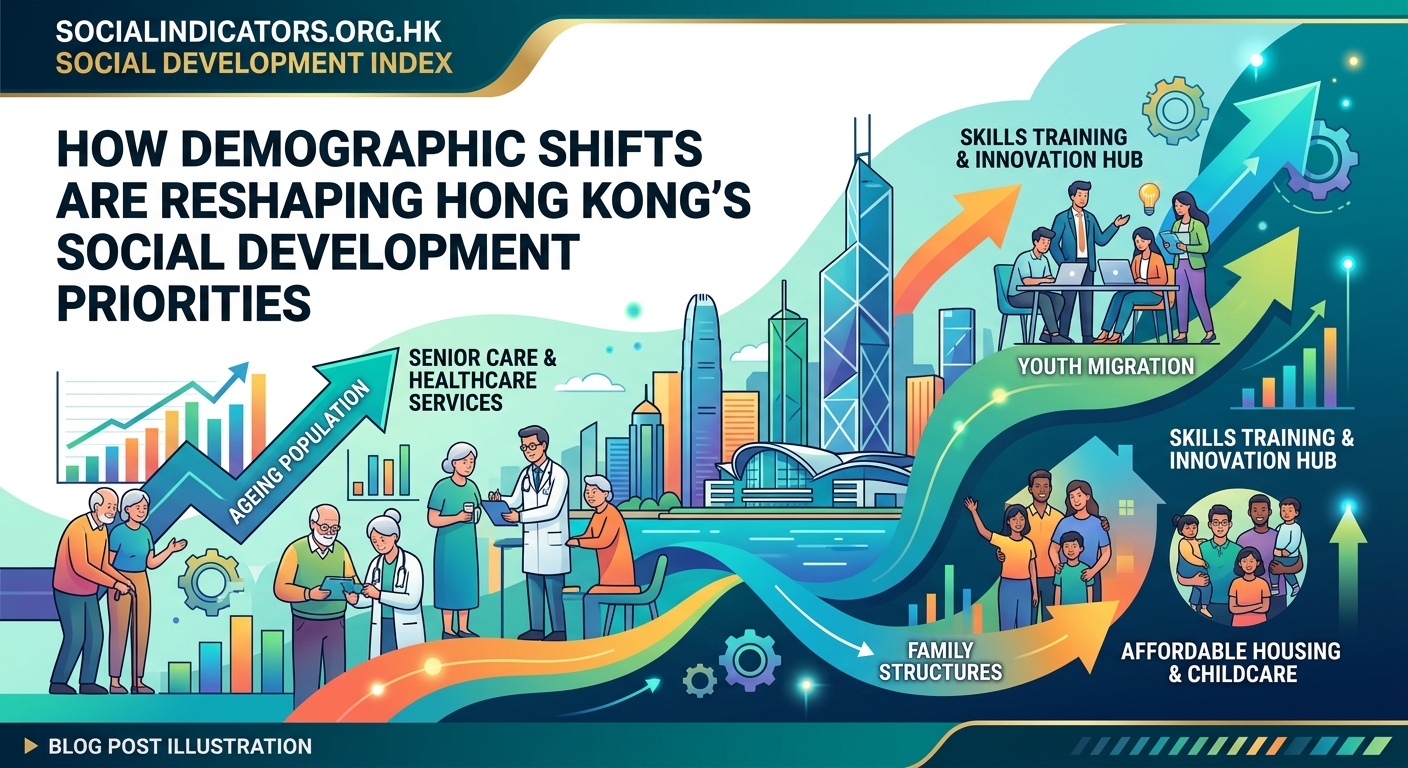
The Hospital Authority already reports longer wait times for specialist services. Elderly patients with chronic conditions need ongoing management, not just one-time treatments. The demand for long-term care beds, community health centers, and home-based nursing services is growing faster than supply.
Government spending on healthcare has increased, but the model remains reactive. Most resources go toward acute care in hospitals rather than preventive or community-based services. This approach worked when the population was younger and healthier. It does not work now.
Policy adjustments include:
- Expanding community health centers in districts with high elderly populations
- Subsidizing private nursing homes to relieve public sector pressure
- Training more geriatric specialists and allied health professionals
- Piloting telemedicine programs for remote consultations
These measures address symptoms, not root causes. The real challenge is shifting from a hospital-centric model to one that supports aging in place. That requires coordination across housing, transport, and social welfare departments.
Housing policy adapting to smaller households
Average household size in Hong Kong has dropped below 2.8 people. More elderly residents live alone or with a single adult child. Young couples delay having children or choose not to have them at all. These trends change the type of housing people need.
Large family flats are less in demand. One-bedroom and studio units are more practical. Yet public housing allocation systems still prioritize families with children. Single elderly applicants face long wait times unless they qualify for special schemes.
The government has introduced targeted programs:
- Elderly persons priority scheme for public rental housing
- Singleton elderly persons allocation for smaller units
- Reverse mortgage programs to help seniors monetize property assets
- Subsidized housing for young professionals in new development areas
Each program addresses a specific need, but coordination remains weak. An elderly resident might qualify for priority housing but find the unit located far from healthcare services. A young professional might get a subsidized flat but struggle with long commutes.
“Demographic planning is not just about building more units. It is about matching the right housing to the right people in the right locations. That requires data sharing across departments and a willingness to redesign allocation criteria.”
This quote from a recent policy forum captures the core issue. Housing policy cannot operate in isolation. It must align with transport networks, healthcare access, and employment hubs.
Workforce and economic implications
An aging population means fewer working-age residents supporting more retirees. The dependency ratio is rising. By 2040, there will be roughly two working adults for every elderly person. That is a dramatic shift from the current ratio of four to one.
This imbalance affects public finances. Pension obligations grow while tax revenue from a smaller workforce stagnates. The government faces a choice: raise taxes, cut services, or find ways to extend working lives.
Policy responses include:
- Raising the retirement age incrementally
- Offering tax incentives for employers who hire older workers
- Retraining programs for mid-career professionals
- Attracting skilled immigrants to fill labor gaps
Each option has trade-offs. Raising the retirement age helps public finances but may not suit physically demanding jobs. Immigration can fill gaps but requires infrastructure and social integration support.
Migration patterns reshaping social priorities
Emigration has accelerated since 2019. Families with school-age children, young professionals, and retirees with foreign passports have left in significant numbers. This outflow is not evenly distributed. Certain districts and age groups are more affected than others.
The impact on social services is uneven. Some schools face falling enrollment while others remain oversubscribed. Childcare centers in certain districts operate below capacity. Community centers designed for young families now serve an older demographic.
Government agencies are adjusting:
- Consolidating schools in low-enrollment districts
- Repurposing community centers for elderly services
- Offering incentives for families to return or relocate within Hong Kong
- Streamlining visa processes for talent attraction schemes
These adjustments are reactive. A more strategic approach would use demographic projections to anticipate changes and plan infrastructure accordingly. That requires better data sharing and long-term scenario modeling.
Comparing policy approaches across sectors
Different government departments respond to demographic changes with varying levels of agility. Some have adapted quickly. Others remain locked into outdated planning assumptions.
| Sector | Current Approach | Key Challenge | Adjustment Needed |
|---|---|---|---|
| Healthcare | Hospital-centric acute care | Rising chronic disease burden | Shift to community and preventive care |
| Housing | Family-focused allocation | Growing single-person households | Flexible unit sizes and priority schemes |
| Education | Fixed school network | Falling enrollment in some districts | Dynamic capacity planning and repurposing |
| Social Welfare | Means-tested assistance | Increasing elderly poverty | Universal elderly support and pension reform |
| Transport | Commuter-focused networks | Elderly mobility needs | Barrier-free access and localized services |
This table highlights a common pattern. Most sectors are adjusting incrementally rather than rethinking their core models. Incremental change helps manage immediate pressures but does not address structural mismatches.
Data-driven policy making in practice
The Social Development Index tracks multiple indicators across health, education, housing, and social cohesion. These metrics help identify which districts and populations are falling behind. They also reveal where policy interventions have the most impact.
For example, districts with high elderly populations and low healthcare access scores benefit most from new community health centers. Districts with falling school enrollment but rising elderly populations are candidates for facility repurposing.
Data alone does not drive change. It needs to inform budget allocation, regulatory reform, and cross-department collaboration. That requires political will and institutional flexibility.
Intergenerational equity as a policy lens
Demographic shifts create tensions between age groups. Elderly residents need more services but contribute less in taxes. Working-age adults face higher tax burdens and housing costs. Young people see fewer job opportunities and delayed family formation.
Policy makers must balance these competing needs. Investing heavily in elderly care without addressing youth employment and housing affordability creates resentment. Focusing only on economic growth without supporting vulnerable populations erodes social cohesion.
Effective policies consider intergenerational impacts:
- Pension reforms that ensure sustainability without cutting benefits too sharply
- Housing policies that serve both elderly residents aging in place and young families forming households
- Healthcare systems that prevent disease in younger populations while caring for older ones
- Education and retraining programs that support lifelong learning across all ages
This balance is difficult to achieve. It requires transparent communication about trade-offs and long-term commitments that survive political cycles.
District-level variations and targeted interventions
Hong Kong is not demographically uniform. Some districts have much higher proportions of elderly residents. Others have younger populations and higher birth rates. These variations mean one-size-fits-all policies often fail.
Targeted interventions work better. A district with many elderly residents living alone benefits from mobile health services and meal delivery programs. A district with young families needs affordable childcare and quality schools.
The government has begun piloting district-based approaches. These programs coordinate services at the local level and tailor interventions to specific needs. Early results show promise, but scaling these models requires sustained funding and institutional support.
Future scenarios and planning horizons
Demographic trends are relatively predictable. Birth rates, life expectancy, and migration patterns change slowly. This predictability allows for long-term planning, but only if institutions use it.
Three scenarios shape current policy debates:
-
Continued emigration: If outflows persist, the population could shrink faster than projected. This would ease pressure on housing but worsen workforce shortages and public finance challenges.
-
Stabilization: If emigration slows and birth rates edge up slightly, the population could stabilize at a lower level. This scenario still requires adjusting infrastructure and services for an older demographic.
-
Immigration-driven growth: If talent attraction schemes succeed and immigration offsets emigration, the population could grow modestly. This would ease workforce shortages but require investment in integration and infrastructure.
Each scenario demands different policy responses. Planning for multiple futures rather than betting on one outcome makes systems more resilient.
Building adaptive institutions
The real test of policy effectiveness is not whether current programs meet current needs. It is whether institutions can adapt as demographics continue to shift. That requires:
- Regular updates to population projections and service demand models
- Budget processes that allow reallocation across sectors
- Performance metrics tied to demographic outcomes
- Cross-department coordination mechanisms
- Public engagement to build support for difficult trade-offs
Hong Kong has strong technical capacity. The challenge is translating data and analysis into timely action. Political pressures, bureaucratic inertia, and competing priorities often delay necessary reforms.
Rethinking social contracts for a changing city
Demographic change is not just a technical problem. It is a question of what kind of society Hong Kong wants to be. An aging population with fewer young families requires rethinking assumptions about work, retirement, family structure, and community support.
Traditional models assumed multi-generational households and extended family care. Those structures are weakening. More people live alone. Geographic mobility separates family members. Informal support networks are thinner.
Policy must fill these gaps without creating dependency. That means investing in community infrastructure, supporting voluntary organizations, and designing services that respect autonomy and dignity.
The path forward is not about returning to the past. It is about building systems that work for the population Hong Kong actually has, not the one it used to have. That requires honesty about trade-offs, creativity in designing solutions, and commitment to long-term thinking over short-term fixes.



Post Comment