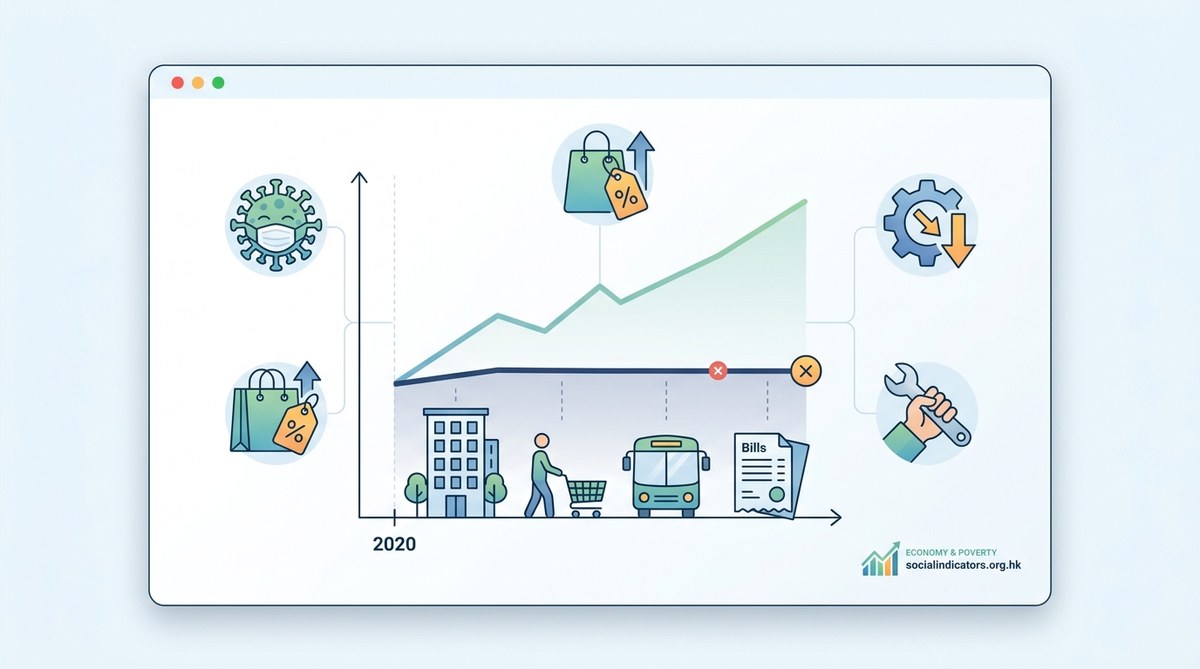
Why Hong Kong’s Disposable Income Growth Has Stalled for the Bottom 40% Since 2020
For many years, Hong Kong was a place where rising tides lifted most boats. But a closer look at the numbers reveals a troubling shift. Since 2020, the disposable income of the bottom 40% of households has essentially flatlined. This isn’t just a statistic. It means that millions of people in one of the world’s wealthiest cities are running harder just to stay in place. To understand why this is happening, we need to look past the headline GDP figures and examine the real pressures on lower-income families.
Since 2020, Hong Kong’s bottom 40% have seen their disposable income growth stall due to a perfect storm of rising housing costs, stagnant wages in service jobs, and reduced government transfers. This stagnation is widening the city’s inequality gap and threatening social mobility, making it a critical issue for policymakers and socially conscious investors alike.
The Numbers Behind the Stalled Engine
When we talk about “disposable income,” we mean the money left after taxes and mandatory payments. For the bottom 40% of earners, this figure has barely budged since 2020. While the city’s overall economy has shown signs of recovery, the benefits have not trickled down.
Consider this: between 2015 and 2019, even the lowest income groups saw modest but real gains. Their disposable income grew by roughly 1.5% per year. Since 2020, that growth has dropped to near zero. In some quarters, it has even turned negative. This is a stark contrast to the top 20% of earners, whose income has continued to climb, albeit more slowly than before.
What changed? The answer is a combination of factors that hit the poorest households hardest. Let’s break them down.
The Three Main Culprits
- Housing costs that refuse to budge: Rent is the single biggest expense for most low-income families in Hong Kong. Even with a cooling property market, rents for subdivided flats and smaller units have remained stubbornly high. Landlords, facing their own rising costs, have little incentive to lower them.
- Wage growth that can’t keep up: The jobs that employ the bottom 40% are often in retail, hospitality, and cleaning services. These sectors were devastated by the pandemic and have been slow to recover. Even as the economy reopens, wages have not returned to pre-2020 levels in real terms. A dollar today buys less than it did five years ago.
- Shrinking government support: During the pandemic, the Hong Kong government provided temporary relief measures. These included wage subsidies and one-off payments. As those programs ended, many households lost a critical buffer. The social safety net has not expanded to fill the gap.
How Housing Swallows the Raise
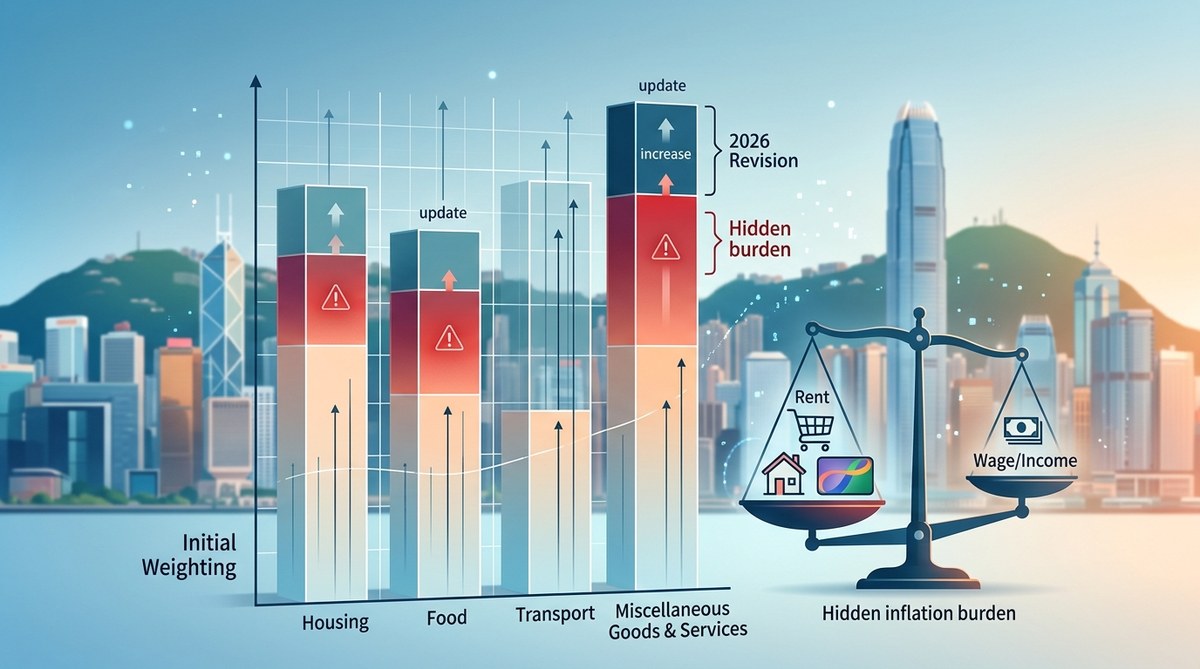
It is almost impossible to overstate the role of housing in this crisis. For a family in the bottom 40%, rent can consume 40% to 60% of their monthly income. This leaves very little for everything else: food, transportation, healthcare, and education.
Let’s look at a typical scenario. A couple working in retail and food service might earn a combined monthly income of HKD 30,000. After taxes and mandatory contributions, their disposable income is closer to HKD 25,000. A modest 400-square-foot flat in a less central district costs at least HKD 12,000 to rent. That leaves HKD 13,000 for two people to live on. Any increase in wages is instantly eaten up by a rent increase or a rise in utility costs.
This dynamic creates a poverty trap. Even if a worker gets a small raise, they cannot move to a better neighborhood or save for the future. The cost of living is a ceiling that prevents any real improvement in their standard of living.
A Practical Look at the Budget Squeeze
To see how this plays out in real life, here is a sample monthly budget for a low-income household in Hong Kong in 2026:
| Expense Category | Monthly Cost (HKD) | Percentage of Disposable Income |
|---|---|---|
| Rent (subdivided flat) | 12,000 | 48% |
| Food and groceries | 5,000 | 20% |
| Transportation | 1,200 | 5% |
| Utilities (electric, water, gas) | 800 | 3% |
| Healthcare and medicine | 500 | 2% |
| Children’s education | 1,000 | 4% |
| Total Essentials | 20,500 | 82% |
| Remaining for savings, debt, or emergencies | 4,500 | 18% |
This table shows that 82% of income goes to non-negotiable expenses. There is almost no room for error. A single unexpected medical bill or a broken appliance can push a family into debt. This is the reality for millions of Hong Kongers.
The Changing Nature of Work
The labor market has also shifted in ways that hurt the bottom 40%. The rise of the gig economy and part-time work means fewer people have stable, full-time jobs with benefits. Many workers are classified as “self-employed” even though they work for a single platform or company. This classification means they miss out on mandatory provident fund contributions, paid leave, and job security.
For a deeper look at how employment patterns are reshaping inequality, check out our analysis of how employment patterns are shaping social inequality in Hong Kong today. The data shows that the share of low-income workers in precarious employment has risen steadily since 2020.
“The working poor in Hong Kong are not lazy. They are often holding down two or three jobs just to pay the rent. The problem is structural, not personal.” – Dr. Emily Wong, social policy researcher at the University of Hong Kong.
This quote from Dr. Wong captures the core issue. The system is no longer providing a path upward for those at the bottom. The social contract that once defined Hong Kong is fraying.
Why This Matters for Everyone
You might think this only affects the poor. But income stagnation at the bottom has consequences for the whole city. It reduces consumer spending, which hurts small businesses. It increases social tension and crime. It also puts a strain on public services as more people need assistance.
For investors and business leaders, a shrinking middle and lower class means a smaller market for goods and services. The “Asian consumer” story that has driven investment for decades is losing its power in Hong Kong. If the bottom 40% cannot increase their spending power, the local economy will struggle to grow.
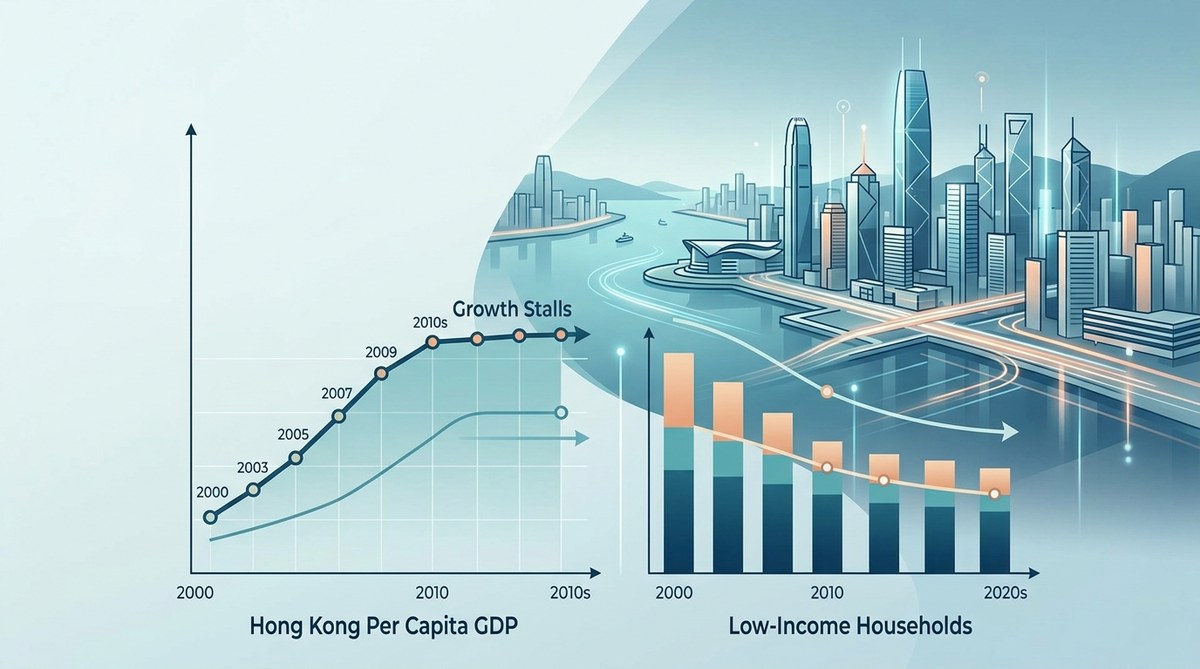
To understand how this fits into the bigger picture, read our piece on what 20 years of GDP data reveal about Hong Kong’s economic resilience. The disconnect between GDP and household income is one of the most telling signs of a structural imbalance.
What Can Be Done? A Three-Step Framework
Solving this problem will require action from government, business, and civil society. Here is a practical framework for thinking about solutions.
- Target housing directly. The government must accelerate the supply of public housing and introduce stronger rent controls for the private market. This is the single most effective way to increase disposable income for the bottom 40%. A 10% reduction in rent would be equivalent to a 5% wage increase for most families.
- Reform the social safety net. The current welfare system is fragmented and hard to access. A streamlined, means-tested cash transfer program could provide a buffer for families in crisis. This is not about creating dependency. It is about preventing a temporary setback from becoming a permanent slide into poverty.
- Invest in upskilling and job quality. The government and businesses need to work together to create more stable, full-time jobs with benefits. This includes enforcing stricter regulations on platform work and providing subsidies for companies that offer training and career progression.
For a more detailed look at the effectiveness of current welfare programs, see our analysis on does social welfare spending reduce poverty? analyzing two decades of evidence. The evidence shows that targeted spending can work, but only if it is designed correctly.
The Hidden Drivers You Might Miss
Beyond the obvious factors, there are quieter trends that are making the situation worse. One is the aging population. Older workers who lose their jobs often struggle to find new ones. They end up taking lower-paying, part-time work, which drags down the income of the bottom 40%.
Another factor is the rising cost of childcare. For a family with two young children, childcare can cost more than rent. This forces one parent, often the mother, to leave the workforce. This reduces household income and perpetuates the cycle of stagnation.
We have a full analysis on why Hong Kong’s childcare costs are pushing families below the poverty line in 2026. It is a critical piece of the puzzle that often gets overlooked in policy debates.
Tracking the Real Impact on Lives
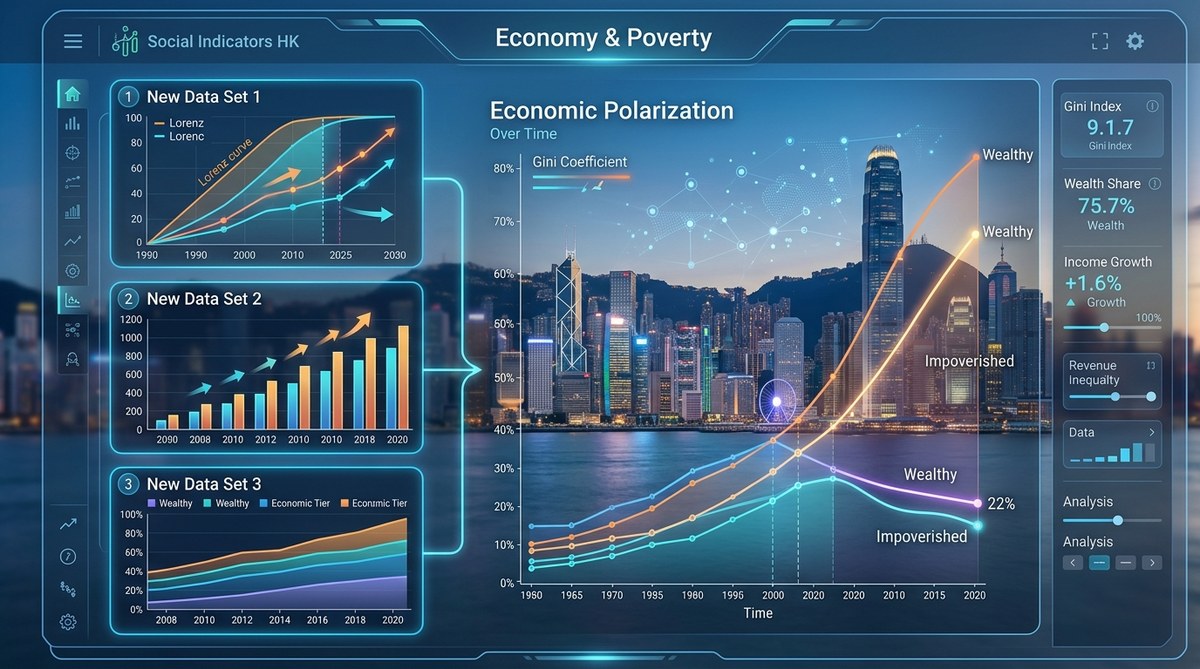
The Social Development Index, which we monitor closely, captures these trends. It shows that while Hong Kong’s overall economic output has grown, social wellbeing has not kept pace. The gap between the rich and the poor is not just about money. It is about access to education, healthcare, and opportunities.
For instance, children from the bottom 40% are far less likely to attend university than their wealthier peers. This is not because they are less talented. It is because their families cannot afford private tutoring or the extracurricular activities that give students an edge. This is how inequality becomes entrenched across generations.
To see how this plays out in schools, read our study on how income inequality shapes educational outcomes in Hong Kong schools. The data is clear: the system is failing the children who need it most.
A Call for Honest Conversation
This is not a problem that can be solved with a single policy or a one-time payment. It requires a fundamental rethinking of how Hong Kong’s economy works. The era of cheap labor and low-cost housing is over. The city needs a new model that shares prosperity more broadly.
For journalists and analysts, this means digging deeper than the quarterly GDP numbers. For investors, it means looking at social stability as a key risk factor. For policymakers, it means listening to the families who are struggling and designing solutions that meet their real needs.
What the Future Holds
If current trends continue, the bottom 40% will fall further behind. Social mobility will slow to a crawl. The city will become more polarized and less stable. But this future is not inevitable. There are levers that can be pulled.
The first step is acknowledging the problem. The second is committing to data-driven solutions. We have the numbers. We know what is broken. Now we need the political will to fix it.
To track how these dynamics are evolving, keep an eye on our tracking two decades of social change through Hong Kong’s development index. It provides the most comprehensive picture of where the city is heading.
A Final Word on Shared Responsibility
Understanding why Hong Kong’s bottom 40% income growth has stalled is the first step toward doing something about it. The data is not just for economists. It is for voters, for business owners, for teachers, and for anyone who cares about the future of this city. When a large portion of the population is left behind, everyone pays the price. The good news is that we have the tools and the knowledge to change course. What we need now is a collective commitment to use them.

Post Comment