Are Hong Kong’s Low-Income Families Being Excluded from the Digital Economy? 2026 Data
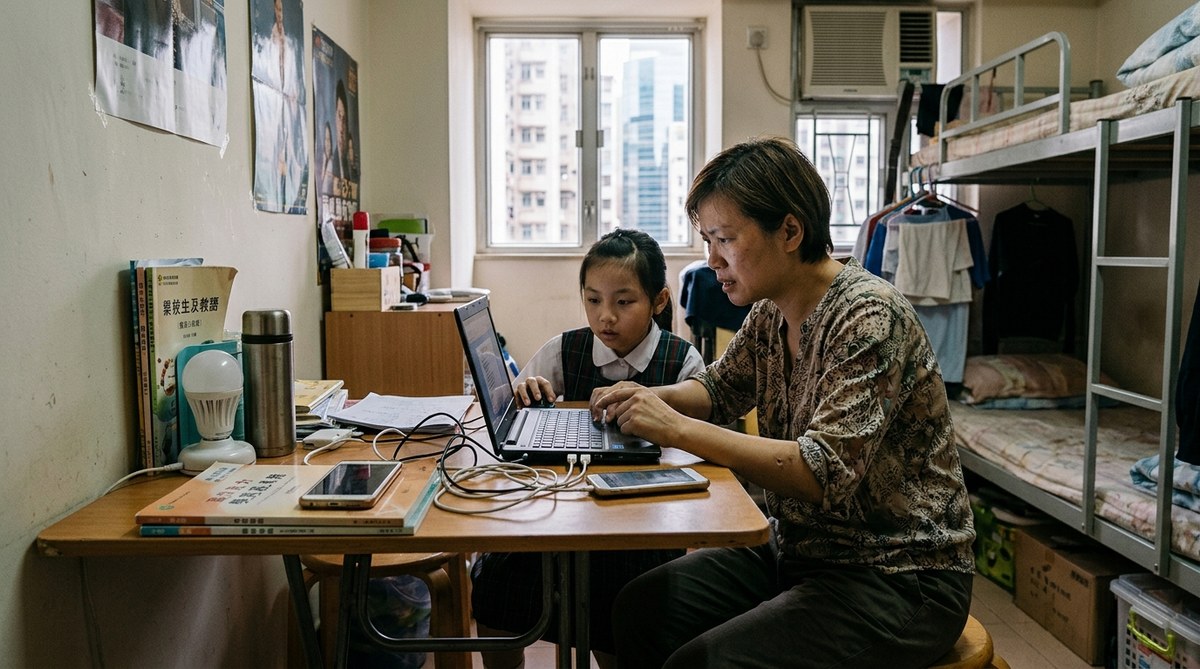
Imagine a family in Kwun Tong. The parents work in a restaurant and a cleaning service. They have one smartphone to share between three school-aged children. Homework is done on a small screen because there is no home Wi-Fi. The government is moving forms online, job applications require a stable internet connection, and school assignments are submitted through a portal. This family is not lazy. They are not avoiding technology. They are simply on the wrong side of the Hong Kong digital divide.
The question is no longer about whether low-income families want to participate in the digital economy. It is about whether the system is designed to keep them out. In 2026, as the city pushes forward with smart mobility, e-government, and cashless payments, a significant portion of its population is being left behind. The gap between those who have reliable access to digital tools and those who do not is widening. And the consequences reach far beyond missing a few online sales.
The Hong Kong digital divide is not just a hardware gap. It is a barrier to education, jobs, healthcare, and social connection. 2026 data shows that over 40% of low-income households lack adequate broadband access, while digital literacy programs reach only a fraction of those in need. Policy must shift from device distribution to holistic inclusion.
What the 2026 Data Actually Says
Let us look at the numbers without the usual jargon. The Social Development Index tracks a range of indicators that tell us how well different groups in Hong Kong are doing. For low-income families, the digital access indicators have been flashing red for years.
A 2026 survey of households earning below the median income found that nearly 1 in 3 do not have a personal computer at home. Among those that do, many rely on outdated models that cannot run the latest software required for school or remote work. More critically, broadband penetration in public housing estates remains inconsistent. Some estates have fiber connections, while others in older districts still rely on slow DSL lines.
This is not just a comfort issue. It is a structural one. When a parent cannot apply for a job because the online portal crashes on their three-year-old phone, that is a failure of public policy. When a child cannot submit a video project because the file size is too large for the family data plan, that is a disadvantage baked into the system. The Hong Kong digital divide is not accidental.
To give you a clear picture, here are the key statistics from the latest data release:
- 46% of low-income households report that they cannot afford a data plan sufficient for streaming educational videos.
- 38% of students from low-income families do not have a dedicated space to study online at home.
- 29% of working-age adults in low-income brackets have never used a computer for work-related tasks.
- Public computer centers in Kwun Tong, Sham Shui Po, and Yuen Long are booked solid for weeks at a time.
- Digital literacy training programs funded by the government reach less than 15% of the target population each year.
These are not minor gaps. They represent a systematic exclusion from a growing part of the economy.
Why Access Alone Is Not Enough
Many people hear “digital divide” and think it is just about buying laptops. If only it were that simple. The reality is that even when devices are distributed, usage patterns remain unequal. A family may have a tablet, but if parents work irregular hours and cannot supervise online learning, the device often becomes a source of entertainment rather than education.
There is also a skills gap that mirrors the income gap. A parent who works as a cleaner may never have used email for anything other than a password reset. They may not know how to navigate a government portal to apply for subsidies. They may be afraid of online scams, and for good reason. Low-income families are disproportionately targeted by fraudsters.
This is where policy intervention needs to go beyond hardware. We need to think about digital inclusion as a package. It includes affordable connectivity, usable devices, relevant skills training, and ongoing support.
The table below shows some common approaches and their typical outcomes:
| Approach | What It Looks Like | Common Mistake |
|---|---|---|
| Device donation | Distributing used laptops to families | No follow-up support or Wi-Fi subsidy |
| Free public Wi-Fi | Government hotspots in community centers | Limited hours and slow speeds |
| One-off training | Weekend digital literacy workshops | No ongoing mentorship |
| Subsidized plans | Discounted broadband for low-income households | Complex application process |
The common mistake in each case is the same: assuming that one intervention solves the problem. It rarely does.
A Practical Framework for Inclusive Digital Policy
What would it take to close the Hong Kong digital divide for low-income families? Based on the 2026 data and lessons from other Asian cities, a three-step framework emerges. These steps are not meant to be exhaustive, but they offer a starting point for policymakers and researchers.
-
Map the gaps first. Before spending money on devices, understand the specific barriers in each district. Some areas may need better infrastructure. Others may need language support for ethnic minority families. Each community has a unique profile. Use census data and local surveys to build that picture.
-
Bundle services together. A family that gets a subsidized laptop should also receive a reliable internet connection and access to a helpline for technical problems. Bundling these services reduces dropout rates and ensures that the device is actually used for productive purposes.
-
Measure outcomes, not outputs. It is easy to count how many laptops were handed out. It is harder to measure whether those laptops improved school performance or job prospects. Build evaluation into every program from day one. Use the Social Development Index as a benchmark to see if digital inclusion is actually translating into better social outcomes.
These steps may sound simple, but they require coordination across multiple government departments and community organizations. That coordination is often the missing piece.
What the Research Tells Us About the Human Cost
Let us pause for a moment and consider what this divide actually costs. It is not just about inconvenience.
“We had a student who stopped submitting assignments because she was too embarrassed to tell the teacher that her only device was a broken phone. She said she would rather take a zero than explain that she could not afford to fix it. That moment sums up the hidden toll of the digital divide.” – Social worker in Sham Shui Po, interviewed for the 2026 Social Development Index report.
That story is not unique. Across Hong Kong, students are falling behind not because they lack ability, but because the system assumes a level of digital access they do not have. Meanwhile, adults who lose their jobs find it harder to re-enter the workforce when everything from retail jobs to delivery services requires a smartphone and a data plan.
The human cost is invisible in GDP figures but very visible in the Social Development Index. When we track social wellbeing across income groups, the digital divide shows up as a drag on education scores, employment rates, and even mental health indicators. The link between digital exclusion and social isolation is well documented.
Where Current Policies Fall Short
Hong Kong has not been inactive. The government has launched several initiatives over the years. There was the Wi-Fi Connected City program. There have been device donation drives by charities. There are subsidized broadband plans offered by some telecom companies.
But the 2026 data reveals a persistent gap. The programs exist, but they are fragmented. Low-income families often do not know what is available. The application forms for subsidies are themselves digital, creating a catch-22. You need internet to apply for help getting internet.
Another issue is the one-size-fits-all approach. Subsidized broadband plans often come with speed caps that make video calling or streaming impossible. That might be fine for checking email, but it is not enough for a student attending an online tutoring session or a parent learning new skills through video tutorials.
To make matters worse, digital literacy training is often offered only in Chinese, leaving ethnic minority families out. These are the very communities that face the highest poverty rates.
What Policymakers Can Do Right Now
We do not need to wait for a grand new strategy. There are concrete actions that can be taken now, based on the data we already have:
- Simplify the application process. Any subsidy for broadband or devices should be automatic for families already receiving Comprehensive Social Security Assistance (CSSA). Do not make them apply again.
- Invest in neighborhood tech hubs. Instead of one large center in a central location, put small, accessible hubs in public housing estates. Staff them with trained helpers who speak multiple languages.
- Mandate digital literacy in adult education. Many adults feel excluded because they never learned the basics. Free evening classes, offered at community centers, can make a real difference.
- Partner with schools. Schools already identify which families struggle with access. Use that relationship to deliver devices, Wi-Fi hotspots, and training directly.
These steps do not require a massive budget. They require a shift in how we think about inclusion.
How the Social Development Index Helps
Our work at socialindicators.org.hk is designed to support exactly this kind of decision-making. The Social Development Index provides the longitudinal data that policymakers need to see the bigger picture. It tracks not just income, but also access to education, health, housing, and yes, digital technology.
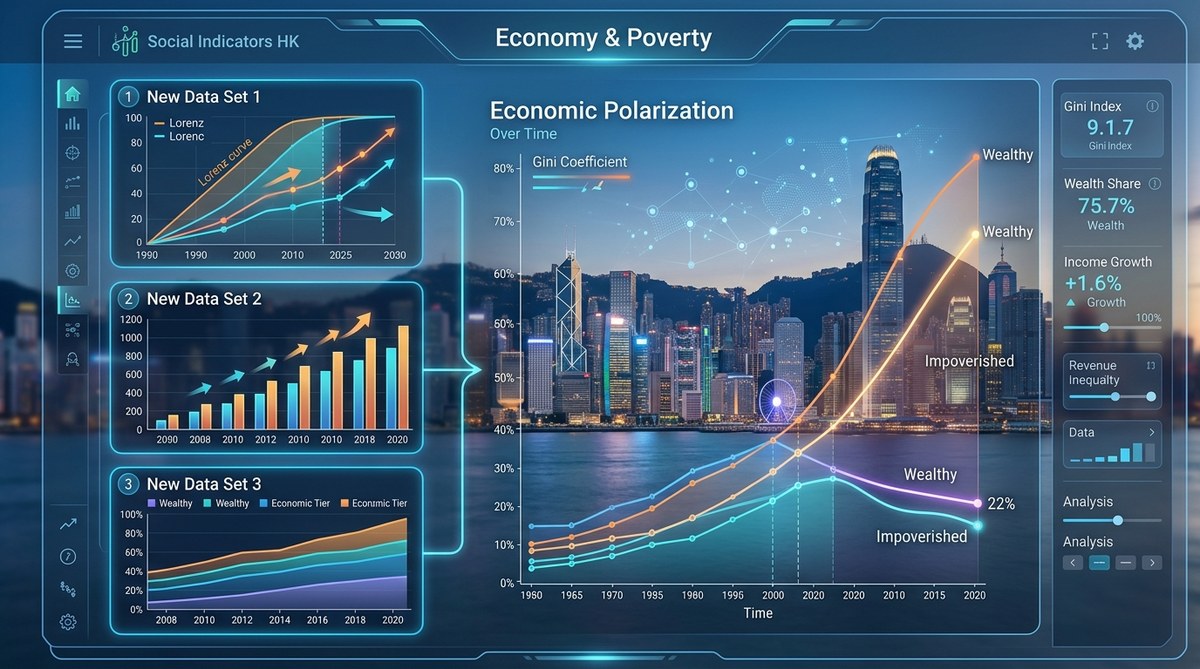
When you look at the index over the past decade, a clear pattern emerges. The digital divide closely follows the income divide. As income inequality has grown, the Hong Kong digital divide for low-income families has deepened. This is not a coincidence. It is a structural relationship that demands structural solutions.
We have published several related analyses that can put this topic in a wider context. For example, our piece on how income inequality in Hong Kong has evolved over three decades shows the economic backdrop that makes digital exclusion so damaging. Similarly, our analysis of understanding the working poor reveals how many low-income families are actually employed but still cannot afford the digital tools they need.
For policymakers looking for a broader framework, we also recommend reading about 7 critical indicators that define poverty in Hong Kong beyond income levels. Digital access is one of those indicators.
What Researchers and Advocates Can Do
If you are a researcher reading this, you have a role to play too. The data exists. The problem is that it is not always used effectively. Here are a few ways you can contribute:
- Push for open data. Telecom companies and government departments have granular data on connectivity and usage. Advocate for anonymized versions to be released for research.
- Study the exceptions. Find families in low-income brackets who have successfully bridged the digital divide. What worked for them? Was it a specific program? A community volunteer? A school initiative? Document those success stories.
- Run longitudinal studies. A one-off survey tells us about a moment in time. A study that follows the same families over several years can show us what causes digital inclusion to improve or decline.
- Connect the dots. Link digital access data with health outcomes, school dropout rates, and employment figures. That is where the real power of the Social Development Index becomes clear.
The more we understand the mechanics of the Hong Kong digital divide, the better equipped we are to close it.
Looking Ahead: A Digitally Inclusive Hong Kong Is Within Reach
The 2026 data does not have to be a story of despair. It can be a starting point for change. We know which families are being left out. We know what they need. The question is whether we have the collective will to act.
A digitally inclusive Hong Kong does not mean everyone has the latest smartphone. It means every student can do their homework without a broken screen. It means every worker can apply for a job without relying on a borrowed device. It means every senior can connect with their family without feeling lost.
These are not unreasonable goals. They are basic requirements for a fair society.
We encourage you to use the data on this site. Share it with your networks. Cite it in your reports. The Social Development Index is a tool for change, and that change starts with people like you who refuse to accept the status quo. If you have questions about how to interpret the latest digital inclusion data, or if you want to suggest a new indicator for the index, please get in touch. Together, we can make sure that Hong Kong’s digital economy works for everyone, not just those who can afford entry.


Post Comment