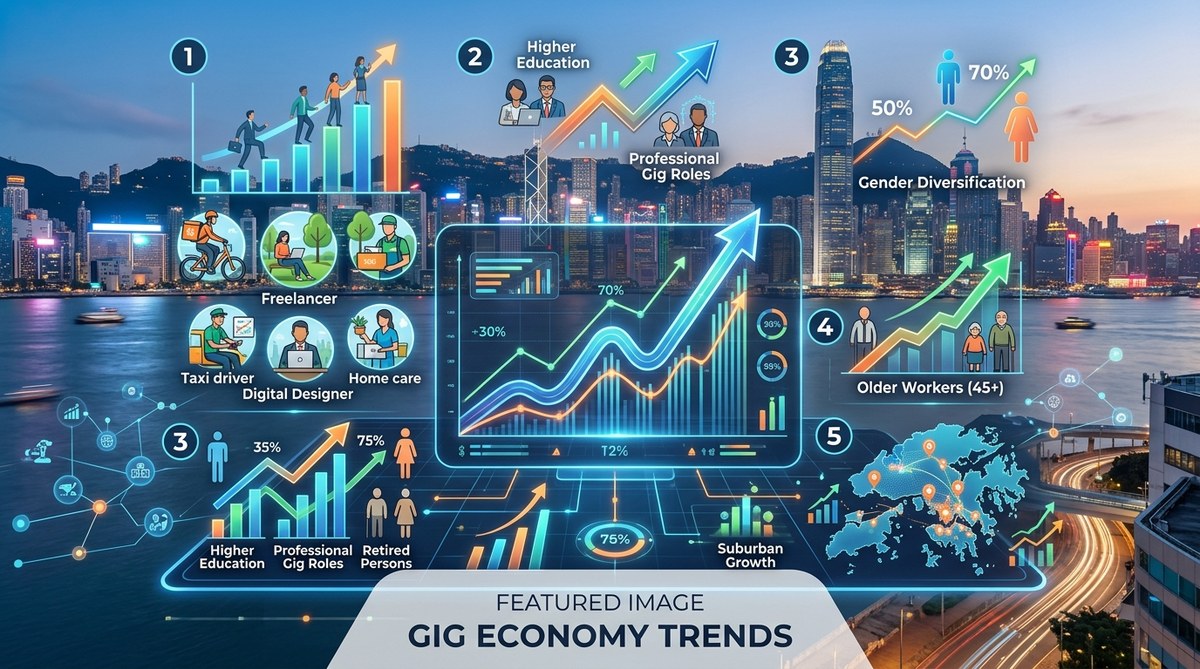
5 Surprising Trends in Hong Kong’s Gig Economy Employment Statistics
The gig economy has transformed how Hong Kong residents earn their living. What started as a side hustle for students and retirees has become a primary income source for thousands of workers across the city. Understanding these shifts matters for anyone making decisions about workforce planning, policy development, or market strategy.
Hong Kong’s gig economy has grown substantially over the past decade, with platform workers now representing approximately 8.2% of the total workforce. These workers face unique challenges including income volatility, limited benefits, and regulatory gaps. This guide provides data-driven insights into workforce composition, earnings patterns, demographic trends, and policy implications for business leaders and researchers analyzing Hong Kong’s evolving employment landscape.
Measuring the size of Hong Kong’s gig workforce
Quantifying gig economy participation presents methodological challenges. Traditional employment surveys often miss platform workers who toggle between multiple income sources.
Recent census data suggests around 300,000 Hong Kong residents engage in gig work as their primary or secondary income source. This figure includes food delivery riders, freelance designers, ride-hailing drivers, and online tutors.
The number has doubled since 2015. Growth accelerated during the pandemic when job losses pushed workers toward flexible earning options.
Breaking down the numbers reveals interesting patterns:
- Food delivery platforms employ approximately 65,000 active workers
- Ride-hailing services engage roughly 40,000 drivers
- Freelance professional services account for 85,000 workers
- Online marketplace sellers represent 60,000 individuals
- Task-based platforms connect 50,000 workers to short-term jobs
These categories overlap. Many gig workers maintain accounts on multiple platforms to maximize earning opportunities.
Income patterns and earnings volatility
Gig worker earnings vary dramatically based on platform, skill level, and time commitment. Understanding these patterns helps organizations benchmark compensation and assess market conditions.
Median monthly earnings for full-time gig workers range from HK$12,000 to HK$18,000. This sits below Hong Kong’s median employee income of approximately HK$20,000.
However, top performers earn considerably more. The highest-earning 10% of freelance professionals report monthly incomes exceeding HK$40,000. This group typically possesses specialized skills in areas like software development, financial consulting, or creative services.
Income stability remains a persistent challenge. Survey data shows 67% of gig workers experience month-to-month income fluctuations exceeding 30%. This volatility complicates financial planning and creates barriers to accessing credit or housing.
| Worker Category | Median Monthly Income | Income Volatility | Benefits Access |
|---|---|---|---|
| Food delivery | HK$14,000 | High (40%+ variance) | Minimal |
| Ride-hailing | HK$16,500 | Moderate (25% variance) | Limited |
| Freelance professional | HK$22,000 | Moderate (30% variance) | Self-funded |
| Online retail | HK$11,000 | Very high (50%+ variance) | None |
| Task platforms | HK$9,500 | Extreme (60%+ variance) | None |
The relationship between income inequality in Hong Kong and gig work merits attention. While flexible work creates opportunities, it also concentrates risk on individual workers rather than employers.
Demographic composition of the gig workforce
Age distribution in Hong Kong’s gig economy differs from traditional employment sectors. Young workers dominate certain platforms while older workers gravitate toward others.
Workers aged 18 to 34 represent 58% of food delivery and ride-hailing platform participants. This group values schedule flexibility and views gig work as a bridge between education and career employment.
The 35 to 54 age bracket accounts for 31% of gig workers. Many in this group turned to platform work after job displacement or to supplement primary employment income.
Workers over 55 comprise 11% of the gig workforce. Retirement-age workers often choose less physically demanding gigs like tutoring or online sales.
Gender distribution varies by platform type. Food delivery skews 82% male while freelance services show near parity at 48% female participation. Professional service platforms attract more women than manual labor gigs.
Educational attainment among gig workers spans the full spectrum. Approximately 35% hold university degrees, challenging assumptions that gig work attracts only low-skilled labor. Many degree holders choose freelancing to escape rigid corporate structures or pursue creative work.
The challenges facing working poor employment populations intersect significantly with gig economy trends. Platform work offers accessibility but rarely provides pathways out of poverty.
Platform economics and commission structures
Understanding how platforms extract value helps explain worker earnings. Most platforms operate on commission models that shift business costs onto workers.
Food delivery platforms typically charge restaurants 20% to 35% commission while taking 15% to 25% from delivery fees. Drivers receive the remainder after platform costs, leaving them with approximately 60% to 70% of the total transaction value.
Ride-hailing platforms claim 20% to 30% of each fare. Drivers also bear vehicle costs, fuel, insurance, and maintenance. After expenses, net earnings often fall 40% below gross receipts.
Freelance service platforms charge workers 10% to 20% commission on completed projects. Some add payment processing fees of 2% to 3%. These platforms provide less infrastructure than delivery or transport services, making their commission rates more contentious.
The platform model creates information asymmetries. Workers rarely know how much customers pay versus what they receive. This opacity prevents workers from assessing whether commission rates reflect actual platform costs.
Regulatory gaps and worker protections
Hong Kong’s employment law framework predates the gig economy. Current regulations struggle to address platform work realities.
Most gig workers operate as independent contractors rather than employees. This classification excludes them from protections including:
- Minimum wage guarantees
- Mandatory rest days and paid leave
- Severance and long-service payments
- Occupational safety and health coverage
- Employer-funded retirement contributions
The independent contractor classification benefits platforms by reducing labor costs and regulatory compliance burdens. Workers absorb these costs individually.
Recent court cases have challenged worker classifications. A 2022 ruling found certain food delivery riders should be considered employees based on platform control over work conditions. However, most platforms have restructured contracts to maintain independent contractor status.
Occupational injury rates among delivery riders exceed those in traditional transport sectors. Government data shows delivery work generates 3.2 injuries per 100 workers annually, compared to 1.8 for general transport workers.
The absence of collective bargaining rights limits worker leverage. Platform workers cannot legally organize unions under current Hong Kong labor law. This prevents coordinated advocacy for better conditions.
Policy discussions around gig work often reference social welfare spending effectiveness. Without employer contributions, gig workers place greater demands on public assistance programs.
Skills development and career progression
Gig work presents limited opportunities for skill building or career advancement. Most platforms optimize for task completion rather than worker development.
Traditional employment often includes training, mentorship, and clear advancement paths. Gig platforms provide none of these structures. Workers must self-fund skill development while managing income volatility.
Some freelance platforms offer certification programs or skill assessments. However, these rarely translate into higher earnings or better job security. Platform algorithms prioritize completion rates and customer ratings over credentials.
“The gig economy creates a paradox. Workers need flexibility, but that flexibility comes at the cost of the very supports that enable long-term career growth. Without investment in training or progression, many workers find themselves stuck in a cycle of low-wage task work.”
The relationship between youth unemployment and underemployment trends and gig work participation deserves scrutiny. Young workers often enter platform work during job searches but struggle to transition into stable careers.
Professional freelancers face different challenges. While they possess marketable skills, platform intermediation reduces their ability to build direct client relationships. This dependence on platforms limits long-term business development.
Geographic distribution and district-level patterns
Gig work concentrates in specific Hong Kong districts based on platform type and customer density. Understanding these patterns helps assess local economic impacts.
Central and Western, Wan Chai, and Yau Tsim Mong districts show the highest gig worker activity. These areas combine dense residential populations with commercial centers generating delivery and transport demand.
Outlying islands and rural New Territories show minimal platform activity. Low population density and limited commercial infrastructure make these areas unprofitable for most gig platforms.
District-level income data reveals disparities. Gig workers in affluent areas like Central earn 25% to 40% more than those in working-class districts like Sham Shui Po. This reflects both customer tipping behavior and order values.
Housing costs create additional pressure. Workers living in expensive districts must earn more to cover basic expenses. Yet platform algorithms often dispatch workers across multiple districts, preventing them from optimizing for high-value areas near their homes.
The connection between housing stress and social wellbeing outcomes affects gig workers acutely. Income volatility makes securing stable housing challenging, while housing costs consume a larger share of irregular earnings.
Health and safety considerations
Physical demands and accident risks make gig work more hazardous than many traditional jobs. Platform pressure to complete tasks creates safety compromises.
Food delivery riders face the highest injury rates. Traffic accidents account for 78% of serious injuries among this group. Pressure to meet delivery times incentivizes risky driving and traffic violations.
Weather conditions amplify risks. Delivery demand spikes during rain and typhoons, pushing workers onto dangerous roads. Platforms rarely suspend operations during extreme weather, leaving workers to choose between safety and income.
Mental health impacts receive less attention but affect many gig workers. Income uncertainty, social isolation, and customer conflicts create chronic stress. Survey data shows 42% of gig workers report anxiety related to income volatility.
Access to healthcare compounds these challenges. Without employer-provided insurance, gig workers must purchase individual coverage or rely on public healthcare. Many skip preventive care due to cost concerns.
The intersection of health inequality trends and gig work creates vulnerable populations. Workers who need steady income most are those least able to afford health coverage or take sick leave.
Technology adoption and digital literacy barriers
Platform work requires smartphone ownership, internet access, and digital competency. These requirements create barriers for some potential workers.
Approximately 95% of Hong Kong residents own smartphones, but device quality varies. Older or budget devices struggle with multiple platform apps, GPS tracking, and constant connectivity. Workers must regularly upgrade devices at their own expense.
Data costs represent another hidden expense. Platform apps consume significant bandwidth through GPS, messaging, and real-time updates. Workers in lower-income brackets may limit app usage to control costs, reducing their earning opportunities.
Digital literacy affects platform navigation and optimization. Workers must understand algorithms, ratings systems, and customer communication norms. Those lacking these skills earn less and face higher rejection rates.
Language barriers affect some workers. Most platforms operate in Chinese and English, creating challenges for ethnic minority workers or recent immigrants. This limits their access to certain gig opportunities.
The digital divide in Hong Kong classrooms parallels barriers in gig work. Technology access and literacy determine economic opportunity in both contexts.
Impact of economic cycles on gig work
Gig economy employment shows different patterns than traditional sectors during economic downturns. Understanding these dynamics helps forecast labor market shifts.
During the 2019 protests and 2020 pandemic, gig work absorbed displaced workers from tourism, retail, and hospitality sectors. Platform registrations increased 34% between 2019 and 2021.
However, gig work also contracts during severe downturns. When consumer spending drops, delivery and transport demand falls. Unlike salaried employees, gig workers experience immediate income reductions.
The 2022 to 2023 economic slowdown demonstrated this vulnerability. Average monthly gig worker earnings fell 18% as order volumes declined. Workers could not reduce their hours proportionally because platform algorithms favor high-activity accounts.
Recovery patterns differ too. Traditional employment rebounds slowly as companies rebuild confidence. Gig work can expand rapidly when consumer demand returns, providing faster income restoration for some workers.
Connections to broader economic resilience patterns show gig work functioning as both economic shock absorber and vulnerability amplifier.
Comparing Hong Kong to regional gig economies
Regional context helps assess whether Hong Kong’s gig economy patterns are unique or reflect broader trends. Neighboring cities show both similarities and differences.
Singapore’s gig workforce represents approximately 7% of total employment, similar to Hong Kong. However, Singapore has implemented stronger regulatory frameworks including insurance requirements and minimum earnings standards.
Shenzhen’s gig economy dwarfs Hong Kong’s in absolute numbers but represents a smaller workforce percentage. Platform diversity is greater, with specialized apps for virtually every service category.
Tokyo shows lower gig economy penetration at around 4% of the workforce. Stronger traditional employment protections and corporate loyalty norms limit platform work appeal.
Seoul has experienced rapid gig economy growth, reaching 9% workforce participation. Youth unemployment drives adoption, mirroring Hong Kong patterns.
Platform business models remain consistent across cities. Commission structures, worker classifications, and regulatory challenges show remarkable similarity regardless of local context.
Future projections and workforce planning
Projecting gig economy trends helps organizations prepare for labor market shifts. Several factors will shape Hong Kong’s platform work landscape over the next decade.
Automation threatens certain gig categories. Delivery robots and autonomous vehicles could displace human workers in transport and logistics. However, technical and regulatory barriers will slow adoption.
Platform consolidation appears likely. Smaller platforms struggle to compete with established networks. Mergers and acquisitions will reduce worker options and potentially increase commission rates.
Demographic shifts will reshape the worker pool. As Hong Kong’s aging population grows, more retirees may seek supplemental income through gig work. This could increase competition for available tasks.
Regulatory intervention seems inevitable. Public pressure around worker protections and safety will likely force policy changes. The form and timing remain uncertain, but the status quo appears unsustainable.
International platform expansion may create new opportunities. Global freelance platforms could connect Hong Kong workers to international clients, potentially increasing earnings for skilled workers.
Organizations planning workforce strategies should monitor these trends. The boundary between traditional employment and gig work will continue blurring, requiring flexible talent management approaches.
Making sense of the numbers for strategic decisions
Hong Kong gig economy statistics reveal a workforce segment that provides flexibility while concentrating risk on individual workers. The data shows steady growth, significant income volatility, and gaps in worker protections that create both opportunities and vulnerabilities.
For business leaders, these patterns suggest a labor pool that offers scalability but requires different management approaches than traditional employment. HR managers should consider how gig workers might complement core teams while recognizing the ethical and practical challenges of platform-mediated work.
Researchers will find rich territory for studying how technological change reshapes employment relationships. The Hong Kong context offers insights into how developed economies adapt to platform business models.
Policymakers face difficult tradeoffs between flexibility and protection. The statistics make clear that current frameworks leave many workers exposed to risks that traditional employment law was designed to address.
The numbers tell a story of transformation. They show how technology creates new earning opportunities while challenging assumptions about what employment should provide. Understanding these patterns helps everyone make better decisions about Hong Kong’s economic future.

Post Comment