How Financial Stress Affects Different Age Groups in Hong Kong According to Longitudinal Data
Financial hardship doesn’t hit everyone the same way. A 25-year-old struggling with student debt faces different pressures than a 55-year-old supporting aging parents while saving for retirement. In Hong Kong, where living costs consistently outpace wage growth, understanding these age-specific patterns matters for anyone designing interventions or studying social outcomes.
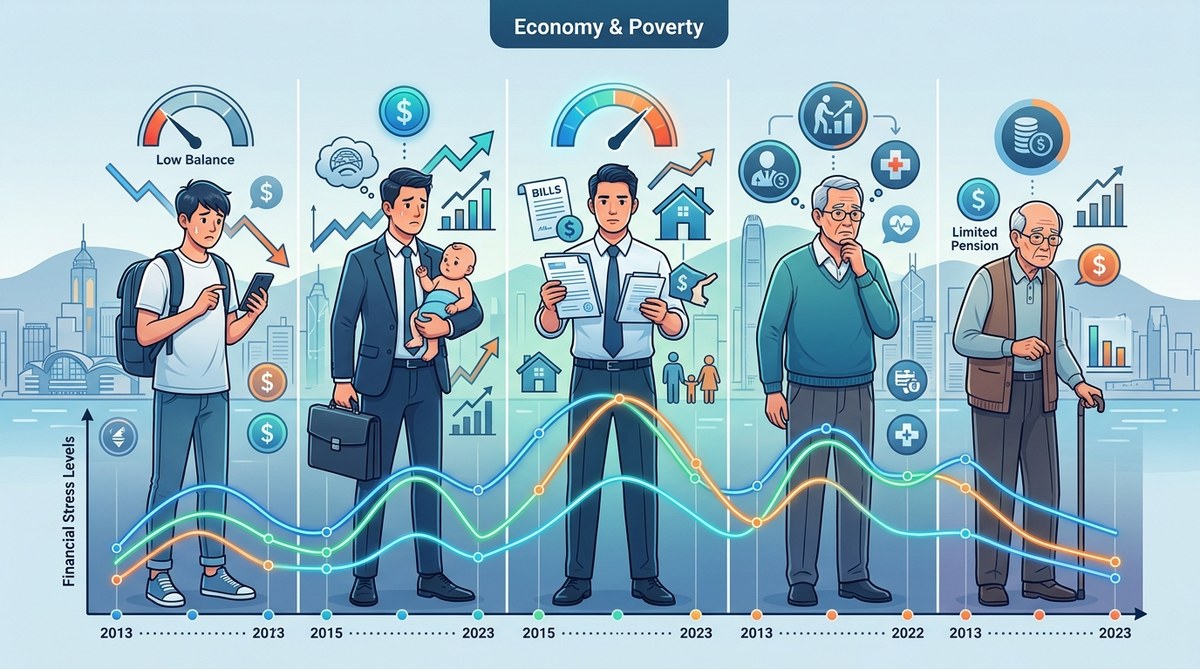
Longitudinal studies show financial stress affects Hong Kong residents differently across age groups. Young adults face housing affordability challenges, middle-aged workers juggle multiple dependents, and elderly residents struggle with inadequate retirement savings. These patterns reveal critical gaps in social support systems and inform targeted policy interventions addressing demographic-specific economic vulnerabilities.
Understanding the longitudinal approach to financial stress research
Longitudinal data tracks the same individuals over months or years. This method reveals how financial pressures evolve as people age, change jobs, or face life transitions.
Cross-sectional snapshots can mislead. They show 30-year-olds earning less than 50-year-olds, but they don’t reveal whether today’s 30-year-olds will catch up or fall further behind.
The Hong Kong Panel Study of Social Dynamics and similar research programs follow thousands of residents across multiple waves of data collection. Researchers measure income volatility, debt levels, savings adequacy, and subjective stress indicators.
This approach captures three critical dimensions:
- Age effects: Natural changes that occur as people move through life stages, like retirement or peak earning years.
- Period effects: Events affecting everyone simultaneously, such as the 2008 financial crisis or COVID-19 pandemic.
- Cohort effects: Unique experiences of people born in specific decades, like millennials facing different housing markets than baby boomers did at the same age.
Separating these three influences requires sophisticated statistical modeling. Without this separation, policymakers might design programs that miss the actual drivers of financial stress.
Young adults and the housing affordability crisis
People aged 18 to 35 report the highest levels of housing-related financial anxiety in recent longitudinal studies.
The numbers tell a stark story. In 2000, the median property price was roughly 8 times the median annual household income. By 2020, that ratio exceeded 20 times in many districts.
Young professionals earning reasonable salaries still cannot afford down payments. A 30-year-old software engineer making HK$40,000 monthly would need to save every dollar for over five years just for a 20% down payment on a modest flat.
This creates cascading stress:
- Delayed family formation and childbearing decisions
- Extended periods living with parents or in subdivided units
- Reduced discretionary spending affecting quality of life
- Lower retirement savings contributions during crucial early earning years
How subdivided flats are reshaping Hong Kong’s urban landscape documents the physical manifestation of this crisis.
Longitudinal tracking shows these pressures don’t ease as young adults age. Unlike previous generations who saw housing become more affordable in their 30s, current cohorts face persistent barriers.
“The data reveals a fundamental shift. Previous generations experienced temporary housing stress that resolved with career advancement. Current young adults show sustained or worsening housing anxiety even as incomes rise, because property prices rise faster.”
Middle-aged workers and the sandwich generation phenomenon
The 40 to 55 age bracket faces unique financial pressures from multiple directions.
These workers often support three generations simultaneously. They pay for children’s education while also covering parents’ medical expenses and potentially contributing to grandparents’ care.
Longitudinal data reveals this stress intensifies over time rather than plateaus. As parents age, healthcare costs accelerate. As children reach university age, education expenses spike.
The financial burden breaks down into measurable components:
| Expense Category | Percentage of Income | Trend Over 5 Years |
|---|---|---|
| Children’s education | 15-25% | Increasing |
| Elderly parent support | 8-15% | Sharply increasing |
| Own housing costs | 30-40% | Stable but high |
| Retirement savings | 5-10% | Decreasing |
Many middle-aged workers sacrifice their own retirement security to meet immediate family obligations. Panel data shows retirement account contributions declining precisely when they should accelerate.
Understanding the working poor employment statistics that challenge common assumptions explores how employment doesn’t guarantee financial security for this demographic.
The psychological toll compounds the financial strain. Workers report feeling trapped between obligations, unable to reduce support for dependents but watching their own future security erode.
Analyzing financial stress measurement across demographics
Researchers measure financial stress through both objective and subjective indicators.
Objective measures include:
- Debt-to-income ratios
- Months of emergency savings available
- Housing cost burden (percentage of income)
- Ability to meet unexpected HK$10,000 expense
Subjective measures capture:
- Self-reported stress levels about money
- Sleep disruption due to financial worries
- Frequency of arguments about finances
- Perceived financial security for the next year
Different age groups show distinct patterns across these measures. Young adults score worse on housing burden but better on emergency savings flexibility. Middle-aged workers show moderate objective stress but high subjective anxiety. Elderly residents often underreport subjective stress despite severe objective constraints.
This measurement complexity matters for policy design. Programs targeting objective financial gaps might miss populations experiencing severe psychological distress with moderate objective indicators.
Elderly residents and retirement inadequacy
Hong Kong residents over 65 face financial stress rooted in inadequate retirement preparation.
The Mandatory Provident Fund system only began in 2000. Workers who retired in the past two decades had limited time to accumulate meaningful savings through this mechanism.
Longitudinal studies tracking individuals from working years into retirement reveal concerning patterns:
- Actual retirement savings fall 40-60% short of amounts needed to maintain pre-retirement living standards.
- Many retirees exhaust savings within the first decade of retirement.
- Reliance on family support increases over time rather than decreases.
The situation varies dramatically by pre-retirement income level. Higher earners typically have adequate savings. Lower and middle-income workers face severe shortfalls.
Why are elderly residents disproportionately affected by inadequate housing examines how housing compounds financial stress for this age group.
Medical expenses create particular vulnerability. A single hospitalization can deplete years of savings. Chronic conditions requiring ongoing medication create sustained financial drain.
Many elderly residents continue working past traditional retirement age not by choice but by necessity. They take lower-wage positions because their savings cannot support basic living costs.
Gender differences within age groups
Financial stress patterns differ significantly between men and women, and these differences vary by age.
Young women report higher financial stress than young men despite similar income levels. Research suggests this reflects greater awareness of future caregiving responsibilities and career interruption risks.
Middle-aged women face compounded pressures. They typically assume primary caregiving roles for both children and elderly parents, often reducing work hours or leaving employment entirely. This creates immediate income loss and long-term retirement savings gaps.
Panel data tracking women who left the workforce for caregiving shows they rarely recover their previous earning trajectory when returning to work. The income gap persists and widens over time.
Elderly women face particularly severe financial stress. Longer life expectancy means retirement savings must stretch further. Lower lifetime earnings due to caregiving interruptions mean smaller savings to begin with.
Widowhood creates additional vulnerability. Many elderly women relied on spouse income or pensions that cease or reduce after death.
Economic shocks and age-specific vulnerability
Major economic disruptions affect age groups differently, and longitudinal data captures these differential impacts clearly.
During the 2008 financial crisis, young workers experienced higher unemployment rates but recovered relatively faster. Middle-aged workers faced lower unemployment but longer jobless periods when displaced. Elderly workers who lost jobs rarely found comparable replacement employment.
The COVID-19 pandemic revealed different vulnerabilities. Young workers in hospitality and retail faced immediate job loss. Middle-aged professionals experienced income volatility through reduced bonuses and hours. Elderly workers faced health risks that forced earlier retirement than planned.
Recovery patterns also varied by age. Young workers generally bounced back within 18-24 months. Middle-aged workers showed more persistent income effects. Elderly workers who exited the labor force during crises rarely returned.
What do 20 years of GDP data reveal about Hong Kong’s economic resilience provides context for understanding these shock patterns.
These differential impacts matter for policy response. Age-neutral support programs may fail to address the specific vulnerabilities each demographic faces during economic stress.
Mental health connections across the lifespan
Financial stress correlates with mental health outcomes differently across age groups.
Young adults show strong associations between housing unaffordability and anxiety disorders. The uncertainty about ever achieving housing security creates persistent psychological strain.
Middle-aged workers demonstrate connections between financial stress and depression. The weight of multiple obligations with no clear resolution path contributes to feelings of hopelessness.
Elderly residents show complex patterns. Some underreport mental health struggles due to generational stigma. Others experience acute distress when forced to accept financial help from children, viewing it as role reversal and loss of independence.
How mental health services in Hong Kong have evolved over two decades examines whether support systems address these age-specific needs.
Longitudinal tracking reveals mental health effects often lag financial stress by months or years. Intervention programs targeting only immediate financial relief may miss developing psychological consequences.
Policy implications from age-stratified data
Understanding age-specific financial stress patterns should inform differentiated policy approaches.
For young adults, interventions might focus on:
- Expanding affordable housing supply through public-private partnerships
- First-time homebuyer assistance programs with income-appropriate thresholds
- Student loan restructuring to reduce early-career debt burden
- Financial literacy programs addressing housing market realities
Middle-aged workers need:
- Tax incentives for retirement savings that account for dependent support obligations
- Affordable elderly care options reducing direct family financial burden
- Career transition support for workers facing industry disruption
- Caregiver support programs enabling continued workforce participation
Elderly residents require:
- Enhanced pension adequacy through public assistance supplements
- Medical expense support beyond current programs
- Affordable housing options appropriate for aging populations
- Part-time employment opportunities with age-appropriate conditions
Does social welfare spending reduce poverty analyzing two decades of evidence evaluates whether current spending patterns align with these needs.
Comparing Hong Kong patterns to regional contexts
Hong Kong’s age-specific financial stress patterns share some similarities with other developed Asian economies but show distinct characteristics.
Singapore faces similar housing affordability challenges for young adults. However, their Central Provident Fund system provides more comprehensive retirement security than Hong Kong’s MPF.
Japan’s elderly population experiences severe financial stress, but their challenge stems from demographic aging rather than inadequate retirement systems.
South Korea shows middle-aged financial stress patterns similar to Hong Kong, with high education costs and elderly support obligations.
These comparisons reveal Hong Kong’s unique combination of extreme housing costs, limited social safety nets, and rapid demographic aging creates particularly acute cross-generational financial pressures.
Tracking changes over time within cohorts
Following specific birth cohorts through multiple life stages reveals how financial stress evolves.
People born in the 1960s experienced relatively affordable housing in their 20s and 30s. Their financial stress peaked in middle age with dependent support but generally eased in retirement.
Those born in the 1980s face sustained housing stress from their 20s into their 40s. Projections suggest this cohort will enter retirement with significantly less accumulated wealth than previous generations at the same age.
The 1990s cohort shows even more concerning trajectories. They entered the job market during economic uncertainty, face the most extreme housing unaffordability, and will likely support parents with inadequate retirement savings.
Income inequality across generations a statistical portrait of Hong Kong’s age divide examines wealth gaps between these cohorts.
This generational divergence threatens social cohesion and economic stability. Each successive cohort faces worse financial prospects than the previous one.
Data collection challenges and methodological considerations
Longitudinal financial stress research faces several methodological hurdles.
Participant attrition creates bias. People experiencing severe financial distress may be harder to track over time, potentially underestimating true stress levels.
Self-reporting introduces measurement error. Cultural factors affect willingness to disclose financial difficulties. Elderly respondents may underreport due to shame. Young respondents may overreport due to different reference points.
Defining consistent measures across decades proves difficult. What constituted adequate savings in 2000 differs from 2020 due to inflation, changing life expectancy, and shifting social expectations.
Panel studies must balance sample size, follow-up duration, and measurement frequency against resource constraints. More frequent assessments capture dynamics better but increase costs and participant burden.
Despite these challenges, longitudinal approaches provide irreplaceable insights into how financial stress develops, persists, and resolves across the lifespan.
Using longitudinal data for intervention targeting
Age-stratified longitudinal data enables precise intervention targeting.
Programs can identify high-risk transitions:
- The shift from education to employment for young adults
- The period when middle-aged workers’ children enter university
- The first five years of retirement for elderly residents
Interventions timed to these transitions prove more effective than constant programs.
Data also reveals which populations experience temporary versus chronic stress. Temporary stress may need bridge support. Chronic stress requires structural solutions.
Predictive modeling using longitudinal patterns can identify individuals likely to experience future financial stress before crisis occurs. Early intervention prevents worse outcomes and costs less than crisis response.
The hidden cost of living crisis tracking essential expenses vs wage growth since 2010 provides context for understanding intervention timing.
Building evidence for structural reforms
Longitudinal data provides compelling evidence for systemic changes.
Showing that housing unaffordability persists across a person’s entire working life makes a stronger case for supply-side interventions than single-year snapshots.
Demonstrating that retirement savings gaps emerge from caregiving responsibilities rather than poor planning supports policy changes around caregiver support and pension design.
Tracking how economic shocks affect different age groups differently justifies age-specific recovery programs rather than one-size-fits-all approaches.
This evidence base helps policymakers, advocates, and researchers move beyond anecdotes to data-driven reform proposals with clear demographic targeting.
What the data tells us about Hong Kong’s future
The patterns emerging from longitudinal financial stress data paint a concerning picture.
Without intervention, current young adults will reach retirement with inadequate savings. Their children will face even worse housing affordability. The sandwich generation pressures affecting today’s middle-aged workers will intensify for future cohorts.
These aren’t inevitable outcomes. Data-informed policy changes could alter trajectories. Expanding affordable housing, strengthening retirement systems, and supporting caregivers would address root causes rather than symptoms.
The evidence exists. Longitudinal studies provide clear documentation of age-specific financial stress patterns, their causes, and their consequences. The question is whether this evidence will drive meaningful policy response before demographic and economic pressures create a broader social crisis.
Researchers, policymakers, and advocates have the tools to understand these patterns deeply. The data reveals not just problems but also intervention points where targeted action could make measurable differences in financial security across all age groups.

Post Comment