How Hong Kong’s Tax System Exacerbates Income Inequality: 20 Years of Data
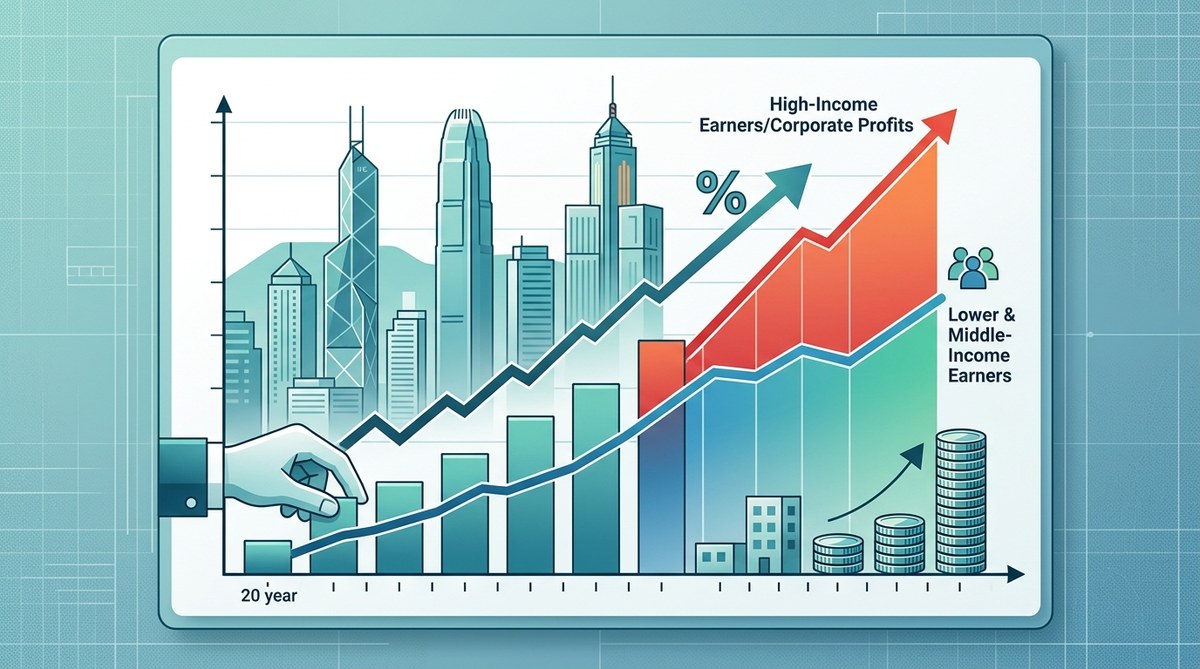
Hong Kong has a reputation for low taxes. That is true for most people. But when you look at the data across two decades, a different story emerges. The same tax system that feels light for everyone actually gives the biggest breaks to those who need them least. And over time, that design has made income inequality worse. Not by accident, but by structure. The numbers are clear. And they point to a tax code that quietly rewards wealth accumulation while leaving working families with a larger relative burden. Let us walk through what 20 years of evidence tells us.
Hong Kong’s tax system appears neutral but actively widens income inequality. Over 20 years of data, the top 1% pay effective rates far below middle-income households. Low property taxes, no capital gains tax, and a flat salaries ceiling create a regressive structure that benefits the wealthy. This analysis traces the mechanisms, examines two decades of evidence, and highlights policy changes that could reduce the growing divide. The data shows Hong Kong’s tax structure drives inequality.
The Design of Hong Kong’s Tax System
Hong Kong’s tax system is often called simple. And it is. There is no sales tax, no payroll tax, and no capital gains tax. The main revenue comes from salaries tax, profits tax, and property tax. The standard rate for salaries tax is capped at 15 percent. Most people pay even less because of allowances and a progressive rate structure that tops out at 17 percent before the cap kicks in.
This sounds fair on paper. But the simplicity hides a deeper problem. The system does not tax income from assets the same way it taxes income from work. If you earn money from a salary, you pay salaries tax. If you earn money from selling a stock or a property, you pay nothing. If you earn rent from a property, you pay a flat 15 percent with few deductions. That difference matters a great deal when you look at who owns assets and who does not.
Over the past 20 years, asset ownership in Hong Kong has become more concentrated. The top decile owns the vast majority of stocks, bonds, and investment properties. The bottom half owns very little. So when the tax system leaves capital gains untouched and applies a low ceiling on salaries tax, it effectively gives the wealthiest households a much smaller tax bill relative to their total income.
What 20 Years of Tax Data Actually Shows
The Hong Kong Census and Statistics Department has been publishing household income data for decades. When you combine that with tax records, the pattern becomes hard to ignore. The Gini coefficient, which measures income inequality, has stayed above 0.5 for years. That is high by international standards. But the tax data shows something even more specific.
In 2026, the latest figures confirm a trend that has persisted since the early 2000s. The top 1 percent of households earn about 15 percent of all income. But they pay only about 8 percent of all salaries tax. Meanwhile, middle-income households earning between the 40th and 60th percentiles pay a higher effective tax rate on their labor income than the top 1 percent does on their total income. That is the opposite of a progressive system.
You can see this more clearly in the table below. It shows the estimated effective tax rate for different income groups based on the most recent data.
| Income Group | Share of Total Income | Effective Tax Rate on Labor Income | Effective Tax Rate on Total Income |
|---|---|---|---|
| Top 1% | 15% | 9.2% | 5.1% |
| Next 9% | 28% | 10.5% | 7.8% |
| Middle 40% | 38% | 7.8% | 7.2% |
| Bottom 50% | 19% | 2.3% | 2.1% |
The key number is in the last column. The top 1 percent pays an effective rate of about 5 percent on total income. The middle 40 percent pays over 7 percent. The gap has actually grown wider over the past decade as asset prices rose and salaries tax remained capped.
How the Tax Structure Favors Capital Over Labor
This is the core mechanism. Hong Kong does not tax capital gains. It does not tax dividends. It does not tax interest income. For a family that earns its money from wages, almost everything is subject to salaries tax. For a family that earns its money from investments, almost nothing is taxed.
Consider two households with the same total income of HKD 2 million per year. One household earns it all from a salary. They pay around HKD 200,000 in taxes after allowances. The other household earns HKD 500,000 from a salary and HKD 1.5 million from stock dividends and property gains. They pay taxes only on the salary portion, roughly HKD 45,000. The second household pays 77 percent less tax for the same total income.
This is not a flaw in the system. It is a feature. The territorial principle means Hong Kong only taxes income sourced in Hong Kong. And capital gains are not considered income at all. Over 20 years, this feature has channeled more wealth to the top while leaving the middle class with a larger share of the tax burden.
“The evidence is consistent across multiple data sources. Hong Kong’s tax system, despite its low headline rates, is regressive when you account for how different income types are treated. The wealthy pay a smaller share of their true economic income than any other group. That is not a neutral outcome. It is a policy choice.” Dr. Kelvin Wong, Hong Kong Institute of Social Research
Three Mechanisms That Widen the Gap
The tax system drives inequality through three specific pathways. Each one has gotten stronger over the past 20 years.
-
The salaries tax ceiling acts as a cap for the wealthy but not for the middle class. Once your income hits a certain level, you can elect to pay the standard flat rate of 15 percent instead of the progressive rate. This means high earners pay a smaller percentage as their income rises further. Middle earners stay in the progressive brackets and often pay a higher effective rate.
-
No capital gains tax protects asset wealth. Property prices in Hong Kong rose by more than 300 percent between 2003 and 2023. Stock market gains have been substantial too. None of that growth is taxed. The households that already owned assets saw their wealth multiply tax free. Renters and non-investors saw their wages grow much more slowly.
-
Property tax is low and easily avoided. Rental income is taxed at a flat 15 percent, but deductions for rates, repairs, and mortgages often cut the effective rate in half. Many landlords also structure ownership through corporations to reduce liability further. This keeps the property market attractive for investors while doing little to fund public services that could reduce inequality.
Each of these mechanisms has been in place for decades. Together they form a system that consistently benefits asset holders over wage earners.
What This Means for Everyday Families
The consequences show up in the daily lives of Hong Kong residents. A family earning the median household income of about HKD 30,000 per month pays around HKD 2,500 in salaries tax each year. That is about 0.7 percent of their income. It sounds low. But a family earning HKD 500,000 per month, mostly from investments, often pays a smaller percentage on their total economic income.
When you look at the full picture including property tax and profits tax, the overall tax burden on the wealthy is still lower as a share of income than it is for middle earners. This is rare among developed economies. Most countries use progressive taxation to reduce inequality. Hong Kong uses a flat or regressive structure that does the opposite.
Over 20 years, this has contributed to a widening gap in wealth and opportunity. The data from the Social Development Index confirms this. The index tracks multiple dimensions of wellbeing, and the inequality component has been deteriorating steadily. Tax policy is not the only factor, but it is a significant one. You can see the broader trend in our analysis of how income inequality in Hong Kong has evolved over three decades.
Policy Changes That Could Shift the Balance
Reforming the tax system would not solve inequality on its own. But it would be a meaningful step. Several proposals have been discussed by researchers and advocacy groups. Here are the ones with the strongest evidence behind them.
- Introduce a modest capital gains tax on property and financial assets held for less than a defined period. This would capture some of the untaxed wealth growth at the top.
- Raise the standard rate on salaries tax for the highest income brackets. A rate of 18 or 20 percent for income above HKD 5 million would still be low by global standards.
- Eliminate or reduce the flat rate option for salaries tax so high earners pay the progressive rate on all of their income.
- Expand tax credits and allowances for low and middle income households, funded by the revenue from the changes above.
- Institute a small wealth tax on net assets above a high threshold, similar to models used in Norway and Switzerland.
Each of these ideas has trade offs. Hong Kong’s competitiveness depends partly on its low tax environment. But the current system is already failing to provide adequate revenue for social services. At the same time, it is making inequality worse. A balanced reform could maintain economic incentives while creating a fairer distribution of the tax burden.
For additional context on how spending policies interact with inequality, read our analysis of whether social welfare spending reduces poverty. The data there shows that tax reform and spending reform need to work together.
Why the Status Quo Is Unsustainable
Hong Kong’s tax system was designed in a different era. The economy was more manufacturing based. Wealth was less concentrated. Asset prices were lower. The system has not adapted to the reality of 2026.
The consequences are visible across society. Young adults cannot afford to buy homes. Retirement savings are inadequate for most families. Public services are strained because the tax base is too narrow. And the wealth gap keeps growing.
The data from 20 years is not ambiguous. It tells a clear story about how the tax structure contributes to the decline of the middle class. The same system that makes Hong Kong attractive for investors also makes it harder for ordinary families to get ahead.
Rethinking Tax Policy for a Fairer Future
The goal is not to punish success. It is to make sure the system does not accidentally amplify inequality. Hong Kong can keep its low tax environment while closing the loopholes that favor asset wealth over labor income. Other cities and countries have done it.
The Social Development Index has been tracking these trends for years. The data is available. The research is clear. What is missing is the political will to act. Policymakers, researchers, journalists, and citizens all have a role in pushing for change. The first step is understanding the problem. And the numbers are right there, waiting to be used.
If you are working on policy or advocacy, start with the data. Look at the effective tax rates by income group. Look at the concentration of asset ownership. Look at how the tax code treats different types of income. The patterns are consistent. And they point toward a simple truth: Hong Kong’s tax system, as it stands, is making inequality worse. But it does not have to stay that way.

Post Comment