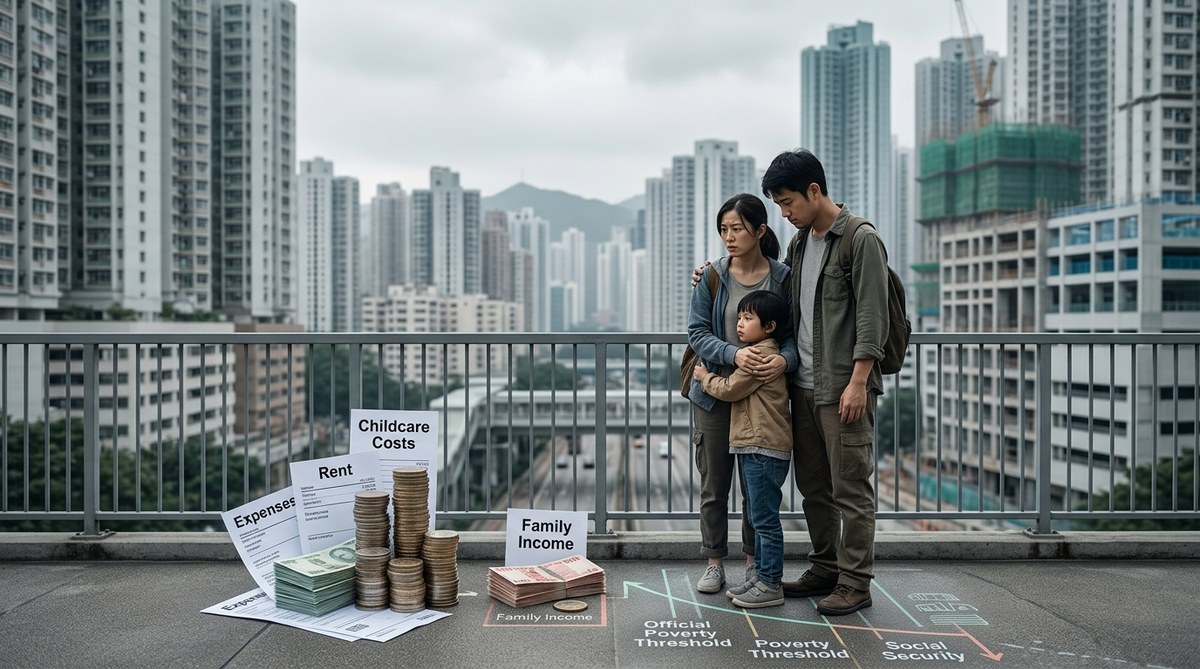
Why Hong Kong’s Childcare Costs Are Pushing Families Below the Poverty Line in 2026
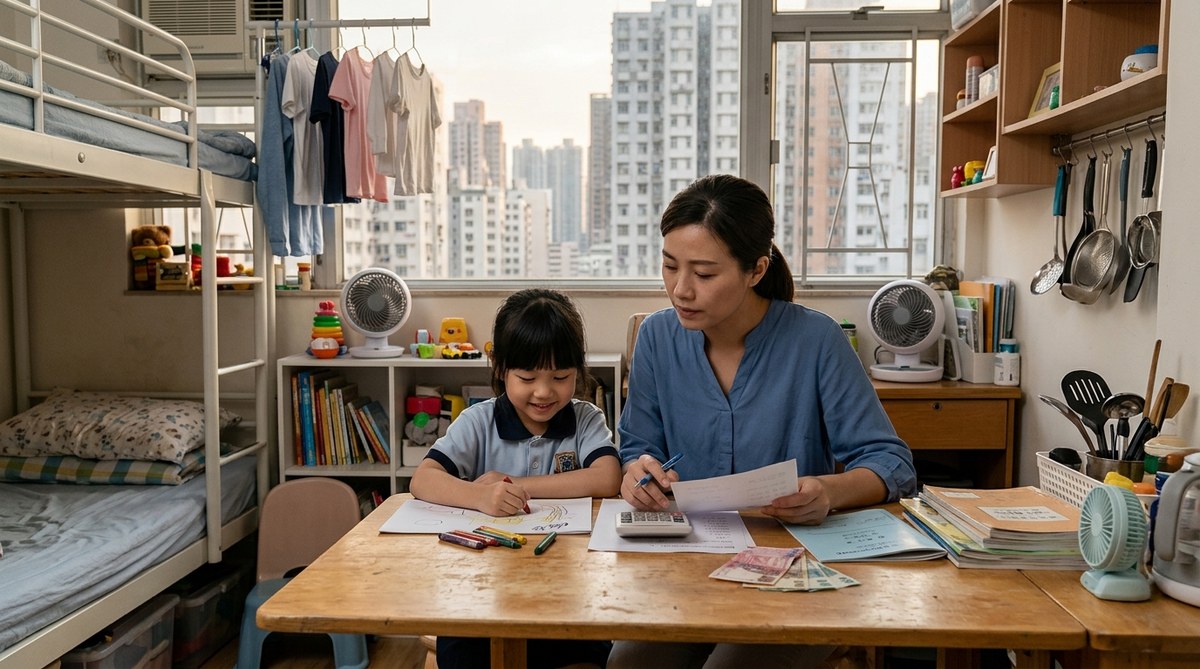
If you live in Hong Kong and have a young child, you already know the feeling. You look at the monthly bill for nursery or kindergarten and feel a knot tighten in your stomach. It’s not just an expense. It feels like a second rent payment, often larger than the first one. For many families across the city, this single cost is no longer just a financial strain. It has become the deciding factor that tips a household from “getting by” into official poverty.
We track the Social Development Index to monitor exactly these kinds of pressures. And the data for 2026 is sending a clear warning signal. Childcare costs are not just high. They are structurally reshaping family finances and undoing years of economic stability for the middle and working classes.
Hong Kong childcare costs in 2026 consume up to 60% of median household income for a single child, far exceeding global averages. This leaves thousands of families below the official poverty line once rent and care fees are deducted. Without urgent policy intervention, this expense is driving a long-term decline in family welfare, fertility rates, and social mobility across the territory.
The True Cost of Childcare in Hong Kong Right Now
Let’s look at the raw numbers for 2026. A full day place at a private independent nursery or kindergarten in Hong Kong now averages between HKD 10,000 and HKD 15,000 per month. If you opt for one of the more “international” playgroups or bilingual programs, that figure can easily jump to HKD 20,000 or more.
Compare that to the median household income. According to recent census data, the median monthly household income in Hong Kong hovers around HKD 30,000. For a single child, that means one parent’s entire salary, or over half of a dual income household’s earnings, goes directly to childcare.
This is not just a “luxury” problem for high earners. For a family earning HKD 25,000 a month, a HKD 12,000 childcare bill leaves them with HKD 13,000 to pay for rent, food, transport, utilities, and medical expenses. In a city where a modest 300 square foot flat rents for HKD 12,000 or more, the math simply does not work.
The cost of essentials has been climbing for years. Our analysis of the hidden cost of living crisis shows exactly how much wages have lagged behind the real inflation rate for basic goods and services.
Breaking Down the Budget: Where Does the Money Go?
Parents often ask us why it costs so much. The headline fee is just the beginning. Here is what a standard month looks like for a family with one child in a typical half day or full day program:
- Tuition fees: HKD 8,000 to HKD 15,000 (this is the baseline)
- Miscellaneous levies: HKD 500 to HKD 1,500 (for materials, cleaning, air conditioning)
- Uniforms, books, and stationery: HKD 300 to HKD 800 per term, spread monthly
- School bus or transport: HKD 800 to HKD 1,500 depending on distance
- Extracurricular activities: HKD 1,000 to HKD 3,000 (piano, ballet, Mandarin, swimming)
- Snacks and lunch: HKD 500 to HKD 1,000 (if not provided by the school)
These costs add up to a total that often exceeds HKD 15,000 per month for a single child. If you have two children, you are effectively looking at a mortgage sized expense every single month.
Why 2026 Feels Different for Hong Kong Parents
This year is a breaking point for several reasons. The economy has not fully rebounded in a way that benefits ordinary households. While Hong Kong’s economy has shown structural resilience, as shown in 20 years of GDP data, this growth has not translated into higher disposable incomes for families.
At the same time, rents have stayed stubbornly high. Food prices have increased. And the government’s existing subsidy schemes, while helpful for the lowest income brackets, have not kept pace with the actual market rates charged by private centers.
Middle income families often fall into a gap. They earn too much to qualify for the most generous subsidies, but not enough to comfortably absorb HKD 15,000 in childcare costs. They are the “squeezed middle,” and they are the ones most at risk of being pushed below the poverty line by this single expense.
How Childcare Costs Directly Push Families Below the Poverty Line
Hong Kong defines the poverty line as 50% of the median household income. In 2026, that threshold is roughly HKD 15,000 for a one person household, and higher for larger families.
Consider a typical family of four. A couple with two children earning HKD 35,000 a month. That sounds like a solid middle class income. But let’s deduct the essentials.
First, subtract rent for a small flat: HKD 14,000. Then subtract childcare for two kids (assuming preschool and a younger toddler): HKD 22,000. That alone takes them to negative HKD 1,000 before they have bought a single meal or paid for an Octopus card.
To avoid bankruptcy, one parent usually drops out of the workforce. This reduces household income dramatically. Suddenly, a family that was “comfortable” on paper is living well below the poverty line.
This is not an abstract statistic. It is happening in Sham Shui Po, Kwun Tong, Tuen Mun, and even parts of the New Territories where dual income families are struggling to keep their heads above water.
Income is not the only factor. These 7 critical indicators that define poverty paint a fuller picture of what families are actually experiencing on the ground.
The Ripple Effect: Beyond the Bank Account
The damage is not just financial. It is social and emotional. When childcare costs force a parent to stop working, it is often the mother who leaves her job. This creates long term career gaps, reduced lifetime earnings, and a loss of economic independence for women.
The stress on parents is immense. Our tracking of how mental health services have evolved shows a growing demand for support from parents experiencing anxiety and depression directly linked to financial pressure.
Children also feel the strain. When families have no money left after paying for care, they cut back on nutritious food, educational toys, and enrichment activities. This creates an achievement gap that starts before the child even enters primary school.
Comparing Childcare Models: Hong Kong vs. Regional Peers
Hong Kong is an outlier in East Asia for its lack of a universal, heavily subsidized childcare system. Let’s put it in perspective.
| City / Region | Avg. Monthly Childcare (USD) | Govt. Subsidy (% of cost) | % of Median Income Spent |
|---|---|---|---|
| Hong Kong | $1,200 – $1,900 | 0% – 20% | 40% – 60% |
| Singapore | $700 – $900 | 50% – 70% | 15% – 25% |
| South Korea | $500 – $700 | 60% – 80% | 10% – 15% |
| Japan | $600 – $800 | 50% – 70% | 10% – 20% |
The table makes it obvious. Singapore, our closest competitor, invests heavily in making childcare affordable. South Korea and Japan treat early childhood education as a public good. Hong Kong largely treats it as a private market. The result is that Hong Kong parents pay the highest percentage of their income for childcare in the developed world.
What Can Be Done? Practical Steps for Families and Policymakers
We believe in data driven solutions. Here are some steps based on what the numbers tell us works.
For families struggling right now:
- Check all available subsidies. The government offers the Kindergarten and Child Care Centre Subsidy Scheme (KCCSS) and the Working Family Allowance (WFA). Many eligible families do not apply because the process feels overwhelming.
- Look into community based centers. Non-profit and church affiliated kindergartens often charge significantly less than private independent schools. The quality can be just as good.
- Talk to your employer. Some larger companies in Hong Kong are starting to offer childcare vouchers or flexible spending accounts. It never hurts to ask Human Resources.
For policymakers and advocates looking at the long term:
- Increase direct subsidies and cap fees. A sliding scale subsidy that covers 50% to 70% of market fees for middle income families would immediately lift thousands out of poverty.
- Invest in public childcare centers. Hong Kong needs more government run nurseries, not just vouchers for private ones.
- Treat childcare as infrastructure. Just like roads and hospitals, childcare enables the economy to function. It deserves capital investment.
“Childcare has transformed from a family expense into a structural driver of poverty. When a second income is entirely consumed by childcare fees, it traps families in a cycle where working actually makes them poorer on paper. We need systemic reform, not just band aid solutions. The data from the Social Development Index confirms that no amount of individual budgeting can overcome a 60% cost burden.” – Dr. Esther Yin-Nei Cho, Researcher on Child Poverty in High Income Asian Societies
Tracking the Crisis Through the Social Development Index
At Social Indicators of Hong Kong, our mission is to provide the data needed to make informed decisions. The Social Development Index is our primary tool for monitoring these trends.
The 2026 wave of data shows a notable decline in the “Family Solidarity” and “Community Cohesion” sub-indexes. These declines correlate directly with the rising burden of childcare costs. When families are financially stretched to the breaking point, social bonds weaken. Parents have less time and energy for community involvement. Isolation increases.
We encourage advocates, journalists, and policymakers to use our complete guide to interpreting social development data to build stronger cases for reform. Numbers do not lie. They tell a story of a system that is failing its youngest citizens and their parents.
A 2026 Call to Action for Hong Kong’s Future
Hong Kong has always prided itself on being a family friendly city. But the data tells a different story. When childcare costs push families below the poverty line, it is not just a household problem. It is a societal failure.
We cannot solve this crisis overnight. But we can start by being honest about the numbers. If you are a parent struggling to make ends meet, you are not alone. The system is stacked against you. If you are a policymaker reading this, understand that inaction has a cost. Every family that falls into poverty today is a child whose potential is limited tomorrow.
Let’s use the data to demand better. Because every family in Hong Kong deserves a fair start.

Post Comment