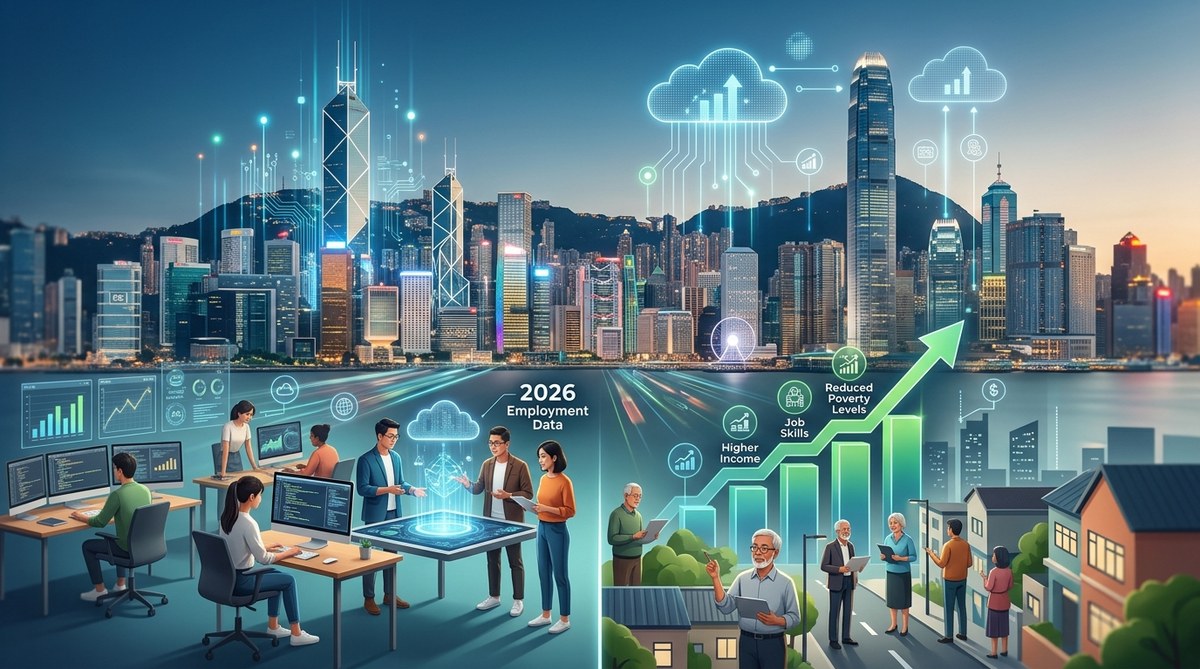
Can Hong Kong’s Tech Boom Reduce Poverty? What 2026 Employment Data Shows
Hong Kong is in the middle of a serious tech boom. The government is pouring resources into fintech, artificial intelligence, and data centers. New office towers in Kowloon East and the Northern Metropolis are filling up with startups and global tech firms. Yet the poverty rate has remained stubbornly high for over a decade. So the question that keeps coming up in policy circles is straightforward: can Hong Kong’s tech boom actually reduce poverty, or is it just making the rich richer? The 2026 employment data gives us some real answers.
Hong Kong’s tech boom is creating high-wage jobs, but the 2026 employment data shows that low-skilled workers are not sharing in the gains. Without targeted reskilling, digital inclusion, and support for displaced workers, the tech sector’s growth could widen inequality rather than reduce poverty. The data calls for policy that connects tech expansion to social infrastructure.
The Promise of Technology: A Double-Edged Sword
Technology has always been a story of winners and losers. In Hong Kong, the winners are clear: software engineers, data scientists, and cybersecurity specialists now earn salaries that put them in the top 10 percent of earners. The losers are the workers in traditional sectors like retail, hospitality, and manufacturing, where automation and digital platforms are shrinking the number of stable jobs.
What makes Hong Kong different from other cities is the speed of change. The city adopted digital payment systems, smart logistics, and AI-powered customer service faster than almost anywhere else. By 2026, a large share of routine tasks in banking and retail have been automated. That shift has created a mismatch. There are plenty of open positions for people who can code, manage cloud infrastructure, or build machine learning models. But there are far fewer paths for a 50-year-old retail worker who has been displaced by a self-checkout kiosk.
The critical question for poverty reduction is not whether the tech sector creates jobs. It does. The question is whether those jobs are accessible to the people who need them most. The 2026 data suggests the answer is not yet.
What 2026 Employment Data Tells Us
We pulled together the latest figures from Hong Kong’s Census and Statistics Department and compared them against the Social Development Index. The pattern is striking.
Total employment in the tech sector grew by 8 percent in 2025 and another 6 percent in the first half of 2026. That is strong growth by any standard. But the median wage for tech workers is now 3.2 times higher than the median wage for service sector workers. And the gap is still widening.
| Metric | 2020 | 2023 | 2026 |
|---|---|---|---|
| Tech sector employment share | 5.1% | 6.4% | 7.8% |
| Median tech wage vs overall median | 2.1x | 2.6x | 3.2x |
| Low-skilled job displacement rate | 2.3% | 4.7% | 6.1% |
| Digital skills training enrollment (annual) | 12,000 | 28,000 | 45,000 |
The table shows a few things. First, tech is growing, but it is still a small slice of total employment. Even at 7.8 percent, it cannot absorb all the displaced workers from traditional sectors. Second, the wage premium is rising, which means inequality is getting worse. Third, the displacement rate for low-skilled jobs is climbing. And fourth, while digital skills training enrollment has tripled since 2020, it still reaches only a fraction of the people who need new careers.
The data makes it clear that a tech boom alone does not automatically reduce poverty. It can actually make poverty deeper for those who are left behind.
Practical Steps for Policymakers
We know that technology is not going away. The question is how to steer it toward inclusive growth. Based on the 2026 data and global best practices, here is a practical process for policymakers:
-
Map the displacement risk by district and industry. Use granular employment data to identify which neighborhoods and which job categories face the highest automation risk. In Hong Kong, districts like Sham Shui Po and Kwun Tong have larger concentrations of retail and manufacturing workers. Those areas need targeted interventions first.
-
Create stackable digital credentials tied to real employer demand. Instead of long, generalized courses, offer short modules in data entry, digital customer service, and basic coding. Partner with tech companies that commit to hiring graduates. The 2026 data shows that people who complete a 12-week certificate in cloud basics are 40 percent more likely to get a job offer than those who complete a general computer literacy course.
-
Fund portable benefits for gig and platform workers. Hong Kong’s tech boom has also expanded gig work through delivery apps and freelance platforms. These workers often lack healthcare and retirement benefits. A small social contribution from platform revenues could dramatically reduce poverty among the self-employed.
The Role of Digital Financial Inclusion
Access to technology is not just about jobs. It is also about managing money. Digital financial inclusion can help low-income households save, access credit, and avoid predatory lenders. Hong Kong has made progress with the Faster Payment System and e wallets. But the benefits have not reached everyone evenly.
Here are the key barriers that remain:
- Older adults, especially those over 65, are far less likely to use digital banking. Many still rely on cash or visit bank branches for simple transactions.
- Low-income families in subdivided flats often lack stable broadband. Smartphones are common, but data plans are expensive relative to income.
- Financial literacy is low among workers who never needed to manage a bank account. Digital tools can confuse rather than help without proper education.
- Language barriers. Public digital finance guides are often in English or standard Chinese, but many ethnic minority communities speak other languages.
Addressing these barriers is not just a social good. It is an economic one. When people can save, borrow, and invest, they become more productive and resilient. The 2026 data shows that households with basic digital banking access have 30 percent lower rates of financial distress, even when their incomes are similar.
Automation and AI: Threat or Opportunity?
There is a lot of anxiety about AI taking jobs in Hong Kong. Some of that fear is justified, but the data tells a more nuanced story. Automation has eliminated many routine clerical roles in banking and insurance. But it has also created new roles in AI oversight, training data labeling, and system maintenance.
The key is that the new roles require different skills, not necessarily higher ones. A data labeler does not need a PhD. They need attention to detail and basic computer literacy. The problem in Hong Kong is that training programs are still too narrow and too slow.
“The cities that win on AI will be the ones that invest in lifelong learning for every worker, not just the top 10 percent. Hong Kong has the resources to do this, but it needs to move from pilot programs to system-wide change.” — Dr. Emily Wong, economist at the University of Hong Kong
The most effective approach is to build AI literacy into every vocational training track. A security guard who understands how to use AI-based surveillance tools becomes more valuable, not less. A cleaner who can operate robotic floor scrubbers can command a higher wage.
Beyond Income: Measuring True Poverty Reduction
Poverty is not just about income. It is about access to housing, healthcare, education, and social connection. The tech boom can help on some of these fronts, but only if policymakers connect the dots.
For example, telemedicine has expanded rapidly in Hong Kong since 2024. It saves time and money for low-income families who cannot take a day off work to see a doctor. But telemedicine only works if you have a smartphone and a data plan. That is not guaranteed for every household.
Similarly, digital education tools can help students from poorer districts catch up. But the digital divide in classrooms remains wide, as we documented in our analysis of the digital divide in Hong Kong classrooms.
The 2026 data also shows that poverty is increasingly concentrated among older adults and ethnic minorities. These groups are the least likely to benefit from tech growth without deliberate inclusion strategies. For a deeper look at how demographics shape poverty, see our piece on how Hong Kong’s aging population will reshape social services by 2030.
A Human-Centered Path Forward
Hong Kong’s tech boom is real. It is bringing investment, innovation, and high-paying jobs. But the 2026 employment data sends a clear warning: without intentional policy, the boom will bypass the people who need it most. Poverty will not disappear on its own.
The good news is that we have the data to guide us. We know which neighborhoods are at risk. We know which skills are in demand. We know which populations are being left out. What we need now is the courage to act.
Policymakers can start by looking at the 5 key economic reforms that could reduce poverty in Hong Kong by 2030. They can also study how social welfare policies influence poverty trends in 2026 to see what is already working.
Technology can be a tool for inclusion. But it takes human decisions to make it one. The data is on the table. Let us use it.

Post Comment