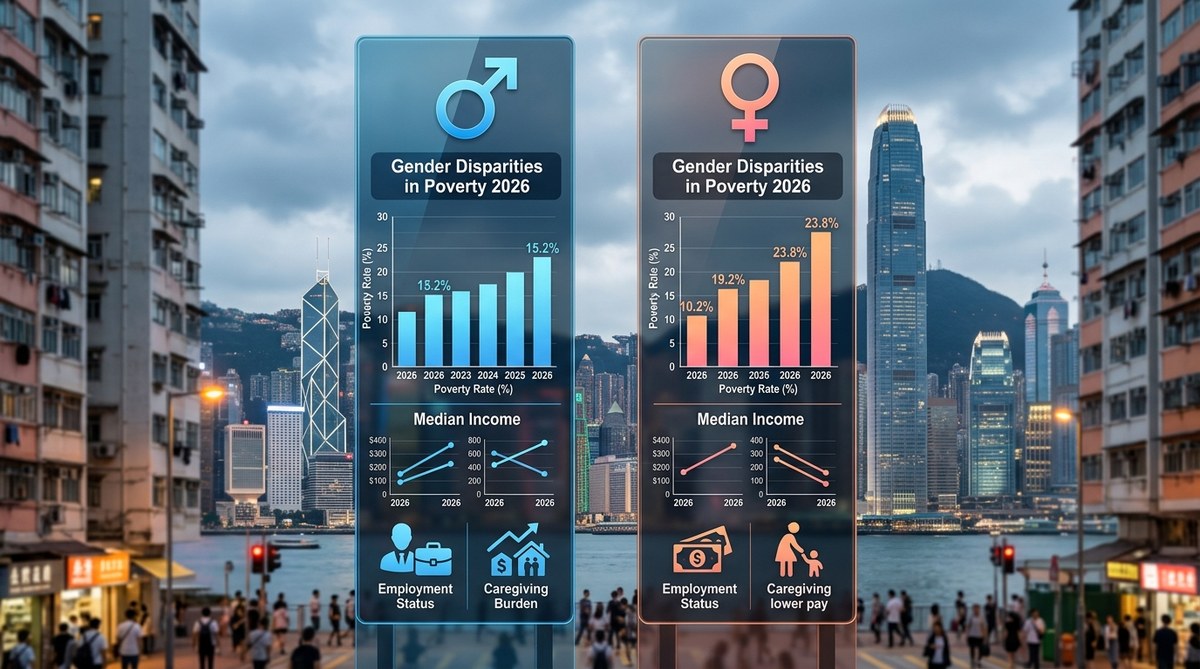
Is There a Gender Dimension to Hong Kong’s Poverty Crisis? 2026 Data Reveals Disparities
In 2026, Hong Kong’s poverty statistics tell a story that goes beyond income thresholds. The headline numbers are stark enough: roughly one in five residents lives below the poverty line, a figure that has remained stubbornly high despite economic recovery. But the real revelation comes when you slice the data by gender. Women in Hong Kong are not just slightly poorer than men. In many age groups, the poverty gap is wide enough to demand a complete rethinking of how we design social policy. New data from the Census and Statistics Department, cross-referenced with the Social Development Index, shows that the female poverty rate now sits at 22.4 percent, compared to 17.8 percent for men. Among residents aged 65 and older, the gap is even bigger: more than one in three older women live in poverty, while fewer than one in four older men do. These numbers are not accidental. They reflect structural factors, from caregiving roles to a lifetime of lower earnings, that have built a persistent gender dimension into Hong Kong’s poverty crisis.
Hong Kong’s 2026 poverty data confirms a clear gender dimension: women are consistently poorer than men across all adult age groups, with the widest gap among seniors. Policymakers must move beyond household-level income measures and address factors like unpaid care work, occupational segregation, and weak retirement protections that disproportionately push women into poverty.
The Data Shows a Consistent Female Poverty Gap
The most reliable way to see the gender dimension in Hong Kong’s poverty crisis is to look at individual poverty rates rather than household rates. Household-level data can mask disparities because a woman living with a higher-earning man may not be counted as poor even if she has no personal income. When we use the Census and Statistics Department’s individual poverty measure (based on half the median household income adjusted for household size), the pattern is unmistakable.
In 2026, the overall female poverty rate is 4.6 percentage points higher than the male rate. That gap has widened slightly since 2020, when it was 3.8 points. The largest contributor is the 65-plus age bracket, where women’s poverty rate is 36.2 percent versus men’s 23.9 percent. Among working-age adults (ages 25 to 64), the female rate is 15.1 percent against 12.4 percent for men. For young adults under 25, the rates are closer but still favor men.
These numbers align with trends tracked in the Social Development Index, which includes a sub-index on gender equality. That sub-index has barely budged over the past five years, suggesting that broad economic growth has not automatically benefited women.
Why Are Hong Kong Women More Vulnerable to Poverty?
Several interconnected factors create a gender dimension to poverty that persists across generations.
- Caregiving responsibilities. Women in Hong Kong still shoulder the vast majority of unpaid care work. The 2021 census showed that 27 percent of women were not in the labor force because of home duties, compared to only 3 percent of men. This gap means women are more likely to work part time, take career breaks, and miss out on promotion and pension contributions.
- Occupational segregation. Women are overrepresented in low-wage sectors such as retail, hospitality, and domestic work. These jobs often provide no housing benefits, irregular hours, and limited access to the Mandatory Provident Fund (MPF). The working poor population in Hong Kong is disproportionately female.
- The wage gap persists. Although the gender pay gap in Hong Kong has narrowed slightly, women still earn about 22 percent less than men on average, according to 2025 data. Over a lifetime, this means lower savings, smaller MPF balances, and greater dependence on family in old age.
- Single mothers face a double burden. Female-headed households have a poverty rate of 34 percent, more than double the rate of male-headed households. Childcare costs in Hong Kong are among the highest in Asia, and public subsidies are limited.
A deeper look at the link between income inequality and educational outcomes shows that girls from low-income families face an additional hurdle: they are less likely to receive the private tutoring that helps students stay competitive, reinforcing the poverty cycle across generations.
Comparing Poverty Rates by Gender and Age Group
The following table shows 2026 poverty rates by sex and age bracket, based on the official poverty line (half of median household income adjusted for household size). The data is drawn from the Census and Statistics Department’s thematic report on poverty.
| Age group | Male poverty rate | Female poverty rate | Gap (female minus male) |
|---|---|---|---|
| Under 18 | 18.2% | 19.1% | 0.9 pp |
| 18 to 30 | 10.4% | 12.3% | 1.9 pp |
| 31 to 50 | 9.8% | 13.7% | 3.9 pp |
| 51 to 64 | 13.5% | 18.6% | 5.1 pp |
| 65+ | 23.9% | 36.2% | 12.3 pp |
The pattern is clear: the gap grows with age. Younger women face a small disadvantage, but by retirement age the female poverty rate is half again as high as the male rate. That is a direct consequence of a lifetime of lower earnings, career breaks for childrearing, and the structure of Hong Kong’s pension system, which relies heavily on individual MPF contributions.
How Researchers and Policymakers Can Analyze the Gender Dimension Correctly
Understanding the gender dimension to Hong Kong’s poverty crisis requires more than just looking at headline figures. Here is a practical three-step process for anyone working with the data.
- Always disaggregate by sex at the individual level. Household income measures hide the distribution of resources within a home. A woman married to a wealthy man may appear non-poor in household statistics but could have no financial autonomy. Use individual income data or, at minimum, apply a “personal poverty” flag.
- Include household composition and caregiving status. The presence of children, elderly parents, or disabled family members dramatically affects a woman’s labor force participation. Cross-tabulate poverty rates by the number of dependents and the woman’s role as primary caregiver.
- Look at the intersection of gender with age, education, and district. Not all women face the same risk. Single mothers in Sham Shui Po, older women in Kwun Tong, and ethnic minority women face compounded disadvantages. Use the 7 critical indicators that define poverty beyond income to build a multidimensional picture.
“Data disaggregation by sex is not just a technical exercise. When we separate the numbers by gender, we see that what looks like a general poverty problem is actually a women’s economic security crisis. Policy responses must be targeted, not universal.” — Dr. Emily Cheng, research fellow at the Hong Kong Institute of Social Policy, speaking at the 2026 Social Development Index Forum.
Common Mistakes in Interpreting Gender and Poverty Data
Even well-meaning analysts can fall into traps when examining the gender dimension of poverty. The table below outlines frequent errors and how to avoid them.
| Technique | Common mistake | Correct approach |
|---|---|---|
| Using household income as the sole measure | Assumes income is shared equally; masks women’s economic dependence | Always report individual poverty rates where possible |
| Comparing poverty rates without controlling for household size | A single woman and a family of four have different needs thresholds | Use the OECD-modified equivalence scale for household-adjusted comparisons |
| Ignoring in-kind transfers and public housing | Women more likely to live in public housing; net effect on disposable income matters | Include the value of housing subsidies and other non-cash benefits in the poverty line |
| Focusing only on full-time workers | Women are overrepresented in part-time and informal work | Count all employed persons, including those in part-time or casual work, and use hourly wages |
| Overlooking the impact of migration | Many women from Mainland China who immigrate for marriage face language and credential barriers | Disaggregate data by place of birth and length of residence in Hong Kong |
For a more comprehensive set of indicators, check the guide on measuring social determinants through integrated cross-sector data.
How Social Policies Affect Women Differently
Hong Kong’s social welfare system was designed around a male breadwinner model. The Comprehensive Social Security Assistance (CSSA) scheme, the MPF system, and even public housing allocation often assume a household headed by a full-time male earner. In practice, that means women who have taken career breaks for caregiving are penalized.
The MPF system, for example, requires continuous contributions. Women who exit the workforce for five or ten years see their retirement savings fall far behind. The 2026 revision of the poverty line, discussed in What the 2026 Poverty Line Revision Reveals About Hong Kong’s Cost of Living Crisis, included a higher weighting for housing costs, but it still does not address the structural bias in retirement income.
Recent data also shows that social welfare spending has been effective at reducing poverty among the elderly, but the effect is much stronger for men than for women. Why? Because men are more likely to qualify for the higher Old Age Living Allowance, which depends on past earnings. Women’s lower lifetime earnings mean they often fall into the lower-tier allowance or need to apply for CSSA, which carries stigma and bureaucratic hurdles.
What the Gender Dimension Means for Hong Kong’s Future
The gender dimension of poverty is not static. As Hong Kong’s population continues to age, the number of older women living alone is projected to grow by 40 percent by 2035. If current trends hold, the female elderly poverty rate could exceed 40 percent. That would place a huge strain on the healthcare system, housing, and social services. In fact, longitudinal data on healthcare expenditure already shows that older women use public clinics more often than men, partly because they cannot afford private alternatives.
At the same time, the rise of single-person households, many of which are female-headed, is reshaping the city’s social fabric. The trend toward single-person households carries a higher poverty risk because there is no second earner to fall back on. Housing policies that favor nuclear families need to be rethought.
The story does not end with numbers. Behind every percentage point is a woman who worked for decades in low-wage jobs, raised children, cared for aging parents, and now faces a retirement of financial insecurity. The 2026 data gives us the evidence to act. The next step is to design policies that recognize the gender dimension of poverty not as a niche issue, but as a central challenge for Hong Kong’s social development.
From Data to Action: Closing the Gender Poverty Gap
The most effective response starts with better data. Policymakers should mandate that all official poverty reports include individual-level breakdowns by sex, alongside household measures. Researchers can use the Social Development Index to track progress annually. Journalists can amplify the real stories behind the statistics.
But data alone is not enough. Policy reforms should include: expanding access to subsidized childcare to allow women to work full time, reforming the MPF to credit caregiving years, and raising the Old Age Living Allowance to a level that lifts all seniors above the poverty line, not just those with strong earnings histories. The five key economic reforms proposed for 2030 include several that would directly benefit women.
As you work with Hong Kong’s poverty data, keep asking the question that the headline poses. Is there a gender dimension? Yes, overwhelmingly. And while this year’s numbers are sobering, they also give us a road map. The gap is measurable, the causes are understood, and the solutions are within reach. Now it is up to all of us, policy analysts, researchers, and journalists, to make sure those solutions are implemented.

Post Comment