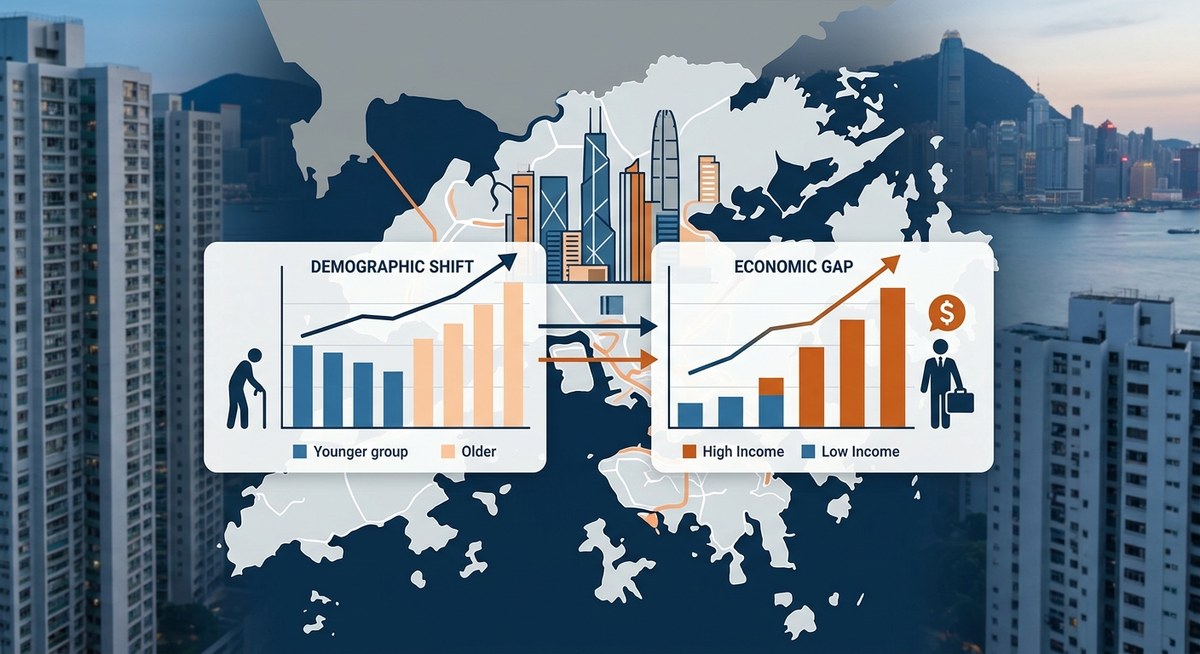
Aging and Inequality: How Hong Kong’s Demographic Shift Is Widening the Economic Gap
Hong Kong is growing older, and the distance between its rich and poor is growing wider. These two trends are not just happening at the same time. They are feeding each other. As the city ages, the economic gap is not just persisting. It is deepening in ways that affect housing, health, and hope for millions. For policymakers and social advocates, understanding this link is key to building a fairer future.
Hong Kong’s demographic shift is a hidden driver of inequality. The rising share of elderly residents, combined with inadequate pension coverage, surging housing costs, and a weakening safety net, means that the aging population is disproportionately bearing the brunt of economic disparity. Data from the Social Development Index reveals that while overall poverty is stable, elderly poverty is climbing. Understanding this connection is essential for designing targeted policies.
The Demographic Shift: A Numbers Story
Hong Kong has one of the highest life expectancies in the world. In 2026, a woman born here can expect to live to 88. A man to 83. At the same time, the fertility rate has dropped to around 0.8 children per woman. That is one of the lowest anywhere. The result: by 2030, roughly one in three Hong Kong residents will be 65 or older.
This is not just a curiosity for demographers. It reshapes the economy in concrete ways. A shrinking working-age population has to support a growing pool of retirees. But here is the catch. The wealth from Hong Kong’s decades of growth is not shared evenly. Older adults are more likely to be poor, and they are becoming a larger share of the population. For more on the underlying causes, read about the fertility crisis why Hong Kong has one of the world’s lowest birth rates and how Hong Kong’s aging population will reshape social services by 2030.
Three Pathways From Graying to Gaping
How exactly does an older population widen the economic gap? Let us break it down into three clear mechanisms.
-
Pension inadequacy. Hong Kong’s Old Age Living Allowance provides a basic income, but it is far below the poverty line. Many elderly rely on savings that were never enough. Those who worked low-wage jobs in their youth have almost nothing saved. The gap between those with workplace pensions and those without is stark.
-
Housing inheritance inequality. Property ownership is the single biggest driver of wealth in Hong Kong. Older homeowners have seen their flats skyrocket in value. Their children inherit that wealth. But elderly renters or those living in subdivided units pass down nothing. This creates a self-perpetuating cycle. The already wealthy stay wealthy across generations.
-
Wage stagnation for older workers. After age 50, many Hong Kong workers face declining job prospects. They are pushed into low-paid roles like security guards or cleaners. Their incomes shrink just as healthcare costs rise. Meanwhile, high-income professionals continue to earn and save well into their 60s.
These three forces combine to make the post-retirement experience radically different depending on your starting point. To see how this has evolved over decades, look at how income inequality in Hong Kong has evolved over three decades.
The Numbers That Tell the Real Story
Let us look at some key figures from the most recent data (2026). The table below compares overall income inequality with elderly-specific measures.
| Indicator | Overall Population | Elderly (65+) |
|---|---|---|
| Gini coefficient (post-transfer) | 0.45 | 0.52 |
| Poverty rate (before social transfers) | 20.2% | 47.8% |
| Poverty rate (after social transfers) | 14.7% | 32.1% |
| Median monthly income | HKD 22,500 | HKD 9,800 |
| Homeownership rate | 51% | 62% (but 38% rent or live in subdivided housing) |
The story is clear. The elderly poverty rate is more than double the overall rate, even after government handouts. And the wealth concentration among older homeowners hides the fact that nearly 40% of seniors have no housing safety net. For a district-level breakdown, see how many Hong Kong residents live in poverty by location and age group.
Why Traditional Safety Nets Fall Short
Hong Kong has a small government by design. Its social welfare spending is modest compared to other developed economies. For an aging population, this creates several gaps.
- Pension is not enough. The Old Age Living Allowance is about HKD 4,000 per month. The average rent for a subdivided flat is over HKD 6,000. That leaves almost nothing for food, transport, and medicine.
- Healthcare costs are rising. Public hospitals are overcrowded. Wait times for specialist appointments can be years. Many elderly end up paying for private care or just skipping it.
- Public housing wait times stretch over a decade. Elderly applicants often die before receiving a flat. Meanwhile, private rents have risen 40% in the last decade.
The result is that the older you are, the more fragile your economic position becomes. This is not just a problem for the elderly. It affects everyone. When seniors spend almost all their income on rent, they cannot help support their adult children. The whole family feels the squeeze. To understand how housing costs drive poverty, read analyzing the impact of housing costs on poverty levels in Hong Kong.
“We are seeing a two-speed society. One in which older professionals with property and pensions are comfortable, while older low-skilled workers face destitution. The gap is not going to close by itself. It requires rethinking the entire safety net.” — Dr. May Wong, social policy researcher at the University of Hong Kong.
How We Measure Inequality Matters
Standard economic indicators like GDP per capita miss the lived reality. The Social Development Index (SDI) tracks a wider set of measures, including health, education, and housing. When we look at the SDI, a worrying pattern appears.
Overall social development has stagnated since 2018. But the sub-index for elderly well-being has actually declined. This is driven by rising poverty rates and worsening housing conditions for seniors. The SDI gives us a more honest picture than income statistics alone. For a full guide, learn how Hong Kong’s Social Development Index reveals hidden inequality patterns.
What Policymakers Can Learn From the Data
The numbers point to several clear actions. Here are five that emerge from the data.
- Increase the Old Age Living Allowance to at least HKD 6,000 per month, indexed to inflation.
- Build more public rental housing specifically for elderly singles and couples.
- Expand community care services to reduce the out-of-pocket health costs for seniors.
- Strengthen mandatory provident fund contributions and close loopholes for low-wage workers.
- Collect and publish age-disaggregated data on income, wealth, and housing annually.
These are not radical ideas. They are common in comparable cities like Singapore and Seoul. The data supports them. The challenge is political will. For more on what welfare spending can achieve, see does social welfare spending reduce poverty analyzing two decades of evidence.
From Data to Action
Hong Kong’s aging inequality is not a destiny. It is a policy choice made visible through data. Every year the gap widens, more seniors slip below the poverty line. But the same data that reveals the problem can also point to solutions.
Researchers and advocates can use these statistics to push for change. Show a lawmaker the Gini coefficient for the elderly. Point to the poverty rate among renters. Reference the SDI decline. Numbers can persuade where stories alone may not. Start with the tracking two decades of social change through Hong Kong’s development index to see the long-term trend.
The next step is yours. Whether you are writing a policy brief, preparing a presentation, or just trying to understand your own family’s situation, the data is here. Use it. Share it. And keep pushing for a Hong Kong where age does not determine your economic fate.

Post Comment