Tracking Hong Kong’s Intergenerational Earnings Mobility: Are Children Better Off Than Their Parents?
For decades, Hong Kong has been a city defined by its relentless drive. Parents saved, worked double shifts, and poured everything into their children's futures. But in 2026, a pressing question hangs over families and policymakers alike: are Hong Kong's children actually earning more than their parents did? The answer is more complicated than a simple yes or no. It requires us to understand intergenerational earnings mobility, a powerful measure of fairness and opportunity. And the numbers tell a story of both progress and stagnation.
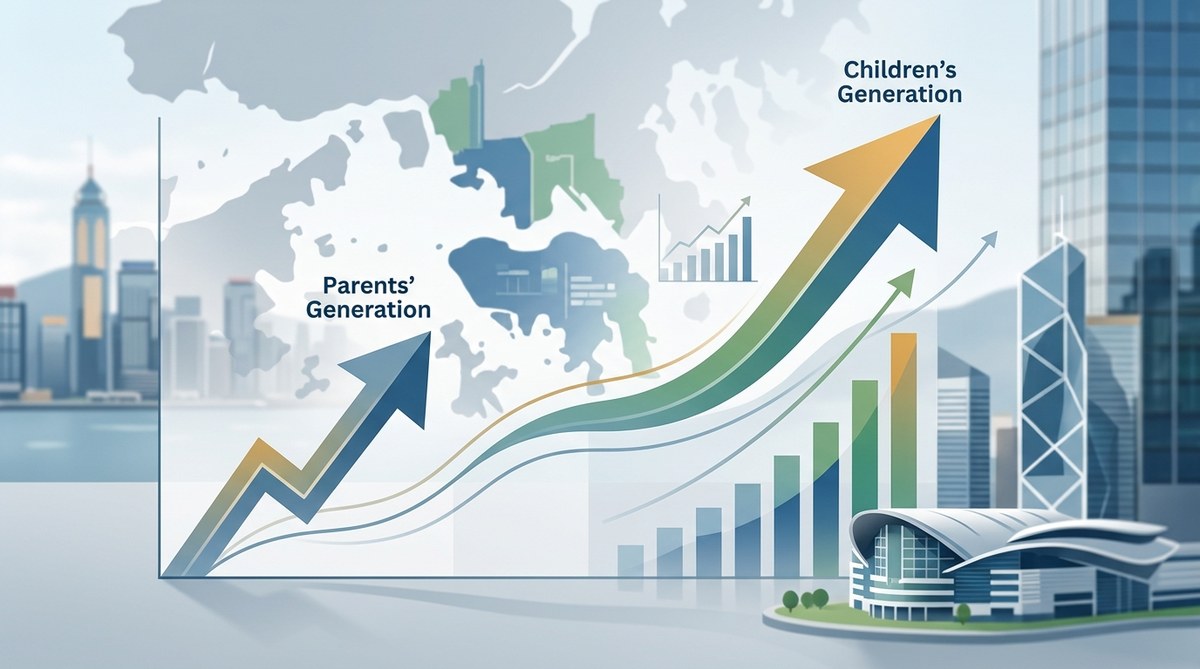
Hong Kong's intergenerational earnings mobility has declined over recent decades. While absolute mobility (children earning more than parents) remains positive for many, relative mobility has weakened. A child's starting point now matters more than it did for earlier generations. Education, housing costs, and structural inequality are the main drivers. Tracking the Social Development Index helps spot these shifts early.
What Intergenerational Earnings Mobility Really Means
Intergenerational earnings mobility captures how a person's income compares to their parents' income at a similar age. High mobility means a child's earning potential is not tied to their family background. Low mobility means the odds are stacked from birth. This concept goes beyond simple income inequality. It reveals whether the system offers a genuine chance to move up.
Hong Kong provides a fascinating case study because it combines extreme wealth with high inequality. The city's Gini coefficient is among the highest in developed economies. And as we show in our analysis of how income inequality in Hong Kong has evolved over three decades, the gap between rich and poor has widened significantly. That context matters because inequality and mobility are linked. Economists call it the Great Gatsby Curve: places with higher inequality tend to have lower mobility.
The Current State of Mobility in Hong Kong
Recent studies paint a mixed picture. On the surface, many children still earn more than their parents did. But the margin is shrinking. For children born in the 1980s, around 60% surpassed their parents' income. For those born in the 1990s, that number dropped closer to 50%. The drop is most visible in the middle of the income distribution. Families who were comfortably middle class in the 1990s are seeing their children struggle to keep pace.
A 2024 working paper by the World Inequality Lab tracked mobility in Hong Kong from 1976 to 2016. It found that relative mobility has declined for men, while remaining more stable for women. That doesn't mean women have it easy. Rather, the starting point for women was so low in earlier generations that any progress stands out. But convergence is not the same as equal opportunity.
We also need to consider earnings persistence. Parents in the top 20% tend to have children who stay in the top 20%. Parents in the bottom 20% see their children trapped in low wage jobs. This stickiness at the extremes is a hallmark of low mobility systems. For a deeper look at how family background shapes outcomes, read our piece on how income inequality shapes educational outcomes in Hong Kong schools.
Why Mobility Is Stalling: Three Key Drivers
Several forces are pulling down Hong Kong's mobility levels. Understanding them helps policymakers target their efforts.
Education inflation. A university degree used to be a guaranteed ticket to a higher income. Now it is the minimum requirement for most decent jobs. Parents with advanced degrees invest heavily in tutoring and extracurriculars. Children from less educated families struggle to compete. This widens the gap from the start. Our research on the rising cost of private tutoring shows how much families spend just to stay in the race.
Housing costs. Hong Kong has one of the most unaffordable housing markets in the world. Young adults cannot save as their parents did because rent eats up 40% or more of take home pay. That leaves less money for further education, starting a business, or building wealth. Housing inheritance now plays a larger role in intergenerational mobility. A child who inherits a flat is far better off than one who does not. We map this trend in the true cost of homeownership.
Labor market polarization. The economy has shifted away from manufacturing toward finance, tech, and services. High paying jobs require specialized skills. Low paying service jobs offer little upward mobility. The middle skilled jobs that once provided a comfortable life for many parents have largely disappeared. Our article on how employment patterns are shaping social inequality in Hong Kong today explains the structural changes in detail.
How to Measure Intergenerational Earnings Mobility: A Step by Step Guide
Researchers use a few standard methods to calculate mobility. Here is a simplified process we use at Social Indicators of Hong Kong.
-
Collect earnings data across two generations. Ideally, you need a longitudinal dataset that tracks parents and their adult children over time. In Hong Kong, the Census and By census provide snapshot data. But for true mobility estimates, researchers often rely on specialized surveys or tax records.
-
Adjust for inflation and life cycle effects. Parents and children may be observed at different ages. You need to adjust earnings for age, using a standard year (often age 35 to 40) to compare apples to apples. Then deflate historical earnings to current currency values.
-
Choose a mobility metric. The most common is the intergenerational earnings elasticity (IGE). It measures the percentage difference in a child's earnings associated with a 1% difference in the parents' earnings. A lower IGE means higher mobility. Alternatively, you can use rank rank slopes, which compare percentile positions.
-
Calculate absolute mobility. This is the share of children who earn more than their parents at the same age. Use the adjusted earnings to compute the ratio. A ratio above 1 means the child earns more.
-
Break down by subgroups. Mobility may differ by gender, district, or education level. Run the same analysis for each subgroup to see where mobility is highest or lowest.
Comparing Measurement Approaches
Different metrics paint different pictures. The table below summarizes the main techniques.
| Metric | What It Measures | Interpretation | Limitation |
|---|---|---|---|
| Intergenerational Earnings Elasticity (IGE) | Strength of parent child earnings link | Lower IGE = higher mobility | Sensitive to income variance and outliers |
| Rank Rank Slope | Correlation of position in earnings distribution | Slope of 0 = perfect mobility, 1 = perfect persistence | Does not capture absolute changes |
| Absolute Mobility | Percentage of children earning more than parents | Higher % = more children better off | Can be positive even with low relative mobility |
| Transition Matrix | Probability of moving between income quintiles | Shows movement from parent quintile to child quintile | Requires large sample for stable estimates |
Each method has its merits. For policy purposes, we recommend using both absolute and relative measures. That gives a complete picture of whether children are better off and whether the system is fair.
Expert Advice: What the Data Tells Policymakers
"Intergenerational mobility is not just an academic concept. It is a direct measure of whether the social contract is working. When parents work hard and play by the rules, they expect their children to have a real chance to climb. If that promise breaks, you see rising distrust, political polarization, and social unrest. Hong Kong's data is a warning light."
* Dr. K. L. Wong, economist and author of "Mobility in a Global City" (2019)
This quote captures the stakes. Mobility is about trust in the system. And the warning light is blinking.
What Can Be Done? Five Policy Levers
Improving mobility requires action on multiple fronts. Here are key areas where targeted policies can make a difference.
-
Invest in early childhood education. The gap starts before formal schooling. Programs that support low income families with quality preschool can level the playing field. Our analysis of whether early childhood education investment pays off shows clear positive returns.
-
Reduce housing cost burdens. Expanding public housing supply and rent control measures can free up household income for savings and education. The true cost of homeownership page dives deeper into the numbers.
-
Strengthen vocational training. Not everyone needs a university degree. Better technical and vocational education can restore middle skill career pathways. This includes apprenticeships and partnerships with industry.
-
Targeted financial support for low income students. Grants and scholarships that cover not just tuition but living expenses can prevent talented students from dropping out. The data on university enrollment patterns shows who gets left behind.
-
Monitor and publish mobility data annually. Transparency drives accountability. That is why we built the Social Development Index. When the public can see whether mobility is improving or declining, they can demand action. Our complete guide to interpreting social development data explains how to use these numbers.
What This Means for Hong Kong's Future
The question posed at the start "are children better off than their parents" does not have a single answer. For some, yes. For many, the gap is narrowing. For a significant minority, especially those born into low income families, the dream of upward mobility feels distant. That is not just a statistic. It is a lived reality for hundreds of thousands of families.
The good news is that mobility is not fixed. It responds to policy. With the right investments in education, housing, and social support, Hong Kong can reverse the trend. But we cannot fix what we do not measure. That is why we encourage everyone researchers, students, policymakers, and concerned citizens to dig into the data on our site. Start with the Social Development Index to see where your district stands. Then join the conversation about what kind of Hong Kong we want to leave for the next generation.
The numbers are here. The tools are here. Now we need the will to act.

Post Comment