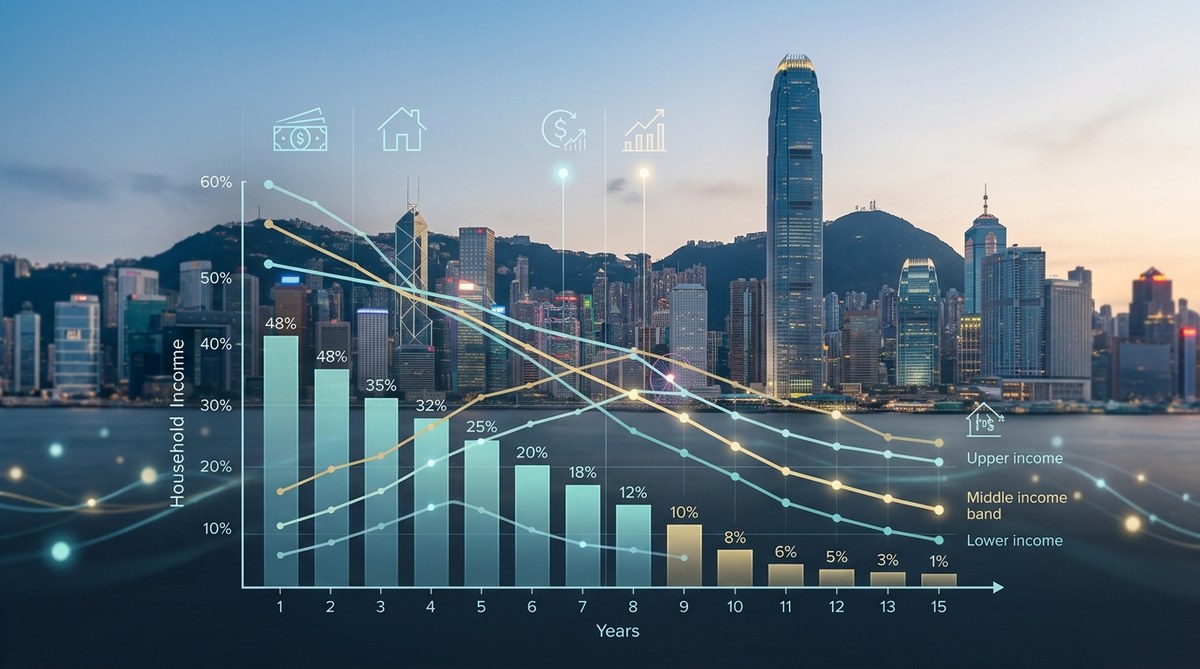
Tracking Hong Kong’s Middle Class Decline Through 15 Years of Household Income Data
Hong Kong’s middle class is shrinking, and the numbers tell a story that official GDP figures often obscure. Over the past 15 years, household income data reveals a troubling pattern: the economic group that once formed the backbone of the city’s prosperity is steadily losing ground. This isn’t speculation or anecdotal observation. The data shows clear evidence of polarization, with wealth concentrating at the top while middle-income households face mounting pressure from rising costs and stagnant wages.
Hong Kong’s middle class has experienced measurable contraction over 15 years, with household income data showing widening gaps between upper and lower income groups. Rising housing costs, wage stagnation, and economic restructuring have squeezed middle-income earners, creating policy challenges that demand evidence-based responses. Understanding these trends requires examining multiple indicators beyond simple income brackets, including purchasing power, housing affordability, and intergenerational mobility patterns.
What the household income data actually shows
The statistical evidence paints a picture that contradicts the narrative of broad-based prosperity. Between 2006 and 2021, the proportion of households earning middle-range incomes decreased while both ends of the spectrum expanded. This hollowing out effect appears most pronounced among households earning between 50% and 150% of median income.
The data reveals three distinct phases. From 2006 to 2011, middle-income households maintained relative stability. The period from 2012 to 2016 saw gradual erosion. After 2017, the pace accelerated significantly.
Income distribution shifted measurably during this period. Households in the top 20% increased their share of total income from 47% to 52%. Meanwhile, the middle 60% saw their collective share drop from 45% to 41%. The bottom 20% remained relatively stable at around 7% to 8%.
These percentages represent real households facing real consequences. A family earning HK$30,000 monthly in 2006 would need approximately HK$42,000 in 2021 just to maintain the same purchasing power. Yet median household income growth lagged behind this requirement by nearly 15%.
Breaking down the numbers by household type
Different household configurations experienced the decline differently. Single-person households in middle-income brackets faced the steepest drops, with their real income growth averaging just 0.8% annually compared to 2.3% for dual-income professional couples.
Families with children encountered unique pressures. How income inequality shapes educational outcomes in Hong Kong schools demonstrates how education costs amplified financial strain on middle-class families, creating a squeeze effect that income figures alone don’t capture.
Elderly households showed surprising resilience initially, benefiting from property ownership and pension income. However, after 2015, this group began experiencing deterioration as healthcare costs rose faster than inflation and property values plateaued in some districts.
The working poor category expanded significantly. These households, despite full employment, couldn’t maintain middle-class living standards. Understanding the working poor: employment statistics that challenge common assumptions provides context for this phenomenon.
Why housing costs destroyed middle-class purchasing power
Housing expenses consumed an ever-larger share of middle-class budgets. In 2006, the median middle-income household spent 28% of income on housing. By 2021, that figure reached 43%.
Property prices increased 180% during this period while median household income grew only 65%. This divergence made homeownership increasingly unattainable for middle-income earners. First-time buyers needed an average of 21 years of savings in 2021 compared to 12 years in 2006.
Rental markets offered no relief. Monthly rents for typical two-bedroom flats in non-premium districts rose from HK$8,500 to HK$15,000, outpacing income growth by a factor of 1.7.
The true cost of homeownership: tracking property price-to-income ratios over two decades examines how this affordability crisis reshaped household financial strategies and forced middle-class families into difficult trade-offs.
The spatial dimension matters too. Middle-income households increasingly relocated to peripheral districts where housing remained marginally affordable, accepting longer commutes and reduced access to amenities. This geographic sorting intensified social stratification.
Tracking the decline through specific income brackets
Examining specific income ranges reveals granular patterns. Households earning HK$20,000 to HK$30,000 monthly saw their proportion of total households drop from 23% to 18%. The HK$30,000 to HK$50,000 bracket declined from 19% to 16%.
Meanwhile, households earning above HK$80,000 monthly increased from 8% to 14%. Those earning below HK$15,000 rose from 15% to 17%.
Here’s how different income brackets shifted:
| Income Bracket (HKD) | 2006 Share | 2021 Share | Change |
|---|---|---|---|
| Below 15,000 | 15% | 17% | +2% |
| 15,000-20,000 | 12% | 13% | +1% |
| 20,000-30,000 | 23% | 18% | -5% |
| 30,000-50,000 | 19% | 16% | -3% |
| 50,000-80,000 | 13% | 14% | +1% |
| Above 80,000 | 8% | 14% | +6% |
These shifts indicate polarization rather than uniform growth. The middle brackets contracted while extremes expanded.
How to interpret middle class decline using multiple indicators
Relying solely on income brackets provides incomplete analysis. A comprehensive assessment requires examining several dimensions simultaneously.
-
Calculate real purchasing power by adjusting nominal income for inflation using category-specific price indices rather than general CPI, since middle-class consumption patterns differ from the average.
-
Measure housing affordability ratio by dividing median property prices by median annual household income, tracking changes over time and across districts to identify geographic variations.
-
Assess consumption capacity by analyzing discretionary spending patterns, particularly in categories like dining out, travel, and education, which middle-class households typically prioritize when financially comfortable.
-
Evaluate wealth accumulation by examining savings rates, investment portfolio values, and retirement preparedness rather than just current income flows.
-
Track intergenerational mobility by comparing children’s economic outcomes to their parents’ positions, identifying whether middle-class status remains achievable for the next generation.
This multi-indicator approach reveals nuances that single metrics miss. A household might maintain nominal middle-class income while experiencing declining real living standards due to cost pressures.
The role of economic restructuring in class composition
Hong Kong’s economic transformation contributed significantly to middle-class erosion. Service sector expansion created polarized job markets with high-paying professional roles and low-wage service positions, but fewer middle-income opportunities.
Manufacturing decline eliminated traditional pathways to middle-class stability. In 1990, manufacturing employed 28% of the workforce at middle-income wages. By 2020, this sector represented just 3% of employment.
Finance and professional services grew dramatically but required credentials and connections that created barriers to entry. These sectors offered excellent compensation for those who accessed them but employed relatively few workers compared to their economic output.
What do 20 years of GDP data reveal about Hong Kong’s economic resilience? shows how aggregate economic growth masked distributional problems.
Technological change automated many middle-skill jobs while creating demand at both high and low skill levels. Administrative roles, mid-level management positions, and skilled trades all experienced employment contraction.
Common mistakes when analyzing income distribution data
Analysts frequently misinterpret household income statistics, leading to flawed conclusions. Recognizing these errors improves data literacy.
Mistake 1: Ignoring household size changes. Average household size decreased from 3.1 to 2.7 persons during the study period. Per-capita income calculations must account for this demographic shift to enable valid comparisons.
Mistake 2: Overlooking composition effects. Population aging means more retired households with lower incomes appear in the data, potentially exaggerating middle-class decline if not properly controlled.
Mistake 3: Neglecting geographic cost variations. Living costs differ substantially across Hong Kong’s districts. An income considered middle-class in Yuen Long might be lower-class in Central.
Mistake 4: Focusing only on labor income. Investment returns, property income, and transfers constitute significant portions of household resources, especially for established middle-class families.
Mistake 5: Using inappropriate inflation adjustments. The CPI basket doesn’t reflect middle-class consumption patterns accurately, particularly regarding housing, education, and healthcare costs that rose faster than general inflation.
Youth and the disappearing middle-class ladder
Younger cohorts face unprecedented barriers to middle-class entry. A 30-year-old in 2021 earned 12% less in real terms than a 30-year-old in 2006, despite having higher educational credentials on average.
Entry-level professional salaries stagnated while credential requirements intensified. Positions that once required bachelor’s degrees now demand master’s qualifications, imposing additional costs and delayed earnings without commensurate salary increases.
Youth unemployment and underemployment: statistical trends shaping a generation documents how younger workers experienced disproportionate economic pressure.
Career progression timelines lengthened. The typical path from entry-level to middle-management roles that once took 7 years now requires 11 years, delaying peak earning periods and compressing lifetime wealth accumulation windows.
The data shows that each successive cohort entering the workforce since 2008 has faced worse prospects than the previous one. This isn’t about individual effort or merit. The structural conditions for middle-class attainment have fundamentally changed.
Comparing Hong Kong’s pattern to regional trends
Hong Kong’s middle-class decline fits within broader regional patterns but exhibits unique characteristics. Singapore experienced similar polarization but maintained stronger wage growth at median income levels through active labor market policies.
South Korea saw middle-class erosion driven primarily by employment precarity rather than housing costs, though both factors operated. Japan’s pattern differed, with middle-class stability maintained longer before demographic aging accelerated decline.
Mainland Chinese cities experienced middle-class expansion during the same period, creating an interesting contrast. Shenzhen and Shanghai grew their middle-income populations while Hong Kong’s contracted.
Taiwan’s trajectory most closely resembled Hong Kong’s, with housing costs and wage stagnation producing similar outcomes despite different political and economic contexts.
These comparisons suggest that Hong Kong’s experience reflects both global trends toward income polarization and specific local factors including land policy, economic structure, and demographic patterns.
What policy responses the data suggests
Evidence-based policy development requires acknowledging what the data reveals. Several intervention points emerge from the analysis.
Progressive taxation could address income concentration. Hong Kong’s tax system remains relatively flat, doing little to redistribute gains from economic growth. Marginal rate increases on top earners could fund programs supporting middle-income households.
Housing supply expansion represents an obvious priority. Does public housing still work? evaluating wait times and allocation efficiency examines current program limitations and potential improvements.
Wage policy intervention might include minimum wage adjustments indexed to median income rather than inflation, ensuring lower earners maintain relative position as the economy grows.
Education cost controls could reduce middle-class financial pressure. The rising cost of private tutoring: what the data tells us about Hong Kong families demonstrates how supplementary education expenses strain household budgets.
Healthcare financing reform addressing out-of-pocket costs would particularly benefit middle-income households who earn too much for full subsidies but struggle with serious illness expenses.
The connection between middle-class decline and broader inequality
Middle-class erosion doesn’t occur in isolation. How income inequality in Hong Kong has evolved over three decades provides broader context for understanding these patterns.
Gini coefficient measurements show overall inequality increasing from 0.518 in 2006 to 0.539 in 2021. This deterioration reflects both top-end income concentration and middle-class hollowing.
Poverty rates increased simultaneously. How many Hong Kong residents live in poverty? breaking down the latest statistics by district and demographics documents how economic polarization pushed more households below poverty thresholds.
The relationship operates bidirectionally. Growing inequality makes middle-class maintenance harder by raising the cost of positional goods like education and housing. Simultaneously, middle-class decline reduces the moderating force that historically constrained extreme inequality.
Social cohesion metrics correlate with middle-class size. Societies with robust middle classes typically exhibit higher trust, civic participation, and institutional stability. Hong Kong’s social indicators declined alongside middle-class contraction.
Measuring decline beyond income statistics
Income data provides essential evidence but doesn’t capture all dimensions of middle-class experience. Subjective measures reveal additional insights.
Self-identification surveys show declining middle-class identity. In 2006, 58% of respondents classified themselves as middle class. By 2021, only 47% did so despite similar objective income positions.
Financial security perceptions deteriorated sharply. The proportion of middle-income households reporting they could handle a HK$50,000 emergency expense dropped from 64% to 51%.
Lifestyle indicators shifted too. Restaurant dining frequency, overseas travel, and cultural activity participation all declined among middle-income households, suggesting reduced quality of life despite stable nominal incomes.
Stress and wellbeing measures worsened. How mental health services in Hong Kong have evolved over two decades connects economic pressure to psychological health outcomes.
These subjective dimensions complement statistical evidence, providing a fuller picture of middle-class experience.
District-level variations in middle-class population
Geographic analysis reveals that middle-class decline affected different areas unevenly. Central and Western district saw middle-income household proportions drop from 42% to 31%. Wan Chai experienced similar patterns.
New Territories districts like Yuen Long and Tuen Mun actually increased middle-income household shares slightly as families relocated seeking affordable housing. However, these gains often came with trade-offs in commute time and access to services.
Kowloon districts showed mixed patterns. Kowloon City maintained relatively stable middle-class presence while Sham Shui Po experienced significant erosion.
Mapping housing inequality: district-by-district statistical breakdown provides detailed geographic analysis of these patterns.
Understanding spatial dimensions matters for policy design. District-specific interventions might prove more effective than territory-wide programs that ignore local variation.
What the data means for future generations
Projection models based on current trends suggest continued middle-class contraction absent policy intervention. By 2030, middle-income households could represent just 35% of the population compared to 45% in 2006.
Intergenerational mobility appears increasingly constrained. Children born to middle-class families in 2021 face lower probability of maintaining that status than those born in 2006, even with similar educational attainment.
The fertility crisis: why Hong Kong has one of the world’s lowest birth rates connects economic pressure to demographic choices that will reshape society’s future composition.
Retirement security concerns intensify. Current middle-income workers in their 40s and 50s face inadequate pension accumulation given housing costs that prevented earlier savings.
The social contract that promised upward mobility through education and hard work appears broken for many. Restoring this compact requires acknowledging what the data shows and designing responses accordingly.
Using this data for advocacy and policy work
Researchers and advocates can leverage household income data effectively by following systematic approaches.
Start with clear definitions. Specify exactly what income range constitutes “middle class” in your analysis and justify that choice. Different definitions produce different results, so transparency matters.
Adjust for household size using equivalence scales that account for economies of scale in larger households. The square root of household size provides a reasonable adjustment factor.
Control for demographic composition changes through standardization techniques that separate pure distributional shifts from population aging or household size effects.
Compare multiple time points rather than just endpoints to identify trend breaks and acceleration periods that reveal policy impacts or economic shocks.
Supplement income data with consumption, wealth, and subjective measures to triangulate findings and strengthen conclusions.
The complete guide to interpreting social development data for policy advocacy offers additional methodological guidance.
Present findings accessibly. Convert percentages to concrete examples. Instead of “median income grew 65%,” say “a household earning HK$25,000 in 2006 would earn HK$41,250 in 2021.”
The statistical tools needed for proper analysis
Analyzing household income data rigorously requires specific technical skills. Understanding these tools helps evaluate research quality.
- Lorenz curves visualize income distribution graphically, plotting cumulative population share against cumulative income share to reveal inequality patterns
- Percentile ratios compare income levels at different distribution points, such as the 90th percentile to 50th percentile ratio, showing how top earners pull away from median
- Kernel density estimation reveals distribution shapes beyond simple summary statistics, identifying multiple peaks or gaps that suggest class structure
- Decomposition analysis separates total inequality into between-group and within-group components, isolating specific factors driving overall patterns
- Panel data methods track the same households over time rather than comparing different cross-sections, revealing mobility patterns that cross-sectional data miss
These techniques move beyond basic descriptive statistics to uncover causal relationships and structural patterns.
Statistical software like R or Python enables sophisticated analysis, but even spreadsheet tools can perform meaningful calculations when applied thoughtfully.
Why this matters for Hong Kong’s social fabric
Middle-class decline carries consequences beyond individual household finances. Social stability historically depends on a broad middle class with stake in the existing system.
Political participation patterns correlate with middle-class size. Declining middle-class populations often exhibit increased polarization and reduced civic engagement.
Consumer markets depend on middle-class purchasing power. Retail, hospitality, and service sectors suffer when middle-income households cut discretionary spending.
How Hong Kong’s social development index reveals hidden inequality patterns demonstrates broader social impacts of economic polarization.
Cultural vitality relies on middle-class patronage of arts, entertainment, and education. These sectors contract when their primary audience faces financial pressure.
The data compels attention not just for economic reasons but because middle-class health indicates overall social wellbeing.
Understanding what the numbers reveal about our shared future
Fifteen years of household income data tells an uncomfortable story about Hong Kong’s evolving social structure. The middle class that once defined the city’s character is measurably smaller, financially squeezed, and increasingly pessimistic about future prospects.
This isn’t inevitable. The trends reflect policy choices, economic structures, and priorities that can change. Recognizing what the data shows represents the first step toward evidence-based responses that might reverse these patterns.
For researchers, journalists, and advocates working on these issues, the statistical evidence provides powerful tools for making the case that current trajectories demand attention. The numbers don’t lie, even when they reveal truths we’d prefer to ignore.

Post Comment