Why Hong Kong’s Low-Wage Service Sector Is Trapping Workers in Poverty in 2026
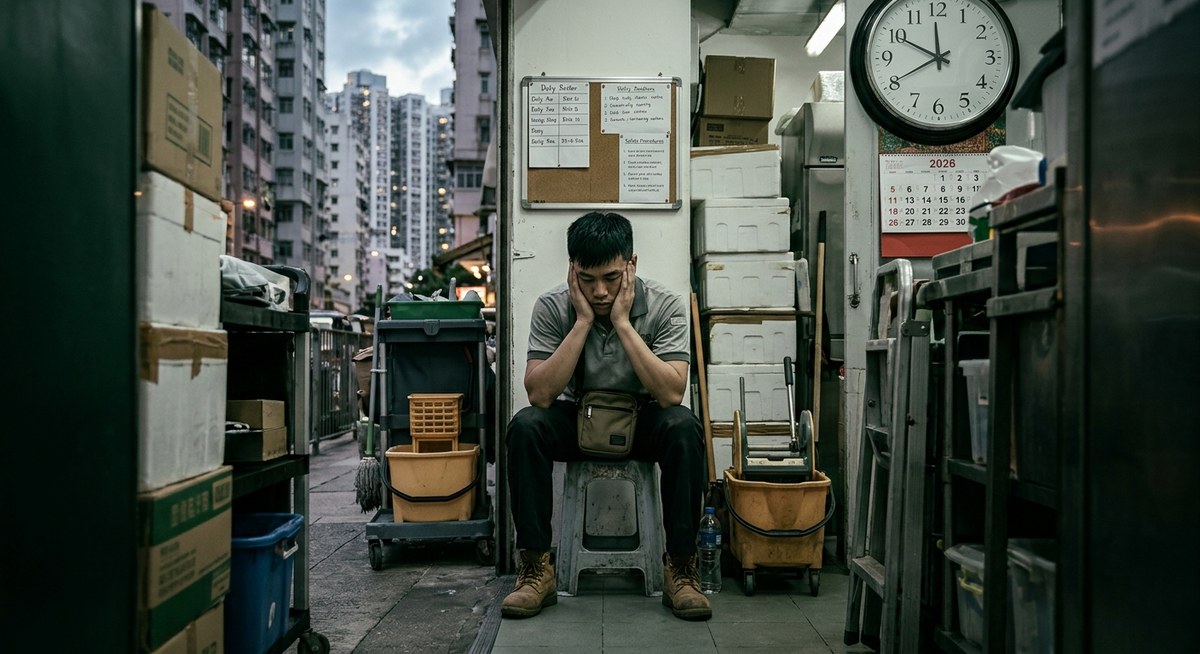
The glow of a neon “Open” sign in Mong Kok hides a hard truth. A security guard working a 12-hour shift, a cashier scanning items at a convenience store, a cleaner mopping the floors of a Central office tower. These workers keep Hong Kong running. Yet in 2026, a full-time job in the city’s vast service sector no longer guarantees an escape from poverty. The numbers are stark. While the cost of a subdivided flat and a bowl of noodles keeps climbing, wages for millions of service workers have barely budged. This is not a story about unemployment. It is a story about the failure of work itself to provide a decent life. We are digging into the latest data from the Social Development Index to show exactly how this trap works and why it demands urgent attention.
Hong Kong’s low-wage service sector is trapping workers in poverty through stagnant wages, soaring housing costs, and a minimum wage that fails to keep pace with inflation. In 2026, over 600,000 working households fall below the poverty line despite full employment. Policy changes, including a living wage and expanded public housing, are critical to breaking this cycle.
How the Service Sector Became a Poverty Trap
The service sector is the backbone of Hong Kong’s economy. It employs roughly 85% of the workforce. But a large portion of these jobs are in retail, food and beverage, cleaning, security, and hospitality. These roles share a common problem: they offer low pay, limited hours, and almost no upward mobility.
In 2026, the median monthly wage for a service worker in these categories hovers around HK$12,000. That sounds like a number until you subtract rent. A typical subdivided flat in Sham Shui Po costs HK$6,000 a month. Add utilities, food, and transport, and there is almost nothing left. The gap between earnings and basic expenses has widened every year since 2020.
What makes this a trap? It is not that people are lazy or unwilling to work. It is that the structure of the labor market prevents them from earning more. Many workers are stuck in part-time or casual contracts. They have no paid sick leave, no pension contributions, and no guarantee of stable hours. They work hard, but the system is designed to keep costs low for employers.
“The problem is not a lack of jobs. It is a lack of good jobs. We see workers holding two or three part-time positions just to cover rent, yet they still qualify as poor. That is a structural failure, not an individual one.” — Dr. Emily Ng, labor economist at the University of Hong Kong
The Minimum Wage: A Broken Safety Net
Hong Kong’s statutory minimum wage was introduced in 2011. It was meant to be a floor, not a ceiling. But in 2026, the floor is crumbling. The current rate is HK$40 per hour. That translates to about HK$9,600 a month for a 60-hour work week. That is below the poverty line for a single person.
The problem is the adjustment mechanism. The Minimum Wage Commission reviews the rate every two years, but the increases have been tiny and infrequent. Inflation in essentials like food and rent has outpaced these adjustments. In real terms, the minimum wage has lost value.
Here is a simple breakdown of the math:
| Year | Minimum Wage (HK$/hr) | Real Value Adjusted for Inflation (HK$) | Monthly Rent for Subdivided Flat (HK$) | Rent as % of Min Wage Income |
|---|---|---|---|---|
| 2019 | 37.5 | 37.5 | 4,500 | 47% |
| 2021 | 37.5 | 35.2 | 5,200 | 55% |
| 2023 | 40.0 | 36.1 | 5,800 | 60% |
| 2026 | 40.0 | 33.8 | 6,500 | 68% |
The table tells a clear story. In 2019, a minimum wage worker spent less than half their income on rent. By 2026, they spend over two-thirds. That leaves almost nothing for food, healthcare, or savings. The safety net has become a noose.
Why Disposable Income Growth Has Stalled for the Bottom 40%
This is not just about the minimum wage. It is about the broader wage structure. Data from the Census and Statistics Department shows that the bottom 40% of earners have seen their disposable income grow by less than 2% per year since 2020. Meanwhile, the top 10% have seen gains of over 8% annually.
Why are service sector wages stuck? Several factors are at play:
- Oversupply of labor. The service sector has a large pool of available workers, especially older workers and new immigrants. This gives employers little reason to raise wages.
- Weak union power. Union density in the service sector is very low. Workers have limited collective bargaining power.
- Outsourcing and subcontracting. Many cleaning and security jobs are outsourced to third-party contractors who bid for government and corporate contracts. The lowest bidder wins, and workers pay the price.
- Limited productivity growth. Many service roles are hard to automate. A security guard cannot be replaced by a machine in a high-security building. But that also means there is no productivity gain to justify a wage increase.
For a deeper look at how these trends connect to broader inequality, check out our analysis on how income inequality in Hong Kong has evolved over three decades.
The Housing Cost Trap
If wages are the lock, housing is the key that turns it. Hong Kong has the most expensive housing market in the world. In 2026, the average price per square foot for a private apartment is over HK$18,000. For low-wage workers, private housing is completely out of reach.
Public housing is the only option, but the waitlist is over 150,000 households long. The average wait time is 5.6 years. While they wait, families crowd into subdivided flats, cage homes, and rooftop structures. These are not just uncomfortable. They are dangerous. Fires are common. Mold and pests are everywhere.
The stress of housing insecurity makes everything worse. It is hard to hold down a job when you are moving every few months. It is hard to save when you are paying HK$6,000 for a room the size of a parking space. It is hard to send your kids to school when you are worried about eviction.
For more on how this dynamic plays out across different neighborhoods, read our piece on why Hong Kong’s economic recovery is bypassing its poorest districts.
The Hidden Costs of Being Poor
Being poor in Hong Kong is expensive. This is a paradox, but it is true. Low-wage workers pay more for almost everything.
- Food. Without a kitchen, you cannot cook. You rely on cheap takeout or convenience store meals, which are less nutritious and more expensive per calorie than cooking at home.
- Transport. You live far from your job because rent is cheaper there. You spend hours and hundreds of dollars each month on the MTR and buses.
- Healthcare. Public hospital wait times are long. Private clinics are expensive. Many workers skip checkups or delay treatment until a minor issue becomes a major one.
- Debt. When an emergency hits, there is no savings. You turn to credit cards or loan sharks. The interest piles up.
These hidden costs are not captured by the official poverty line, which only looks at pre-tax income. That is why many experts argue that the poverty line needs a major overhaul. Our article on 5 key data points that show how Hong Kong’s poverty line fails to capture real hardship explains this in detail.
What Can Be Done? A Three-Part Action Plan
Breaking the poverty trap requires action on multiple fronts. Here is a practical list of policy changes that could make a real difference:
- Introduce a living wage. The minimum wage should be replaced with a living wage that is calculated based on the actual cost of basic needs in Hong Kong. In 2026, that number is around HK$60 per hour. This would lift a full-time worker above the poverty line.
- Expand public housing supply. The government must accelerate the public housing construction program. It should also introduce rent control for subdivided flats to prevent price gouging while people wait for a permanent home.
- Strengthen labor protections. Ban zero-hour contracts. Mandate paid sick leave and pension contributions for all workers, including part-time and casual staff. Enforce these rules with real penalties.
These changes are not radical. They are standard in most developed economies. Hong Kong has the wealth to afford them. The question is whether it has the political will.
Why Traditional Economic Indicators Miss the Mark
GDP is growing. The stock market is active. Luxury stores in Tsim Sha Tsui are full. By these measures, Hong Kong looks healthy. But these indicators tell us nothing about the security guard sleeping in a cage home or the cleaner skipping meals to pay her child’s school fees.
The Social Development Index was created to fill this gap. It tracks 20 different indicators across health, education, housing, and income. In 2026, the index shows a worrying trend. While the overall economy has recovered from the pandemic shock, the social indicators for low-income groups have continued to decline.
This disconnect between macroeconomic data and lived experience is dangerous. It allows policymakers to claim that everything is fine while millions struggle. If you want to understand the real Hong Kong, you need to look beyond GDP. Our guide on why traditional economic indicators fail to capture Hong Kong’s social reality offers a more complete picture.
The Human Face of the Data
Statistics can feel cold. Let us put a face to them.
Meet Mr. Chan. He is 58 years old. He works as a security guard in a commercial building in Wan Chai. His shift is 12 hours long, six days a week. He earns HK$13,500 a month. He lives in a subdivided flat in To Kwa Wan. The room is 80 square feet. It has a bed, a small fridge, and a hot plate. The toilet is shared with three other families. His rent is HK$5,800. After rent, utilities, and transport, he has about HK$4,000 left for food and everything else. He has not seen a doctor in three years. He has no savings. He cannot retire because he has no pension.
Mr. Chan is not lazy. He works harder than most people. But the system is stacked against him. He is one of over 600,000 working poor in Hong Kong. He is the face of the low-wage service sector trap.
How to Read the Data Like an Advocate
If you are a journalist, policy analyst, or activist, you need to know how to use the data effectively. Here are some tips:
- Look at the median, not the average. The average income in Hong Kong is skewed by the ultra-rich. The median tells you what a typical worker actually earns.
- Track real wages, not nominal wages. A HK$2 raise means nothing if inflation is 5%. Always adjust for the cost of living.
- Pay attention to household size. A single person earning HK$12,000 is different from a family of four earning the same amount. Per capita income matters.
- Check the source. Government statistics are useful, but they often use outdated poverty lines. Cross-reference with NGO reports and academic studies.
For a complete toolkit on interpreting these numbers, see our guide on the complete guide to interpreting social development data for policy advocacy.
A Call for Better Measurement
The current poverty line in Hong Kong is set at 50% of the median household income. In 2026, that is about HK$12,500 for a single person. But this measure has a fatal flaw. It is relative. If the median income falls, the poverty line falls too. That means fewer people are classified as poor, even if their actual living conditions have not changed.
A better approach would be to use a fixed basket of goods. Calculate the cost of basic needs: rent, food, transport, utilities, healthcare, and education. Anyone who cannot afford that basket is in poverty, regardless of what the median income does. This is called a “minimum income standard.” It is used in the UK and Australia. It should be used in Hong Kong.
Our analysis of what the 2026 poverty line revision reveals about Hong Kong’s cost of living crisis shows how this change would reshape our understanding of the problem.
The Trap Is Not Inevitable
The low-wage service sector trap is a choice. It is the result of decades of policy decisions that prioritized low taxes and cheap labor over worker welfare. But choices can be unmade.
Other cities have faced similar problems and found solutions. London introduced the London Living Wage. New York raised its minimum wage and expanded rent stabilization. Singapore built massive public housing estates that keep rents affordable. Hong Kong can learn from these examples.
The first step is admitting that the trap exists. The second step is measuring it accurately. The third step is acting. We hope this article gives you the data and the arguments you need to push for change.
Where the Data Leads Us Next
The numbers are clear. The stories are heartbreaking. But there is a path forward. We encourage you to use the resources on this site to stay informed and to hold policymakers accountable.
If you want to go deeper, start with our piece on understanding the working poor: employment statistics that challenge common assumptions. It provides the foundational data you need to understand the scale of the problem.
Then, look at how Hong Kong’s social welfare policies influence poverty trends in 2026 to see what the government is currently doing and where it is falling short.
Finally, join the conversation. Share this article. Talk to your local representative. Demand better data and better policies. The trap is real, but it is not permanent. Together, we can work to spring it open.



Post Comment